


Robotaxi Trends 2027
By Axis Intelligence Research
Co-author: Aidan Jad | Last updated: November 28, 2026 | License: CC BY 4.0
The robotaxi trends with the strongest evidence going into 2027 are happening outside the United States. WeRide grew its robotaxi fleet from nearly 750 vehicles on October 31, 2025 to more than 2,300 on October 31, 2026 (WeRide Q3 2026 results, SEC filing), and Pony.ai went from 961 to 2,768 (Pony.ai Q3 2026 results). Axis Intelligence Research calculates that both operators roughly tripled their fleets within a year, faster than the 2.7x annual pace that Goldman Sachs’ forecast of 1 million robotaxis by 2030 requires. In the US, Waymo serves 15 cities but has not updated its “more than 500,000 rides per week” figure since April 29, 2026, and it pulled every freeway ride after California’s DMV order of November 11, 2026.
The ten shifts below are ranked by the Robotaxi Trend Evidence Score (RTES), an Axis metric that scores each trend from 0 to 100 on dated, sourced evidence (method in the next section).
| # | Trend for 2027 | Strongest dated evidence | Stage | Who it affects | Signal to watch in 2027 | RTES |
|---|---|---|---|---|---|---|
| 1 | Chinese operators triple fleets and sell abroad | WeRide ~750 → 2,300+ robotaxis (Oct 2025 → Oct 2026); 90% of its Q3 2026 robotaxi revenue came from overseas | Mainstream | Fleet investors, Uber, Gulf and European cities | Whether Pony.ai reports 3,500 vehicles for year-end 2026 | 90 |
| 2 | The Gulf becomes the first driverless market outside the US and China | WeRide’s Middle East fleet ~400 → ~600 (Jul 31 → Oct 31, 2026); Apollo Go doubled its Dubai fleet in Q3 2026 | Scaling | Transport authorities, Uber, Baidu, WeRide | Full coverage of core Abu Dhabi and Dubai, WeRide’s year-end 2026 goal | 90 |
| 3 | Purpose-built robotaxis enter paid service | Zoox paid rides in Las Vegas from August 2026; Tesla Cybercab paid rides in Austin from Sept 3, 2026; Waymo’s Ojai van opened to public riders in Q2 2026 | Scaling | Automakers, suppliers, NHTSA | Outcome of NHTSA’s Cybercab audit (AQ26002) | 80 |
| 4 | Regulators move from permits to operating restrictions | California DMV freeway order on Waymo, effective Nov 11, 2026; China’s L4 licence freeze (Apr to Jul 2026) | Scaling | Waymo, Baidu, every operator’s ODD | Whether California lifts the Waymo freeway order | 80 |
| 5 | Operators split between their own apps and Uber | Waymo leaves Uber exclusivity in Austin and Atlanta in Jan 2028; Uber targets 2,000+ driverless vehicles by end-2027 | Scaling | Uber, Lyft, riders, city regulators | Uber’s driverless vehicle count at each 2027 earnings call | 80 |
| 6 | Tesla scales unsupervised miles, not disclosed rides | Cumulative unsupervised miles up eightfold in Q3 2026 to nearly 2 million; ~3.1 million by Oct 18 across six metros (Axis calculation from Tesla data) | Scaling | Waymo, Uber, NHTSA | A first Tesla ride count or a California driverless permit | 70 |
| 7 | Ride counts go dark | Waymo’s last weekly figure: Apr 29, 2026; Baidu’s Q3 2026 release has no ride total | Emerging | Analysts, journalists, investors | Waymo’s figure at Alphabet’s Q4 2026 call | 60 |
| 8 | The federal rulebook is rewritten for cars without steering wheels | First commercial Part 555 exemption (Zoox, July 30, 2026), capped at 2,500 vehicles a year | Emerging | Zoox, Tesla, every no-controls design | Final FMVSS rules for vehicles without manual controls | 60 |
| 9 | Unit economics turn positive, city by city | WeRide: positive unit economics in Guangzhou (Q3 2026); Pony.ai insurance at ~40% of a human taxi’s | Emerging | Operators, insurers, fleet financiers | First company-level operating profit from a robotaxi line | 60 |
| 10 | Europe and Japan: 2027 is a testing year | Waymo lists London and Tokyo as “Up Next”; Wayve runs supervised commercial rides on Uber in London | Emerging | EU and UK regulators, Uber, Lyft | Waymo’s first riders in Madrid, planned for 2027 | 60 |
Aidan Jad, Automotive & EV Analyst at Axis Intelligence I’d read this table against the ride headlines. The fastest fleet growth is coming from operators who deploy through partners and sell vehicles abroad, while the US leader’s binding constraint for 2027 is its operational design domain (ODD), not demand. A fleet that can’t use freeways loses its longest trips, so Waymo’s 2027 is about getting validated back onto the roads it lost.
Which robotaxi trends have the strongest evidence for 2027?
Axis Intelligence Research scores two trends at 90 out of 100 on the Robotaxi Trend Evidence Score (RTES), as of November 28, 2026: the fleet growth of Chinese operators and the Gulf’s driverless build-out. Both score above any US-led trend.
How RTES works. Each trend gets four scores of 5, 15 or 25 points, which add up to the RTES (0–100). Every input is a dated, sourced fact listed in the CSV.
| Component | 25 points | 15 points | 5 points |
|---|---|---|---|
| Adoption evidence | 3 or more operators or regulators with documented 2026 evidence | 1–2 operators or regulators | Announcements only |
| Momentum | Latest disclosed metric up 2x or more year on year, or 3 or more dated milestones from June to November 2026 | Growth, or 1–2 milestones | Flat, declining or no milestone |
| Maturity | Paid service in several markets for more than a year | Paid service live in at least one market in 2026 | Testing, supervised service or proposed rules |
| Barriers (inverted) | No active restriction found, plus a government deployment target | An active probe, recall, cap or pending rule, with activity continuing | Activity halted by a regulator or law |
RTES = adoption evidence + momentum + maturity + barriers
| Trend | Adoption | Momentum | Maturity | Barriers | RTES |
|---|---|---|---|---|---|
| Chinese operators triple fleets and sell abroad | 25 | 25 | 25 | 15 | 90 |
| The Gulf’s driverless build-out | 25 | 25 | 15 | 25 | 90 |
| Purpose-built robotaxis in paid service | 25 | 25 | 15 | 15 | 80 |
| Operating restrictions replace permits | 25 | 25 | 15 | 15 | 80 |
| Own apps vs Uber | 25 | 25 | 15 | 15 | 80 |
| Tesla’s unsupervised network | 15 | 25 | 15 | 15 | 70 |
| Ride counts go dark | 25 | 15 | 5 | 15 | 60 |
| Federal rules for no-controls vehicles | 15 | 25 | 5 | 15 | 60 |
| City-level unit economics | 25 | 15 | 5 | 15 | 60 |
| Europe and Japan testing | 25 | 15 | 5 | 15 | 60 |
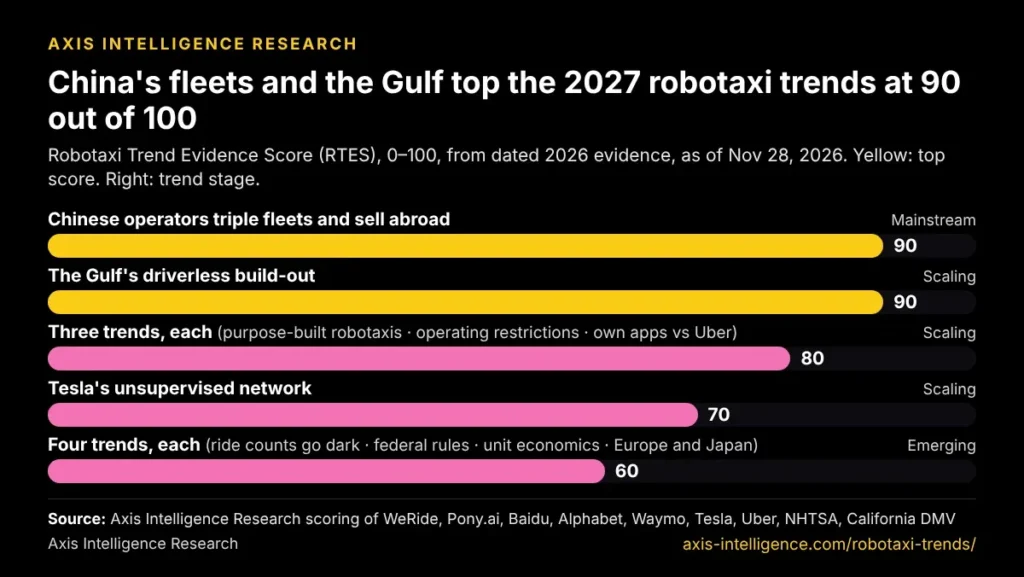
The Barriers column is the only one where the Gulf beats China. Dubai’s ambition is to make 25% of all trips smart and driverless by 2030, as Dubai Taxi Company’s group CEO restated at Apollo Go’s commercial launch (Baidu release, April 1, 2026). Mainland China, meanwhile, froze new L4 licences for about three months in 2026.
Aidan Jad, Automotive & EV Analyst at Axis Intelligence RTES rewards how much dated evidence a trend has, not how big the company behind it is. Waymo’s 500,000 weekly rides earn no extra points because that figure is seven months old. That’s deliberate: if you can’t measure a trend in 2027, you can’t underwrite it. The four trends at 60 aren’t weak ideas. Each one is waiting on a single filing, permit or ride count that would move it up a band.
How many robotaxi rides are people taking going into 2027?
Waymo last reported “more than 500,000 fully autonomous rides per week” on April 29, 2026 (Alphabet Q1 2026 remarks). Baidu’s Apollo Go last reported a ride total for Q2 2026: “around 1 million fully driverless operational rides” (Baidu Q2 2026 call). Neither company has published a newer count. That gap is Trend 7: ride counts go dark (RTES 60).
| Operator | Latest ride figure | Period | What changed since |
|---|---|---|---|
| Waymo | More than 500,000 per week | Reported Apr 29, 2026 | Not repeated in Alphabet’s Q2 remarks (July 22) or Q3 remarks (Oct 28, 2026) |
| Waymo | 15 million rides in 2025 | Full year 2025 | Waymo’s 2026 target is 1 million rides a week by year-end |
| Apollo Go | 3.4 million fully driverless rides | Q4 2025 | — |
| Apollo Go | 3.2 million, weekly peak above 350,000 in March | Q1 2026 | Wuhan fleet stall on March 31, 2026 |
| Apollo Go | Around 1 million | Q2 2026 | Q3 2026 release gives no ride total |
| Tesla | No ride count; reports unsupervised miles | Jan 22–Oct 18, 2026 | See the Tesla section |
| WeRide | 21 daily orders per vehicle (domestic average; single-day peak of 33) | Q3 2026 | Per-vehicle figure only |
Sources: Waymo 2025 year in review, Baidu Q1 2026 results, Baidu Q3 2026 results, WeRide Q3 2026 results.
Waymo’s year-end target was set in its own 2025 review: it was already serving 1 million rides a month in spring 2025, “a number that we’re on a path to hit every week by the end of 2026.” Getting there from the last published figure means doubling weekly volume, at a time when Waymo has added 10 commercial cities in 2026 (from 5 to 15, based on Alphabet’s April and October remarks) but lost freeway access.
Apollo Go fell from 3.2 million rides in Q1 to around 1 million in Q2. Axis Intelligence Research calculates that as a drop of about 69% quarter on quarter, or roughly 76,900 rides a week on a 13-week quarter. On the call, Baidu said volume “was temporarily affected by operational adjustments in certain domestic cities” and that operations had begun to resume in August. Its Q3 release reports kilometers instead of rides: 34 million autonomous kilometers in the quarter and 30 cities as of October 2026. The only ride figure it gives is a roughly 170% quarter-on-quarter increase in Shenzhen.
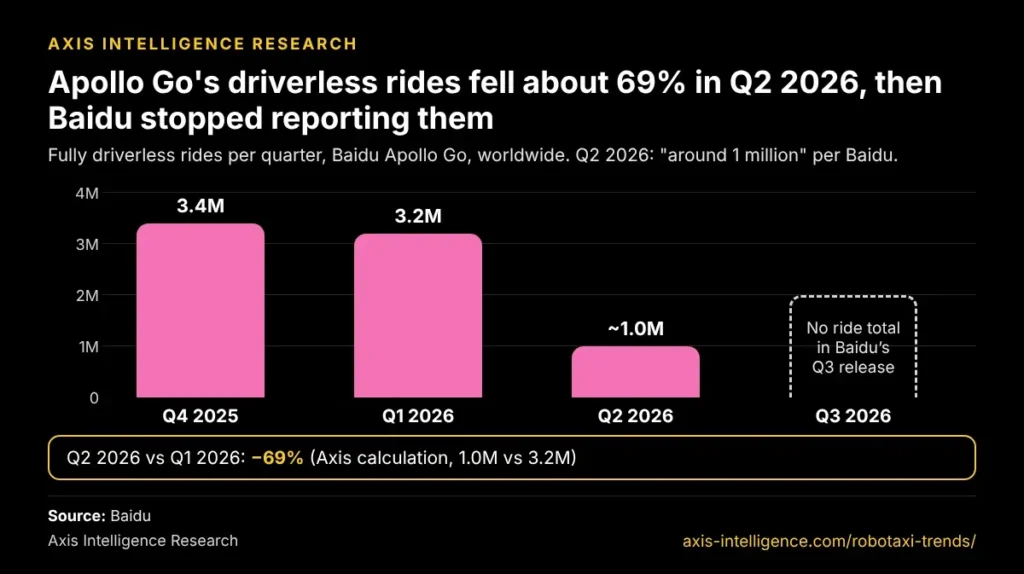
Aidan Jad, Automotive & EV Analyst at Axis Intelligence The Apollo Go drop is the most important number on this page. One fleet-wide stall on March 31 cost roughly two-thirds of a quarter’s volume. A human taxi fleet doesn’t fail all at once, but a robotaxi fleet running one software stack can. I expect 2027 permits to start pricing that correlated risk, through fleet caps per city or fallback requirements. When the biggest operator stops publishing ride totals the quarter after a shock like that, treat the gap itself as a data point.
The per-operator counts we track sit on our robotaxi statistics page, the Waymo history is in Waymo statistics, and safety data across operators is in self-driving car statistics.
How fast are robotaxi fleets growing, and will they hit their 2027 plans?
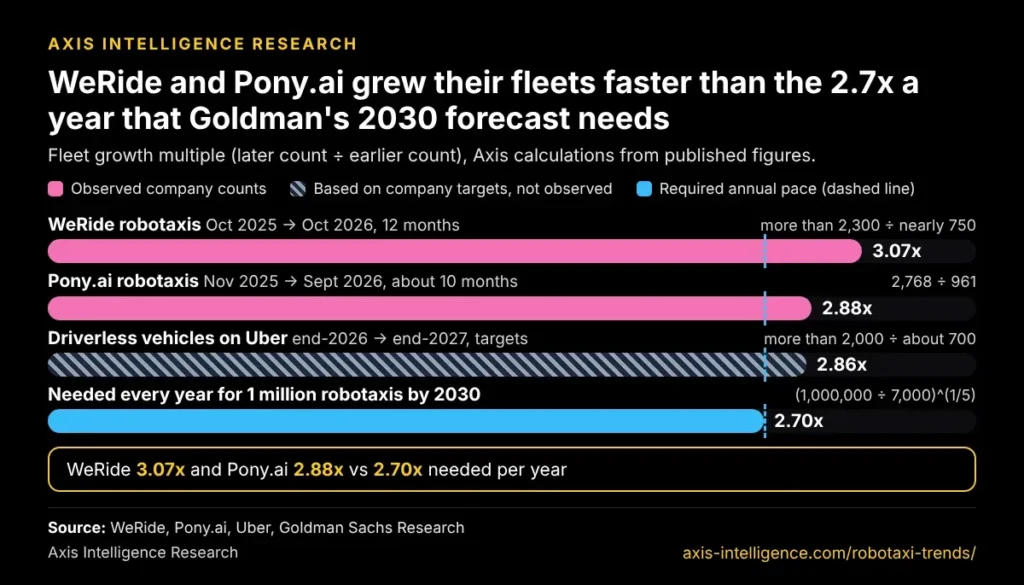
WeRide had more than 2,300 robotaxis on October 31, 2026, up from nearly 750 a year earlier (WeRide Q3 2025 release). Axis Intelligence Research calculates that as a 3.07x increase in 12 months. That growth drives Trend 1 (RTES 90).
| Fleet | Earlier count | Latest count | Multiple (Axis calculation) | Next public target |
|---|---|---|---|---|
| WeRide robotaxis | Nearly 750 (Oct 31, 2025) | More than 2,300 (Oct 31, 2026) | 3.07x in 12 months | Full core coverage of Abu Dhabi and Dubai by end-2026 |
| Pony.ai robotaxis | 961 (Nov 23, 2025) | 2,768 (Sept 30, 2026) | 2.88x in about 10 months | 3,500 vehicles in 20 cities by end-2026 (79% reached at Sept 30) |
| Driverless vehicles on Uber | — | ~700 expected (end-2026) | 2.86x implied by the 2027 target | More than 2,000 by end-2027 |
| Global commercial fleet, Goldman Sachs | ~7,000 (2025) | — | 2.70x a year needed | ~1 million (2030) |
Sources: WeRide and Pony.ai filings; Pony.ai Q3 2025 release; Uber Q3 2026 prepared remarks; Goldman Sachs Research. Required pace: (1,000,000 ÷ 7,000)^(1/5) = 2.70.
WeRide’s own numbers show where the fleet is going. Its Middle East fleet grew from about 400 to about 600 vehicles between July 31 and October 31, 2026, and its CEO said 90% of Q3 2026 robotaxi revenue came from overseas (WeRide Q3 2026 call). Pony.ai reports more than 4,000 robotaxis “under agreements in negotiation across international markets.” That is the second half of Trend 1: Chinese operators are scaling by putting vehicles into partners’ fleets abroad, not only by running their own. Our Chinese EV companies and China EV statistics pages cover the vehicle makers supplying them.
Waymo does not publish a fleet count. NHTSA’s recall report 26E035 covered 3,871 vehicles with its fifth-generation driving system built through May 19, 2026 (NHTSA). That is a floor, since it excludes sixth-generation Ojai vans. Semafor reported, citing people familiar with the plan, that Waymo aims for 8,000 vehicles by the end of 2026 and 20,000 by the end of 2027 (as summarized by The Next Web, Oct 20, 2026). Waymo has not confirmed those figures.
Trend 3: purpose-built vehicles take paid riders (RTES 80)
Three vehicles built without a human driver in mind reached US public riders in 2026:
- Zoox: NHTSA granted the first commercial Part 555 exemption for a robotaxi without manual controls on July 30, 2026, valid through July 31, 2028 and capped at 2,500 vehicles a year (NHTSA; Federal Register). Paid rides started in Las Vegas in August, while rides in San Francisco, Austin and Miami stayed free (Reuters via The Star).
- Tesla Cybercab: two seats, no steering wheel or pedals, paid rides in Austin from September 3, 2026. NHTSA opened an audit of Tesla’s self-certification the same week (TechCrunch). Tesla lists installed Cybercab capacity in Texas at more than 125,000 vehicles a year, while warning that installed capacity is not the current production rate (Tesla Q3 2026 Update, p. 6). That is 50 times the 2,500-a-year cap on Zoox’s exemption, the clearest sign that the two paths to market differ in scale as well as in legal route.
- Waymo Ojai: a Zeekr-built van running Waymo’s sixth-generation driver, introduced to public riders in Q2 2026 (Alphabet Q2 2026 remarks).
Aidan Jad, Automotive & EV Analyst at Axis Intelligence Goldman needs 2.7x a year; WeRide and Pony.ai are running at roughly 3x, but from a base of a few thousand vehicles. Purpose-built cars are what keep that multiple sustainable, because a cheaper vehicle lowers depreciation per mile, the cost line Goldman expects to fall from about $0.35 a mile in 2025 to $0.14 in 2035. The test for 2027 is the year-end 2026 counts. If Pony.ai lands short of 3,500, the 2030 curve starts the year already behind.
Where will robotaxis operate in 2027?
Waymo lists 15 US metros under “Serving Riders In” and 17 more cities as “Up Next,” including London and Tokyo (Waymo, checked November 28, 2026). Baidu’s Apollo Go reached 30 cities worldwide as of October 2026. Outside those two, the Gulf is where fully driverless commercial service is growing fastest: Trend 2 (RTES 90).
| Region | Fully driverless paid service in November 2026 | What’s announced for 2027 |
|---|---|---|
| United States | Waymo (15 metros: Atlanta, Austin, Dallas, Denver, Houston, Las Vegas, Los Angeles, Miami, Nashville, Orlando, Phoenix, San Antonio, San Diego, SF Bay Area, Tampa); Tesla (unsupervised miles reported in Austin, Dallas, Houston, Orlando, Tampa, Miami); Zoox (paid in Las Vegas) | Waymo’s 17 “Up Next” cities; Nuro–Lucid–Uber in the Bay Area in Q1 2027; Uber expects Avride driverless deployments in 2027 |
| China | Apollo Go, Pony.ai, WeRide across tier-one cities | Pony.ai’s 3,500-vehicle, 20-city target for end-2026 sets the 2027 base |
| Gulf | WeRide in Abu Dhabi and Dubai (~600 Middle East vehicles); Apollo Go in Dubai, fleet doubled in Q3 2026 | Uber expects nearly 200 fully driverless cars in the UAE by end-2026 |
| Europe | None at scale; Wayve runs supervised commercial rides on Uber in London | WeRide holds Spain’s first national L4 permit; Waymo plans first riders in Madrid in 2027; Apollo Go testing in London with Uber and Lyft |
| Japan and Canada | None | Waymo lists Tokyo as “Up Next” and announced Toronto in October 2026 |
Sources: Waymo; Tesla Robotaxi safety page; Baidu Q3 2026; WeRide Q3 2026; Uber Q3 2026 prepared remarks.
Trend 10: Europe and Japan treat 2027 as a testing year (RTES 60). The operators are there, but the service type is not. Every European deployment named in the Q3 2026 filings is supervised, a pilot, or a permit not yet used commercially. Pony.ai’s Zagreb deployment has logged over 200,000 kilometers and “several thousand passenger trips.” For comparison, Apollo Go once averaged more than 76,000 rides a week in its weakest recent quarter.
Aidan Jad, Automotive & EV Analyst at Axis Intelligence The Gulf scores 90 because the regulator is effectively a co-founder: one authority, a published 2030 target, and city-level permits that let operators drop the safety officer, which is the single biggest line in robotaxi operating cost. Europe has the riders and the partners but issues permits one country at a time. For a 2027 plan, I’d count Gulf vehicles as revenue fleet and European vehicles as validation fleet.
Is Tesla’s Robotaxi catching up with Waymo?
Not on any figure either company publishes. Tesla’s Robotaxi safety page reports 2.95 million unsupervised miles in Austin, Dallas and Houston between January 22 and October 18, 2026, which it says is 95% of its total (Tesla). Axis Intelligence Research derives a total of about 3.1 million unsupervised miles, roughly 1% of the more than 300 million fully autonomous miles Waymo reported on October 28, 2026 (Alphabet Q3 2026 remarks). This is Trend 6 (RTES 70).
| Driverless distance | Value | As of | Source |
|---|---|---|---|
| Waymo, fully autonomous miles (cumulative) | More than 300 million | Oct 28, 2026 | Alphabet |
| Apollo Go, fully driverless kilometers (cumulative) | More than 240 million km (about 149 million miles, Axis conversion) | Q2 2026 release | Baidu |
| Tesla Robotaxi, unsupervised miles | About 3.1 million (Axis calculation: 2.95 million ÷ 0.95) | Jan 22–Oct 18, 2026 | Tesla |
Tesla’s own Q3 2026 update gives the growth rate behind that total: cumulative unsupervised Robotaxi miles reached “nearly two million” at the end of the quarter, after growing “eightfold quarter over quarter, driven by sustained double-digit weekly growth” (Tesla Q3 2026 Update, pp. 3 and 8). Axis Intelligence Research infers that the total stood near 250,000 miles at the end of June. The base is small, but no other US operator is growing its driverless distance at that rate. The deck names only Austin for Cybercab service.
Tesla’s safety page compares its record with human drivers on the same Texas miles. It estimates humans would have had about 9.1 collisions with an injury and 4.1 with their own airbag deployed, and it counts no pedestrians or cyclists hit by a Robotaxi. Tesla doesn’t disclose a fleet size or ride count. The six metros on its safety page are the widest unsupervised footprint it has documented. Tesla’s company figures are on our Tesla statistics page.
Aidan Jad, Automotive & EV Analyst at Axis Intelligence Miles aren’t rides, and Tesla changed what it reports right as volume started to matter. A mileage counter can grow with empty repositioning. Paid trips per vehicle per day is what shows whether a robotaxi network works. Tesla’s camera-only cost base could be the cheapest in the industry, but I’d treat its 2027 position as unproven until it publishes rides or wins a California driverless deployment permit.
Are robotaxis safe, and why are regulators pulling them back?
Waymo reports 95% fewer serious-injury-or-worse crashes, 82% fewer injury-causing crashes and 93% fewer pedestrian injury crashes than a human benchmark, over 271.3 million rider-only miles through June 2026 (Waymo Safety Impact). Regulators are acting anyway, which is Trend 4: operating restrictions replace permits (RTES 80).
| Date (2026) | Regulator or operator action | Scope |
|---|---|---|
| Mar 31 → Apr | Apollo Go fleet stall in Wuhan; China suspends new L4 robotaxi licences | National licensing, resumed in selected cities by late July (electrive) |
| June | Waymo recall 26E035: freeway construction-zone software | 3,871 fifth-generation systems (NHTSA) |
| Sept 3–4 | NHTSA opens an audit of the Tesla Cybercab’s self-certification | Cybercab deployment (TechCrunch) |
| Nov 11 | California DMV bars Waymo from operating or testing on state freeways, calling it “an imminent hazard to public safety” | All California freeways until corrective action (KQED) |
| Nov 17 | Waymo pauses commercial freeway rides in every market | Company decision outside California (TechCrunch) |
The DMV order cites “recurring incursions by its vehicles into active construction zones” despite corrective actions taken after similar incidents on May 18, 2026. The order applies to California. Waymo chose to extend the pause to its other markets.
Aidan Jad, Automotive & EV Analyst at Axis Intelligence Nobody is challenging Waymo’s crash average. Regulators are policing the tails: work zones, flood water, police traffic breaks, the rare scenes that a rate per million miles averages away. The California order is the first time a US regulator has taken a capability away from an operator, not just declined to grant one. For 2027 that changes the expansion maths: a new city now needs validation of its rare scenes, not just its typical routes.
Federal and state rule changes are tracked in our AI regulation tracker, and vehicle-level security standards are covered in vehicle cybersecurity standards.
What federal rules change for robotaxis in 2027?
NHTSA granted Zoox the first commercial exemption for a robotaxi without manual controls on July 30, 2026. It covers portions of eight Federal Motor Vehicle Safety Standards (FMVSS), runs through July 31, 2028, and caps the fleet at 2,500 vehicles a year (Federal Register). This is Trend 8 (RTES 60).
The same July 30 package also did three other things (NHTSA):
- An interim final rule lets vehicles built before an exemption is granted qualify for a commercial deployment exemption.
- A three-year, $5 million consortium with SAE ITC will work toward national AV performance standards.
- A new docket opens NHTSA’s first update to its AV technical guidance since 2017, covering remote assistance, emergency-responder interaction and post-crash behavior.
Those steps build on rulemakings that began in September 2025 to rewrite FMVSS 102, 103, 104 and 108 for vehicles without manual controls (NHTSA). Exemptions are case-by-case and time-limited, and the standards are still proposals. That is why Trend 8 scores low on maturity.
Aidan Jad, Automotive & EV Analyst at Axis Intelligence Two paths to market now exist for a car with no steering wheel, and 2027 will show which one holds. Zoox took the exemption route: capped, reviewed, with extra reporting. Tesla self-certified, and the agency opened an audit within days. If the Cybercab audit closes cleanly, self-certification becomes the faster template and the 2,500-vehicle cap stops mattering. If it doesn’t, every no-controls design waits in the exemption queue.
Will you hail a robotaxi through Uber or the operator’s own app?
Both. The two biggest US players are moving in opposite directions. Uber says it is on track for about 700 fully driverless vehicles on its platform by the end of 2026 and more than 2,000 by the end of 2027. Waymo has notified Uber that it will launch its own app in Austin and Atlanta in January 2028 (The Next Web). This is Trend 5 (RTES 80).
| Claim | Who says it | Date |
|---|---|---|
| Uber’s US AV partners average about 30% more trips per vehicle per day than first-party deployments | Uber | Nov 4, 2026 |
| In mature US AV markets, the ridesharing category grew 7 points faster than in the rest of the country | Uber | Nov 4, 2026 |
| Las Vegas becomes the first US city with two fully driverless partners on Uber (Zoox, then Motional) | Uber | Nov 4, 2026 |
| Waymo vehicles stay on the Uber app through at least May 2028 under the current contract | Uber, as reported | July 2026 |
| Nuro and Lucid launch commercially on Uber in the Bay Area in Q1 2027, driverless from day one | Uber | Nov 4, 2026 |
Uber’s utilization claim and Waymo’s exit decision both concern the same thing, what a vehicle earns per day, and they point to different conclusions. The trip and audience data behind them are on our Uber statistics and Lyft statistics pages.
Aidan Jad, Automotive & EV Analyst at Axis Intelligence Here I’d weight Uber’s number less than Waymo’s decision. A 30% utilization edge over “first-party deployments nationwide” compares Uber cities with markets at different stages, and Uber picked the comparison. Waymo has the full rider funnel in its own app and chose to leave anyway. The 2027 split looks like this: operators with a brand and dense cities go direct, and everyone else, including most Chinese and new US entrants, rents Uber’s demand.
Do robotaxis make money yet, and how big is the market?
No producer publishes a measured 2026 robotaxi market size. Among the largest operators, only Pony.ai and WeRide report robotaxi revenue separately. Pony.ai’s robotaxi services revenue was $17.8 million in Q3 2026, up 165.4% from $6.7 million a year earlier. WeRide’s robotaxi revenue exceeded RMB100 million in the same quarter, up 204% year on year. Waymo and Apollo Go don’t break out robotaxi revenue. City-level profit claims are Trend 9 (RTES 60).
| Indicator | Value | Period | Source |
|---|---|---|---|
| Pony.ai robotaxi services revenue | $17.8 million | Q3 2026 | Pony.ai |
| Pony.ai revenue per average fleet vehicle | About $7,500 a quarter, roughly $82 a day | Q3 2026 | Axis calculation: $17.8M ÷ average of 1,975 and 2,768 vehicles; 92 days |
| WeRide robotaxi revenue | More than RMB100 million (+204% YoY) | Q3 2026 | WeRide |
| WeRide unit economics | “Positive unit economics” in Guangzhou | Q3 2026 | WeRide |
| Pony.ai insurance premium per Gen-7 vehicle | ~40% of a human-driven taxi’s (vs ~50% in 2025) | 2026 renewal | Pony.ai |
| Waymo average fare vs Uber, San Francisco | $19.69 vs $17.47, a 12.7% premium (Axis calculation) | Late Nov 2025–Jan 1, 2026 | Obi, via Axios |
Forecasts disagree mostly because they measure different things:
| Forecast | Value | Horizon | Published | Scope |
|---|---|---|---|---|
| Goldman Sachs Research | $19 billion (revised from $7 billion) | US, 2030 | Apr 30, 2026 | US robotaxi market |
| Goldman Sachs Research | ~$415 billion; ~6 million vehicles | Global, 2035 | Apr 30, 2026 | Robotaxi market and fleet |
| Morgan Stanley Research | ~2.5 million robotaxis | Global, 2035 | July 17, 2026 | Fleet in service |
| Morgan Stanley Research | ~$1 trillion | 2040 | July 17, 2026 | Mobility services, vehicles, software and adjacent industries |
Sources: Goldman Sachs; Morgan Stanley.
Axis Intelligence Research reconciles the two 2035 fleet forecasts as a range of 2.5 million to 6 million robotaxis worldwide. Goldman’s top end is 2.4 times Morgan Stanley’s.
Aidan Jad, Automotive & EV Analyst at Axis Intelligence The 2035 numbers are 2.4x apart, and I wouldn’t pick either one for a 2027 plan. Look at the input both share: cost per mile. Pony.ai’s insurance premium falling to about 40% of a human taxi’s is a real, renewed contract price. That kind of figure, along with per-vehicle revenue around $82 a day, should anchor a model. Until an operator reports a robotaxi segment profit at company level rather than city level, “breakeven” is a claim that holds under assumptions the operator chose.
Our EV market outlook covers the vehicle side, and NVIDIA statistics covers the compute supplier behind several 2027 robotaxi programs.
What could change this outlook in 2027?
| Catalyst or risk | Date | What it would change |
|---|---|---|
| Alphabet Q4 2026 earnings, the first chance for a new Waymo ride count | Early 2027 | Trend 7; whether the 1-million-a-week target was met |
| Baidu Q4 2026 results | Early 2027 | Whether Apollo Go ride totals return after Q2’s ~69% drop |
| Pony.ai full-year 2026 fleet versus its 3,500 target | Early 2027 | Trend 1’s score; the 2.70x path to 2030 |
| California DMV decision on Waymo’s freeway corrective actions | Open | Trend 4; Waymo’s long-trip economics |
| NHTSA closes or escalates the Cybercab audit | Open | Trend 3 and Trend 8 |
| Nuro–Lucid–Uber commercial launch in the Bay Area | Q1 2027 | Trend 5; a second driverless operator in California |
| Waymo’s first riders in Madrid | 2027 (announced) | Trend 10 |
| Uber reaches 2,000+ driverless vehicles | End-2027 (target) | Trend 5 |
| Zoox exemption expiry | July 31, 2028 | Trend 8; the 2,500-a-year cap |
The next edition of this page (November 2027) will grade each of the ten trends against these signposts and publish what we got wrong.
Robotaxi 2027: questions fleet operators, city officials and analysts ask
Will Waymo reach 1 million paid rides a week by the end of 2026?
No public figure shows it on track. Waymo’s last published level was more than 500,000 rides a week (Alphabet, April 29, 2026), and the target set in Waymo’s 2025 year in review is 1 million a week by the end of 2026. Hitting it would mean doubling weekly volume in about eight months, the last of them without freeway service.
Can a Waymo still take the freeway anywhere in the US?
Not right now. California’s DMV barred Waymo from operating or testing on state freeways from November 11, 2026, and Waymo paused commercial freeway rides in all its markets on November 17. The California order stays in place until the DMV accepts Waymo’s corrective actions.
Is a Tesla Robotaxi ride actually driverless?
On the miles Tesla publishes, yes: its safety page excludes miles driven with a safety monitor in the vehicle. It reports 2.95 million unsupervised miles in Austin, Dallas and Houston from January 22 to October 18, 2026. The two-seat Cybercab, which has no steering wheel or pedals, has carried paying riders in Austin since September 3, 2026, under an open NHTSA audit of its certification.
Which robotaxi company has the largest fleet?
No single disclosed figure settles it, because Waymo, Baidu and Tesla don’t publish fleet counts. Among operators that do, WeRide reported more than 2,300 robotaxis (October 31, 2026) and Pony.ai 2,768 (September 30, 2026). NHTSA’s recall data puts Waymo’s fifth-generation fleet at 3,871 vehicles built through May 19, 2026, a floor that excludes its newer Ojai vans.
Are robotaxis cheaper than Uber?
Not yet in San Francisco, the market with the best price data. Obi’s sample from late November 2025 to January 1, 2026 found Waymo averaging $19.69 a ride against $17.47 for Uber and $15.47 for Lyft. That puts Waymo’s premium over Uber at 12.7% (Axis calculation). Obi found Waymo’s prices had fallen since its first survey in June 2025, while Uber’s and Lyft’s had risen.
When can I ride a fully driverless robotaxi in Europe?
Not at commercial scale before 2027. Waymo plans its first Madrid riders in 2027 and lists London as “Up Next.” WeRide holds Spain’s first national L4 permit, and Wayve runs supervised commercial rides on Uber in London. None of these was a scaled, fully driverless paid service in Q3 2026.
Methodology
Every figure on this page comes from an operator filing or release (SEC 6-K and 8-K filings, Baidu and Pony.ai investor relations), a regulator (NHTSA, California DMV via its spokesperson), an operator data page (Waymo Safety Impact, Tesla Robotaxi safety), or a named research producer (Goldman Sachs, Morgan Stanley, Obi). Each was opened on November 28, 2026. Each recurring source was checked for a newer edition. Baidu’s Q3 2026 release, Pony.ai’s and WeRide’s Q3 2026 filings, and Uber’s Q3 2026 remarks are the latest available. Waymo’s weekly ride figure is the latest Alphabet has published. Fleet multiples compare each operator’s own counts at the dates shown, and Pony.ai’s covers about 10 months, not 12. Waymo’s fleet plan of 8,000 and 20,000 vehicles is a press report Waymo hasn’t confirmed, so it doesn’t enter the RTES. RTES scores and inputs, plus all Axis calculations with formulas, are in the CSV.
Download the dataset: robotaxi-trends.csv (CC BY 4.0 for Axis compilation and calculations).
Cite this page: Axis Intelligence Research, “Robotaxi Trends 2027: China and the Gulf Lead on Evidence, While Waymo Hits a Freeway Wall”, data as of November 28, 2026, https://axis-intelligence.com/robotaxi-trends/ [Copy]
More 2027 outlooks for the sector are in the Automotive & Electric Vehicles outlook hub.