


Gaming Trends 2027
By Axis Intelligence Research
Co-author: Noah Mc | Last updated: November 28, 2026 | License: CC BY 4.0
Eight trends carry measured evidence into 2027, and the four strongest all describe one market: consoles cost more and sell fewer units, so platform holders lean harder on the players they already have, while PC keeps adding hours. Axis Intelligence Research calculates that the flagship PlayStation 5, Xbox Series X and Nintendo Switch 2 now list in the US for 33.8% more than at launch (Mid-Cycle Price Premium, November 2026). The PS4 went the other way: Sony cut it 25.1%, to $299, less than three years after launch.
| # | 2027 trend | Strongest dated evidence | Stage | Who it hits first | Signal to watch in 2027 | GTES (0–10) |
|---|---|---|---|---|---|---|
| 1 | Installed base pays, new hardware doesn’t | 33.9 PS4/PS5 games sold per PS5 shipped in Jul–Sep 2026, vs 20.1 a year earlier (Sony) | Mainstream | Platform holders, third-party publishers | Sony and Nintendo holiday-quarter results, February 2027 | 9 |
| 2 | One launch sets the year | GTA VI: $3.79B in day-one retail sales, 32.5M units sold before release (Take-Two, Nov 20, 2026) | Mainstream | Publishers dating 2027 releases | Take-Two’s fiscal Q3 net bookings vs its $3.35–3.50B guide | 9 |
| 3 | Consoles get dearer with age | US average price paid per new hardware unit hit an August record of $541, vs $476 (Circana) | Mainstream | Buyers, retailers, Xbox | Any further list-price move as memory costs climb | 9 |
| 4 | PC compounds and moves to the TV | Steam all-time peak of 43,505,724 concurrent users, Oct 11, 2026 (SteamDB) | Mainstream | Console makers, PC storefronts | GTA VI’s PC date; Steam Machine supply | 9 |
| 5 | Subscriptions stop growing | US non-mobile subscription spending fell 5% in Sept 2026, its first monthly drop since Feb 2024 (Circana) | Mainstream | Xbox, PlayStation Plus, publishers paid for catalog deals | Q4 2026 Circana subscription line | 8 |
| 6 | The audience stops widening | Players reach 62.0% of the online population in 2026, from 61.5% in 2025 (Newzoo) | Mainstream | Anyone budgeting for new-player growth | Newzoo’s 2027 player revision | 8 |
| 7 | Generative AI enters production, unloved | 40% of game professionals use it at work; 55% say it hurts games (GDC, Nov 2026) | Scaling | Studios, art and QA teams | Store disclosure rules, union contracts | 5 |
| 8 | Handhelds become the default second device | 11.0% of internet users 16+ play on a handheld (GWI, Q2 2026); Switch 2 at 26.35M units (Nintendo) | Scaling | Nintendo, Microsoft, PC handheld makers | Microsoft’s next-generation handheld, reported for holiday 2027 | 5 |
Noah Mc, gaming analyst at Axis Intelligence Six years in, the console you can buy today costs more than the one launch buyers took home, and that single fact rewires 2027. A PS5 at $649.99 and a Series X at $799.99 now sit closer to Valve’s $1,049 Steam Machine than to their own $499 launch tags, and that narrowing gap is the opening Steam’s record concurrents are exploiting. I would plan 2027 around a shrinking flow of new console owners and a richer spend from the existing ones, not around a hardware cycle that has stopped arriving on schedule.
Why are consoles getting more expensive, and will prices rise again in 2027?
All three current consoles list above their launch price in the US, by 11.1% (Switch 2) to 60.3% (Xbox Series X), and the cost driver behind the increases is still rising. Axis Intelligence Research’s Mid-Cycle Price Premium (MCPP) measures it: the current US list price divided by the US launch list price, minus one.
| Console | US launch price | US list price, Nov 2026 | MCPP | Last change |
|---|---|---|---|---|
| Xbox Series S (512GB) | $299 | $499.99 | +67.2% | +$100, Aug 1, 2026 (Microsoft) |
| Xbox Series X (1TB disc) | $499 | $799.99 | +60.3% | +$150, Aug 1, 2026 (Microsoft) |
| PS5 Digital Edition | $399.99 | $599.99 | +50.0% | +$100, Apr 2, 2026 (Sony) |
| PS5 (disc) | $499.99 | $649.99 | +30.0% | +$100, Apr 2, 2026 (Sony) |
| PS5 Pro | $699.99 | $899.99 | +28.6% | +$150, Apr 2, 2026 (Sony) |
| Nintendo Switch 2 | $449.99 | $499.99 | +11.1% | +$50, Sept 1, 2026 (Nintendo) |
| Flagship average (PS5, Series X, Switch 2) | +33.8% | Axis calculation | ||
| Benchmark: PS4, Sept 2016 | $399 | $299 | −25.1% | Sony, slim model replaces launch model |
Sources: launch prices from Sony (PS5, 2020), Sony (PS5 Pro, 2024), Microsoft (2020), Nintendo (2025, via Game Informer); current prices from the PlayStation Blog, Xbox Wire and Nintendo’s price notice. Xbox list prices are Microsoft’s October 2025 prices plus its stated August 2026 increase. PS4: 2013 launch, 2016 slim model.
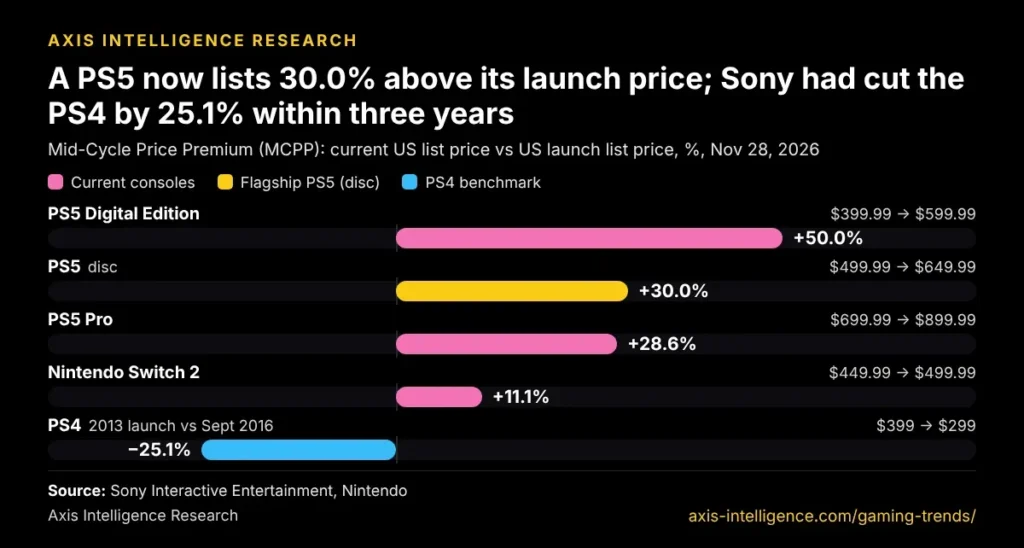
The price tags are reaching the register. Circana reports that the average price paid for a new piece of video game hardware in the US hit an August record of $541, up from $476 a year earlier (Circana, via GamesBeat), a 13.7% rise. Volume is the casualty: even at higher prices, US hardware dollar sales through September 2026 ran 9% behind 2025’s pace, at $2.9 billion (Circana). The split follows the price table. In September, Xbox Series unit sales fell 27% to an all-time September low, while PS5 units rose 22% in the month Marvel’s Wolverine launched.
Nothing in the cost data points to relief in 2027. Microsoft told buyers that console memory and storage prices have increased by more than 2.5x and that it expects another doubling by fall 2027. TrendForce projects conventional DRAM contract prices up another 10–15% quarter over quarter in the fourth quarter of 2026, and warns that PC DRAM supply could shrink in 2027 as capacity shifts to servers (TrendForce, Sept 30, 2026). Newzoo puts DDR5 at roughly 5x its January 2025 price. Nintendo’s own notice says the impact of the market changes behind its increase “is expected to extend over the medium to long term.” The GPU side of the same squeeze is in our GPU price tracker.
Why are Sony and Nintendo selling fewer consoles but more games?
Because the installed base is now the business. In July–September 2026, Sony sold 33.9 PS4 and PS5 games for every PS5 it shipped, up from 20.1 a year earlier, an Axis calculation from Sony Interactive Entertainment’s unit data. PS5 shipments fell 35% in that quarter while software units rose 9.8%, and PlayStation counted 127 million monthly active users at September 30. Cumulative PS5 sell-in passed 100 million units by November 10, 2026, close to six years after launch. The money shows it: in the same quarter, Sony’s game segment sold ¥643.9 billion of digital software and add-on content (+13.3%) and ¥218.3 billion of network services (+19.5%), while hardware and other sales rose 1.9% (Sony Group Q2 FY2026 results, Nov 5, 2026; yen figures include currency effects).
| Sony, sell-in | PS5 units shipped | PS4 + PS5 software units | Software per PS5 shipped (Axis) |
|---|---|---|---|
| FY2024 (Apr 2024–Mar 2025) | 18.5M | 303.3M | 16.4 |
| FY2025 (Apr 2025–Mar 2026) | 16.0M | 317.9M | 19.9 |
| H1 FY2025 (Apr–Sep 2025) | 6.5M | 146.2M | 22.5 |
| H1 FY2026 (Apr–Sep 2026) | 4.2M | 154.3M | 36.7 |
| Q2 FY2025 (Jul–Sep 2025) | 4.0M | 80.3M | 20.1 |
| Q2 FY2026 (Jul–Sep 2026) | 2.6M | 88.2M | 33.9 |
Software units include PS4 titles, so the ratio is a measure of spend per new box, not a PS5 attach rate.
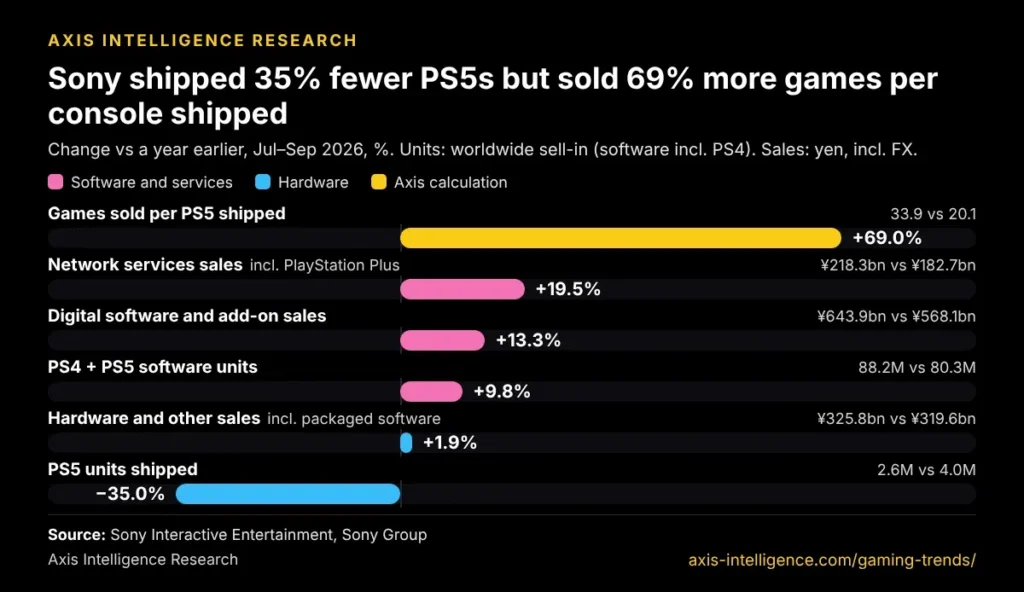
Noah Mc, gaming analyst at Axis Intelligence The ratio nearly doubled in two years, and not because players got hungrier: the box count collapsed while 127 million monthly active PlayStation users kept buying. That is a healthy year for Sony’s margin and a warning for everyone else. A publisher that needs new console owners to find its game is fishing in a pond that loses water every quarter, so 2027 marketing budgets belong with the people already logged in.
Nintendo shows the same split one generation earlier in its cycle. Switch 2 sold 6.49 million units in April–September 2026 against 24.49 million games, or 3.8 games per console shipped, compared with 2.8 per console across its life to date (26.35 million consoles, 73.21 million games) (Nintendo, half-year results). Newzoo expects average revenue per paying player to rise only 1.4%, to $129.6, in 2026, so the gain comes from more purchases per owner, not higher spend per payer. The platform-level detail is on our PlayStation statistics and Switch 2 statistics pages.
How much of 2027 depends on GTA 6?
A large share of the first quarter does. Grand Theft Auto VI generated $3.79 billion in day-one retail sales and sold 32.5 million units before release, Take-Two reported on November 20, 2026 (Form 8-K). That one day is 2.4 times the $1.60 billion in net bookings Take-Two reported for the whole July–September quarter.
| GTA VI launch figure | Value | Producer | What it counts |
|---|---|---|---|
| Day-one retail sales | $3.79B | Take-Two (company estimate) | Worldwide retail sales through end of day Nov 19, all storefronts and retailers |
| Units sold pre-release | 32.5M | Take-Two | All platforms (PS5, Xbox Series X|S) |
| Launch-day revenue estimate | $1.84B | Sensor Tower, via FOX 5 DC | Third-party estimate, including pre-orders |
| Launch-day units estimate | 19.05M | Sensor Tower | Third-party estimate |
| FY2027 net bookings guidance | $8.0–8.2B | Take-Two | Whole company, April 2026–March 2027 |
Noah Mc, gaming analyst at Axis Intelligence Take-Two’s $3.79 billion and Sensor Tower’s $1.84 billion are both right about different things, and the gap is too wide to be noise. I weight the Take-Two number for scale because it is a filed company estimate covering every retailer worldwide, while the Sensor Tower figure is an outside model that is best used for the daily sales curve. Neither is net bookings, so anyone modeling Take-Two’s March 2027 year should anchor on the $8.0–8.2 billion guide, not on day-one headlines.
The concentration cuts both ways. Newzoo writes that without GTA VI, console revenue would decline in 2026, and that publishers have restructured release calendars around the launch. Its own forecast has console player growth recovering to 3.0% in 2026 after nearly stalling at 0.5% in 2025. For 2027, that means a crowded first half of releases that avoided November, and a PC version that Newzoo expects only in late 2027; Take-Two’s launch release names PS5 and Xbox Series X|S only. Running totals sit on our GTA 6 sales tracker, with the wider picture on GTA 6 statistics and Take-Two statistics.
Is PC gaming growing faster than consoles?
Over the next three years, yes. Newzoo projects PC game revenue to grow at a 5.2% compound annual rate from 2026 to 2029, double console’s 2.6%, after both grow about 5% in 2026 ($45.9 billion on PC, $46.9 billion on console, the latter lifted by GTA VI). PC also converts players to payers best, at 55%.
| PC signal | Latest reading | Comparison | Producer |
|---|---|---|---|
| Steam peak concurrent users | 43,505,724 (Oct 11, 2026) | All-time record | SteamDB |
| Premium Steam hours | +13% in H1 2026 | vs H1 2025 | Sensor Tower |
| Premium PC/console revenue (PlayStation, Steam, Xbox) | ~$13.8B in H1 2026 | +5% vs H1 2025 | Sensor Tower |
| PC players | 977M in 2026 | +3.5%; Steam +5.0%, Epic Games Store +4.7% | Newzoo |
| Share of internet users 16+ who play on a laptop or desktop | 31.9% (Q2 2026) | 22.8% on a games console | GWI, in Digital 2027 |
| US PC content spending | +27% in Sept 2026 | Console content +8% | Circana |
| Developers whose next game ships on PC | 81% | PS5 45%, Xbox Series 37%, Switch 2 29%, Steam Machine 21% | GDC State of the Game Industry, Nov 2026 |
| Steam Machine, 512GB | $1,049 | PS5 disc at $649.99 | Valve, via Engadget |
The living-room PC is now a product rather than a project, but at a price that keeps it a niche in 2027: Valve’s Steam Machine opened reservations at $1,049 for 512GB, without a controller, and sold through a randomized queue starting June 29, 2026. Newzoo names component and memory costs as the main near-term risk for PC, and notes Steam’s growth is now led by Latin America and Asia-Pacific markets such as South Korea, Vietnam and Indonesia. Platform data is on our PC gaming statistics and Steam statistics pages.
Which gaming trends will actually hold in 2027?
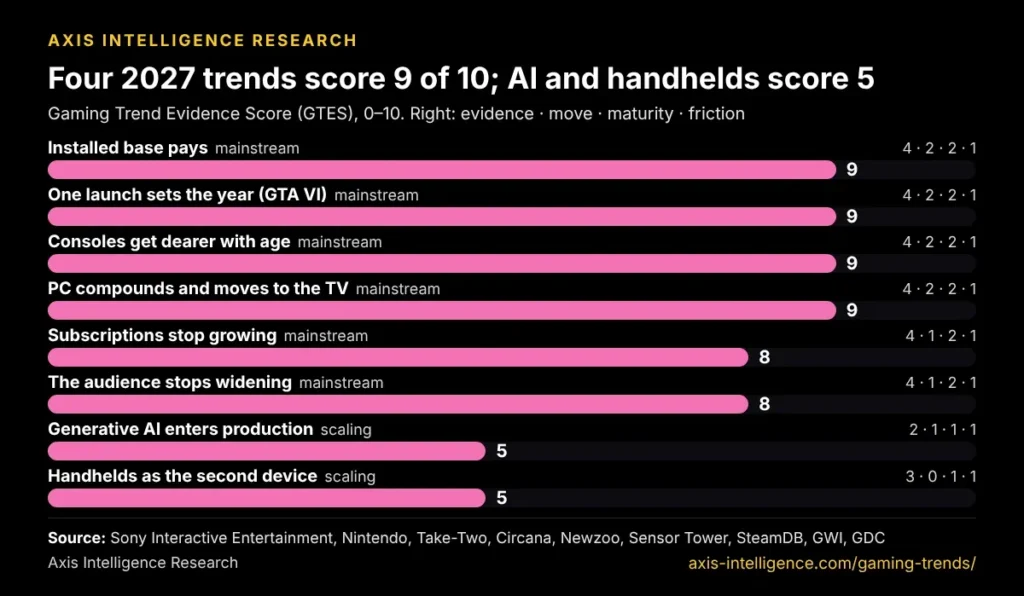
The ones with measured, moving evidence. The Gaming Trend Evidence Score (GTES), created by Axis Intelligence Research, rates each trend from 0 to 10 on four inputs, each tied to a dataset row:
- Adoption evidence (0–4): 4 = measured at platform scale by two or more independent producers; 3 = by one; 2 = survey data only; 1 = company announcements only (watch list, not scored).
- Recent move (0–2): the trend’s lead indicator against its prior comparable reading: 2 = a move of 10% or more (or 5 points) in the trend’s direction; 1 = a smaller move in that direction; 0 = flat, reversed or not measured.
- Maturity (0–2): 2 = mainstream (reaches most buyers of its platform in 2027); 1 = scaling; 0 = emerging.
- Friction (0–2): 2 = no documented constraint; 1 = one; 0 = two or more.
Ties are broken by the size of the lead indicator’s move.
| Rank | Trend | Adoption evidence | Recent move (lead indicator) | Maturity | Friction | GTES |
|---|---|---|---|---|---|---|
| 1 | Installed base pays | 4 (Sony, Nintendo) | 2 (software per PS5 shipped +69.0%) | 2 | 1 (shrinking hardware inflow) | 9 |
| 2 | One launch sets the year | 4 (Take-Two, Sensor Tower, Newzoo) | 2 (Take-Two FY27 guide +20.5% at midpoint) | 2 | 1 (calendar crowding, Newzoo) | 9 |
| 3 | Consoles get dearer | 4 (Sony, Microsoft, Nintendo, Circana) | 2 (US price paid per unit +13.7%) | 2 | 1 (falling unit demand) | 9 |
| 4 | PC compounds | 4 (Newzoo, Sensor Tower, SteamDB, GWI) | 2 (premium Steam hours +13%) | 2 | 1 (component costs) | 9 |
| 5 | Subscriptions stall | 4 (Circana, Newzoo) | 1 (US spend −5%) | 2 | 1 (Newzoo still forecasts growth) | 8 |
| 6 | Audience stops widening | 4 (Newzoo, GWI) | 1 (+0.5 point penetration) | 2 | 1 (Middle East & Africa players +7.9%) | 8 |
| 7 | Generative AI in production | 2 (GDC survey) | 1 (36% to 40%) | 1 | 1 (55% say it hurts games) | 5 |
| 8 | Handhelds as second device | 3 (Nintendo, GWI) | 0 (Switch 2 sell-in −37.4%) | 1 | 1 (price increases) | 5 |
Noah Mc, gaming analyst at Axis Intelligence The score is deliberately boring: it rewards trends you can see in sell-in tables and store data, and it marks down anything that lives in surveys or keynotes. That is why the next console generation is not on it and AI barely is. Four ties at 9 tell you the 2027 story is one story told four ways, price, installed base, a single blockbuster and PC, and a studio that plans for only one of them is exposed on the other three.
Will the PS6 or the next Xbox come out in 2027?
The evidence points to 2028 for both home consoles, with a new Xbox handheld the only next-generation hardware reported for 2027. No platform holder has announced a date or price, so this trend stays on the watch list rather than in the score.
| Signal | What it says | Source |
|---|---|---|
| Microsoft, GDC keynote (Mar 11, 2026) | Alpha Project Helix hardware ships to developers “beginning in 2027” | Xbox Wire |
| Fortune profile of Xbox CEO Asha Sharma (Oct 2026) | Helix console planned for holiday 2028, internally projected at $1,200–1,800; “next-generation handheld” for holiday 2027 | Reported by GamingBolt |
| Sony CFO Lin Tao (Nov 5, 2026) | “From next fiscal year onward, there will be investment in the new platform” (fiscal year starting April 2027) | Reported by God is a Geek |
| GDC State of the Game Industry (Nov 2026) | 10% of developers planning their next game for the next PlayStation, 8% for Helix | GDC report (survey of 2,600+ professionals) |
| Newzoo forecast (Sept 2026) | Assumes a Gen-10 device launch in late 2027 | Newzoo Global Games Market Report 2026 |
Noah Mc, gaming analyst at Axis Intelligence Newzoo’s late-2027 assumption is the outlier, and I would not plan around it. Dev kits that only reach studios in 2027, a CFO who books platform spending from April 2027, and one developer in ten building for the next PlayStation all describe a 2028 window. The Helix price range matters more than the date: a console projected at $1,200 or more is a PC in pricing terms, which is the argument Valve is already making at $1,049.
Are Game Pass and PlayStation Plus still growing?
In the US, no longer. Non-mobile subscription spending fell 5% year over year in September 2026, the first monthly decline since February 2024, Circana reports (September 2026 data). Newzoo estimates Xbox Game Pass at about 30 million subscribers in early 2026, down from the 34 million Microsoft last disclosed in February 2024, after an October 2025 price increase.
Newzoo’s global forecast still has multi-game subscription revenue growing steadily, driven by PlayStation Plus, and Sony’s own numbers back that side: its network services sales, which include PlayStation Plus, rose 19.5% to ¥218.3 billion in July–September 2026.
Noah Mc, gaming analyst at Axis Intelligence Both readings hold, because they measure different services. Circana’s US decline lines up with the Game Pass erosion Newzoo estimates, while Sony’s 19.5% network-services growth is global, in yen and helped by price. For a publisher weighing a catalog deal in 2027, I would treat Game Pass money as shrinking and PlayStation Plus money as steady, and stop pricing day-one subscription launches as if both services were still adding members.
Subscription churn beyond games is tracked on our subscription fatigue statistics page.
Is the number of gamers still growing?
Slowly, and almost entirely through new internet users. Newzoo forecasts 3.83 billion players in 2027, up from 3.70 billion in 2026, but players hold at 62.0% of the online population (61.5% in 2025); the growth comes from the online population itself, estimated at 5.97 billion in 2026 (+3.5%). Survey data agrees: 83.5% of internet users aged 16+ played video games in Q2 2026, unchanged from Q1, against 84.1% in Q2 2024 (GWI, in Digital 2027; GWI removed Russia from its sample in 2026, so the series is not strictly comparable).
| Region (Newzoo, 2026F) | Players | Growth |
|---|---|---|
| Asia-Pacific | 1,940M | +4.0% |
| Middle East & Africa | 640M | +7.9% |
| Europe | 475M | +2.7% |
| Latin America | 394M | +4.7% |
| North America | 251M | +1.5% |
The money stays concentrated where players are not being added: Newzoo expects China and the US to account for 52% of consumer spending on games in 2026. Mobile, which reaches 84% of all players by Newzoo’s count, has its own 2027 analysis in our mobile gaming trends, and the full market sizing is on video game industry statistics.
Are handhelds becoming the main way to play?
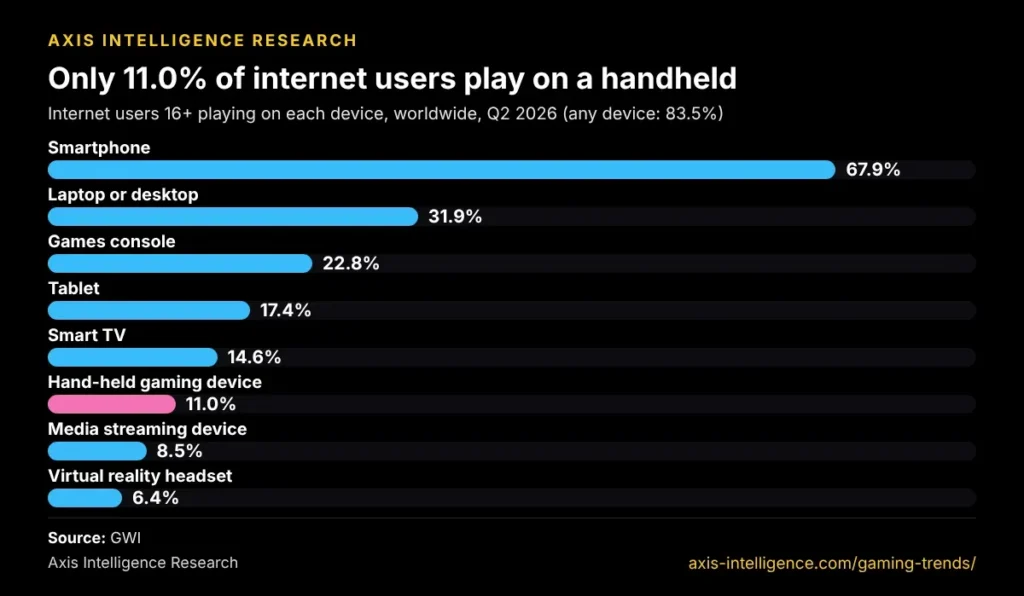
Not the main way, but the default second device. Hand-held gaming devices reach 11.0% of internet users aged 16+, behind smartphones (67.9%), computers (31.9%), consoles (22.8%), tablets (17.4%) and smart TVs (14.6%) (GWI, Q2 2026).
Switch 2 reached 26.35 million units by September 30, 2026, but its sell-in fell 37.4% in April–September against its launch half, and Newzoo notes that the original Switch’s decline offsets most of the new console’s net player gain. Developers lean toward it anyway: 29% of GDC respondents are building their next game for Switch 2, and 47% say they are interested in developing for it (GDC, November 2026). Microsoft’s next-generation handheld is reported for holiday 2027, and Sony’s PlayStation Portal streaming device now lists at $249.99 after April’s increase. Hardware tracking for Microsoft is on our Xbox statistics page.
How are game studios using generative AI going into 2027?
More of them use it, and more of them dislike it. In GDC’s November 2026 State of the Game Industry survey of more than 2,600 professionals in 69 countries, 40% said they use generative AI tools as part of their job, up from 36% in the previous edition, while 55% said it is having a negative impact on the game industry, against 54% a year earlier (GamesBeat report on the survey). Usage runs highest at mobile-only studios (70%) and on free-to-play games (58%). The same survey found 34% of respondents laid off in the past 24 months, 39% in the US.
The adoption is real but shallow by the GTES rule: it rests on one survey, with no sell-in or store data behind it, which keeps it at 5 of 10. How mobile studios use these tools in production is covered in our mobile 2027 analysis.
What could change this outlook in 2027?
| Date | Catalyst | Trend it tests | What would overturn it |
|---|---|---|---|
| Feb 2027 (expected) | Take-Two fiscal Q3 results | One launch sets the year | Net bookings below the $3.35–3.50B guide |
| Feb 2027 (expected) | Sony and Nintendo holiday-quarter results | Installed base pays | Software per PS5 shipped falling back toward 20 |
| Monthly | Circana US reports | Consoles get dearer; subscriptions stall | Average hardware price below the prior year; subscription spend growing again |
| Through 2027 | Memory contract prices (TrendForce) | Consoles get dearer | Quarter-over-quarter DRAM declines, which would make price cuts possible |
| 2027 | Project Helix alpha kits reach studios | Next-gen timing | A dated retail launch inside 2027 |
| Holiday 2027 | Reported Xbox next-generation handheld | Handhelds | Delay into 2028 |
| Late 2027 | GTA VI on PC (Newzoo assumption, not announced) | PC compounds | No PC date by fall 2027 |
Grade-back: the next edition of this page, in November 2027, will score each trend against the signal in the first table and show which held.
Gaming in 2027: questions from studios, retailers and press
Is GTA 6 coming to PC in 2027?
Not officially. Take-Two’s November 2026 launch release lists PS5 and Xbox Series X|S only, and Rockstar has not dated a PC version. Newzoo’s September 2026 report expects the PC release only in late 2027.
Why does the Steam Machine cost more than a PS5?
It is priced as a PC, not as a subsidized console. Valve’s base Steam Machine lists at $1,049 for 512GB without a controller (June 2026), against $649.99 for a PS5 with a disc drive (Sony, April 2026). Valve also sells the controller separately: the 512GB bundle with a Steam Controller is $1,128.
Which genres are players spending on going into 2027?
Shooters, action-adventure and sandbox games. Among internet users who play monthly, 52.2% play shooters and 49.8% action-adventure (GWI, Q2 2026). Newzoo’s H1 2026 revenue rankings for six Western markets put Sandbox among the top five genres on both PC and console, led by Minecraft and Roblox, with Fortnite first in Shooter on both.
How much time do people spend playing video games each week?
Seven hours and 13 minutes on average among internet users aged 16+, across phones, consoles and computers (GWI, Q2 2026). Men aged 16–24 lead at 12 hours 13 minutes a week.
When will PlayStation stop selling new games on disc?
January 2028. Sony said on July 1, 2026 that physical disc production for all new PlayStation games will stop then, with games released earlier staying available on disc (PlayStation Blog).
Is Roblox still growing?
Its spending is not. Roblox averaged 138 million daily active users in July–September 2026, and bookings fell to $1,697 million from $1,922 million a year earlier, an 11.7% decline (Form 10-Q). Platform detail is on our Roblox statistics page.
Methodology
Sources. Company filings and official price notices (Sony Interactive Entertainment, Microsoft, Nintendo, Take-Two, Roblox), measurement firms labeled as estimates (Newzoo, Circana, Sensor Tower, SteamDB, TrendForce), the GWI Q2 2026 survey wave as published in DataReportal’s Digital 2027 Global Overview Report, and GDC’s November 2026 State of the Game Industry report (full report reviewed). Newzoo figures come from its Global Games Market Report 2026 free edition (September 2026) and are forecasts for 2026 and 2027. Sony and Nintendo unit figures are sell-in to retail, not sales to consumers.
Mid-Cycle Price Premium (MCPP). Current US list price ÷ US launch list price − 1, per console model, as of November 28, 2026. The flagship average is the unweighted mean for PS5 (disc), Xbox Series X (1TB disc) and Switch 2. Xbox current prices are Microsoft’s October 2025 list prices plus the increases it announced for August 1, 2026; Microsoft printed launch prices of $499 and $299. List prices exclude tax and promotions.
Gaming Trend Evidence Score (GTES). Adoption evidence (0–4) + Recent move (0–2) + Maturity (0–2) + Friction (0–2), with the rules above. Trends backed only by announcements (next-generation console timing, PlayStation’s end of disc production) are listed as watch items and not scored.
Derived ratios. Software per PS5 shipped = Sony’s PS4 + PS5 software units ÷ PS5 hardware units in the same period.
Dataset. All figures, inputs and calculations are in gaming-trends.csv, released under CC BY 4.0 for Axis calculations; third-party data remains its producers’.
Cite this page: Axis Intelligence Research, “Gaming Trends 2027: Pricier Consoles, Record PC Play and a Next-Gen Wait”, data as of November 28, 2026, https://axis-intelligence.com/gaming-trends/ [Copy]