


AI Search Trends 2027
By Axis Intelligence Research
Co-authors: Elena Rodriguez & Sarah Mitchell | Last updated: November 28, 2026 | License: CC BY 4.0
The AI search trend with the strongest evidence going into 2027 is the chatbot turning into a search channel of its own: Axis Intelligence Research scores it 92 out of 100 on the Search Shift Evidence Score (SSES). AI answers inside Google follow at 78, and the split between rising queries and falling publisher clicks at 75. Three heavily promoted bets score as watch-list items: agentic checkout (35), agentic browsing (20) and court-ordered search competition (15). Scores are as of November 28, 2026, and every input comes from producer data published between October 2024 and November 2026.
| # | Trend | Strongest dated evidence | Stage | Who it hits first | SSES | Signal to watch in 2027 |
|---|---|---|---|---|---|---|
| 1 | Chatbots become a search channel | 42% of U.S. adults use chatbots to search for information (Pew, Feb. 2026); Gemini app 400M → 900M monthly users in a year (Google, May 2026) | Mainstream | Brands, SEO teams, publishers | 92 | Next Pew and GWI waves: does chatbot search keep rising while search-engine brand research keeps falling? |
| 2 | AI answers become Google’s default layer | AI Overviews 2.5B+ monthly active users; AI Mode 1B+ (Google, May 2026) | Mainstream | Publishers, local and retail SEO | 78 | Whether Google discloses AI Mode’s share of total queries |
| 3 | Clicks decouple from queries | Google’s query growth at a five-year high (Alphabet, Q3 2026) while publishers’ Google Search referrals fell 40.2% year over year (Chartbeat, July 2025 → July 2026) | Mainstream | News, reference and affiliate publishers | 75 | First AI click data, not just impressions, in Search Console or Bing Webmaster Tools |
| 4 | Queries get longer and multimodal | Over 50B visual searches a month; AI Mode queries 3× longer than classic searches (Alphabet, Q3 2026) | Scaling | Retail, local, product content | 75 | A disclosed share of AI Mode queries using images or voice above one in five |
| 5 | Ads move inside AI answers | ChatGPT Ads at a $1B annualized run rate in under 200 days (OpenAI, Aug. 2026); Google scaling ads in AI Overviews and AI Mode (Q3 2026) | Scaling | Paid search teams, retail media | 74 | Ad load disclosed for AI Mode; ChatGPT Ads beyond the regions live in Aug. 2026 |
| 6 | Site owners get an AI off switch and AI reports | Google’s opt-out toggle live for all sites worldwide (Aug. 31, 2026); UK conduct requirement (CMA, June 3, 2026) | Scaling | Publishers, legal, SEO leads | 44 | First published opt-out rates; Google’s six-monthly compliance reports to the CMA |
| 7 | Agentic checkout | Google’s Universal Commerce Protocol launched Jan. 11, 2026; OpenAI let merchants run their own checkout from Mar. 24, 2026 | Emerging (watch list) | Retailers, payments | 35 | Any producer figure on completed agent purchases |
| 8 | Agentic browsing | Chrome auto browse in U.S. paid preview (Jan. 28, 2026); OpenAI’s Atlas browser stopped on Aug. 9, 2026 | Emerging (watch list) | Publishers’ analytics, ecommerce UX | 20 | Auto browse leaving paid preview |
| 9 | Courts reopen search distribution | Data-sharing and syndication remedies under appeal; oral argument not yet scheduled (DOJ brief, Oct. 21, 2026) | Emerging (watch list) | Rival search and AI engines | 15 | D.C. Circuit ruling; first certified Qualified Competitor |
Elena Rodriguez, Marketing & Advertising lead at Axis Intelligence Budget the 2027 plan around trend 1, not trend 7. A chatbot that 42% of American adults already use for lookups is a distribution channel you can measure against today; an agent that completes the purchase is still a protocol announcement with no transaction count behind it. I would move test budget toward being cited in answers, and keep agentic checkout as a feed-hygiene task, not a revenue line.
How strong is the evidence behind each AI search trend?
Axis Intelligence Research scores each trend from 0 to 100 on the Search Shift Evidence Score (SSES): a weighted sum of four evidence tests, each scored from producer data opened for this page. Adoption carries the most weight because a search trend matters to a marketer only once people measurably use it.
SSES = Adoption (0–35) + Growth (0–25) + Maturity (0–20) + Barriers (0–20, inverted)
| Test | Points | Scoring rule |
|---|---|---|
| Adoption | 35 / 25 / 15 / 5 / 0 | 35: producer-measured use by at least 1 billion people. 25: 100 million to 1 billion people, 25–50% of a national adult population, at least 10,000 paying organizations, or at least 10 billion measured monthly queries. 15: availability or supply-side enrollment without measured use. 5: launches or court orders only. |
| Growth | 25 / 18 / 10 / 5 / 0 | 25: growth of 2× or more within 12 months on one definition. 18: change of 25–99% within 12 months, or 40% or more over 24 months. 10: smaller change, or a producer’s comparative statement. 5: launches without a growth figure. 0: measured stall or reversal. |
| Maturity | 20 / 12 / 5 | Mainstream / scaling / emerging. |
| Barriers | 20 / 12 / 5 / 0 | 20: none documented. 12: one documented barrier. 5: two or more, or a documented retreat by a leading player. 0: withdrawn with no successor. |
Ties break on Adoption, then Growth, then Maturity. Below 40, a trend goes to the watch list.
| Trend | Adoption | Growth | Maturity | Barriers | SSES |
|---|---|---|---|---|---|
| Chatbots become a search channel | 35 | 25 | 20 | 12 | 92 |
| AI answers become Google’s default layer | 35 | 18 | 20 | 5 | 78 |
| Clicks decouple from queries | 25 | 18 | 20 | 12 | 75 |
| Queries get longer and multimodal | 25 | 18 | 12 | 20 | 75 |
| Ads move inside AI answers | 25 | 25 | 12 | 12 | 74 |
| Site owners get an AI off switch and AI reports | 15 | 5 | 12 | 12 | 44 |
| Agentic checkout | 15 | 10 | 5 | 5 | 35 |
| Agentic browsing | 5 | 5 | 5 | 5 | 20 |
| Courts reopen search distribution | 5 | 0 | 5 | 5 | 15 |
Source: Axis Intelligence Research calculation, as of November 28, 2026. Each input is listed with its producer, date and URL in the downloadable CSV.
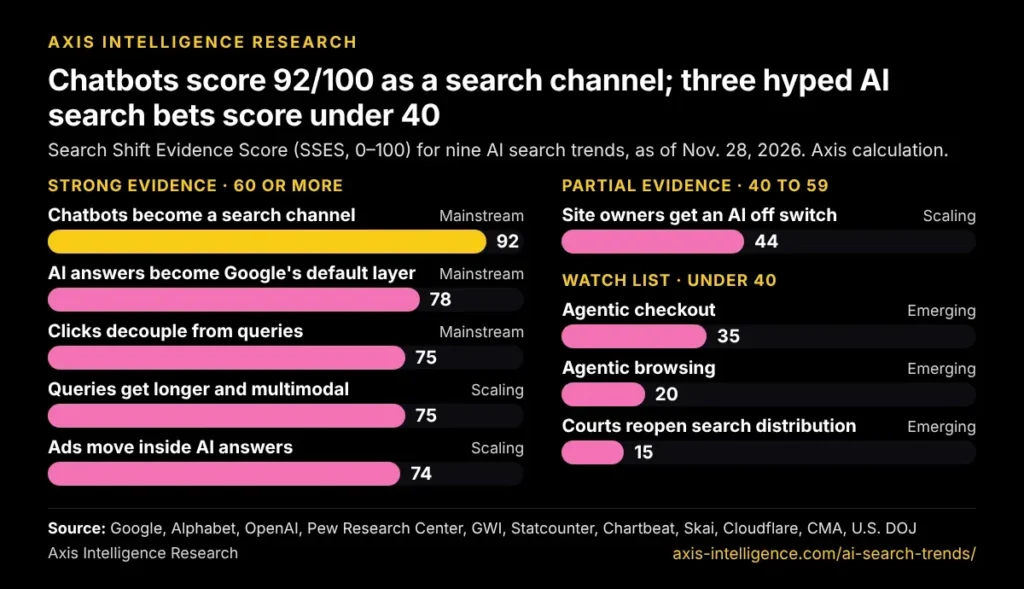
Elena Rodriguez, Marketing & Advertising lead at Axis Intelligence The gap between 74 and 44 is where most 2027 decks get it wrong. Ads in AI answers already have tens of thousands of buyers and a billion-dollar run rate; publisher controls have a toggle and no published uptake. When a vendor pitches “AI search readiness,” ask which of the nine rows the product touches and what that row scores.
Is AI replacing Google Search, or making it bigger?
Bigger, on every number Google and independent trackers publish. Alphabet said its year-over-year query growth in Q3 2026 was the highest in five years, and Statcounter data in DataReportal’s Digital 2027 report puts Google at 91.32% of search-engine referrals in July 2026, up from 89.54% a year earlier. AI is being absorbed into Google rather than routing around it.
That makes the best-known forecast on this topic easy to grade. Gartner predicted on February 19, 2024 that traditional search engine volume would drop 25% by 2026 as chatbots and virtual agents took share. Google does not publish query counts, so the 25% cannot be tested to the decimal, but both available signals moved the other way: Alphabet’s own query growth hit a five-year high in Q3 2026, and Google’s share of search referrals rose. Axis Intelligence Research grades the prediction as missed on volume and right on the direction of risk: the loss landed on the clicks Google sends out, not on the searches it receives.
| Measure | Earlier reading | Latest reading | Change (Axis calculation) | Producer |
|---|---|---|---|---|
| AI Overviews monthly users | 2B+ (July 23, 2025) | 2.5B+ (May 19, 2026) | +25% in 10 months | |
| AI Mode monthly users | 100M+, U.S. and India only (July 23, 2025) | 1B+, global (May 19, 2026) | Not comparable: geography changed | |
| Google share of search-engine referrals | 89.54% (July 2025) | 91.32% (July 2026) | +1.78 points | Statcounter, via DataReportal |
| Google worldwide search share | — | 91.05%; Bing 4.8% (October 2026) | — | Statcounter |
| Monthly visits, June–Aug. 2026 average | — | google.com 86.2B; chatgpt.com 5.49B; bing.com 3.71B; gemini.google.com 2.72B | ChatGPT.com draws 48% more visits than Bing.com | Similarweb, via DataReportal |
The user counts come from Google’s I/O 2026 keynote and its Q2 2025 earnings remarks; the live search share is from Statcounter. Visits are not searches, so the Similarweb row compares destinations, not query volume. Our Google AI Overviews statistics translate the 2.5 billion figure into a share of the world’s internet users, and Google searches per day tracks the query side.
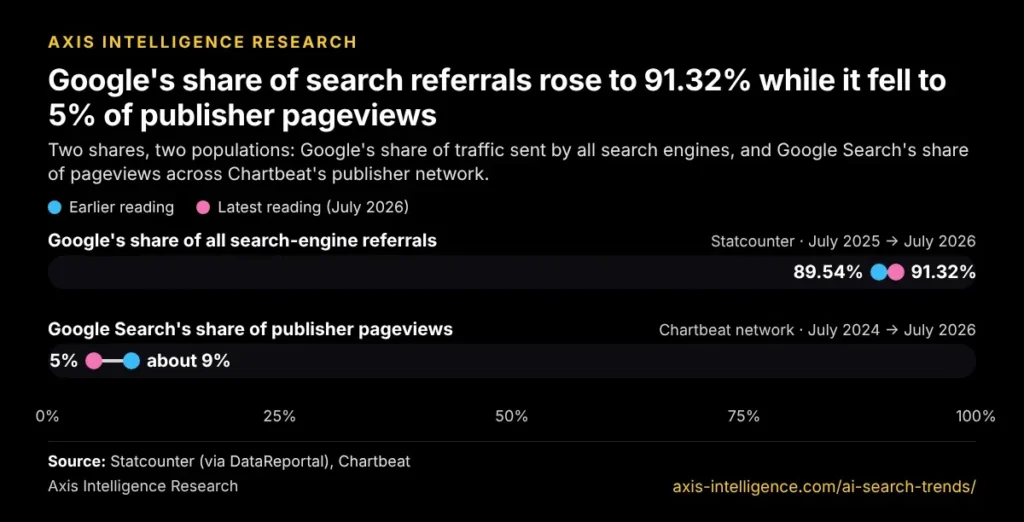
Elena Rodriguez, Marketing & Advertising lead at Axis Intelligence The surprise of the year is that Google’s share of search referrals went up while publishers’ Google traffic went down. Those two facts only reconcile one way: Google keeps the visit and keeps more of the click. For a CMO, “is AI killing Google?” is the wrong frame for 2027; the right one is how much of your demand Google now satisfies without sending it to you.
The court-ordered route to more competition scores lowest of the nine. The remedies require Google to share certain index and user data with approved “Qualified Competitors” and to syndicate results and text ads to them for five years, but both sides are still appealing: the Justice Department’s October 21, 2026 brief carries the header “oral argument not yet scheduled.” Until a rival actually receives the data, the remedy has no measurable effect on the share figures above.
How many people search with chatbots instead of a search engine?
About four in ten U.S. adults now use chatbots to look things up: 42%, per Pew Research Center’s survey of 5,119 adults fielded February 17–23, 2026. Worldwide, 60.4% of active AI users aged 16+ say they use AI tools to find information (GWI, Q2 2026, in Digital 2027).
| Measure | Value | Population and period | Producer |
|---|---|---|---|
| Use chatbots to search for information | 42% | U.S. adults, Feb. 2026 | Pew Research Center |
| Read AI summaries at the top of search results | 60% | U.S. adults, Feb. 2026 | Pew Research Center |
| Have used Gemini | 24% | U.S. adults, Feb. 2026 | Pew Research Center |
| Use AI tools to find information | 60.4% | Active AI users 16+, worldwide, Q2 2026 | GWI, via DataReportal |
| Gemini app monthly users | 400M → 900M+ → 1B | I/O 2025 → I/O 2026 (May 19) → Oct. 28, 2026 | Google / Alphabet |
| ChatGPT weekly active users | More than 1B (Aug. 31, 2026); “collective 1.2B weekly users” (Sept. 29, 2026) | Worldwide | OpenAI |
The behavioral shift shows up where it costs marketers most: product research. GWI’s tracker in Digital 2027 shows search engines named as a primary brand-research channel by 51.0% of internet users in Q2 2024 and 45.3% in Q2 2026. Axis Intelligence Research calculates that as a 5.7-point drop, or 11.2% of the 2024 level, in two years. AI tools such as ChatGPT are already a primary research channel for 26.0%, ahead of price-comparison sites (25.2%) and video sites (22.5%). Our AI Search Parity Index (ASPI) sets those two readings against each other quarter by quarter.
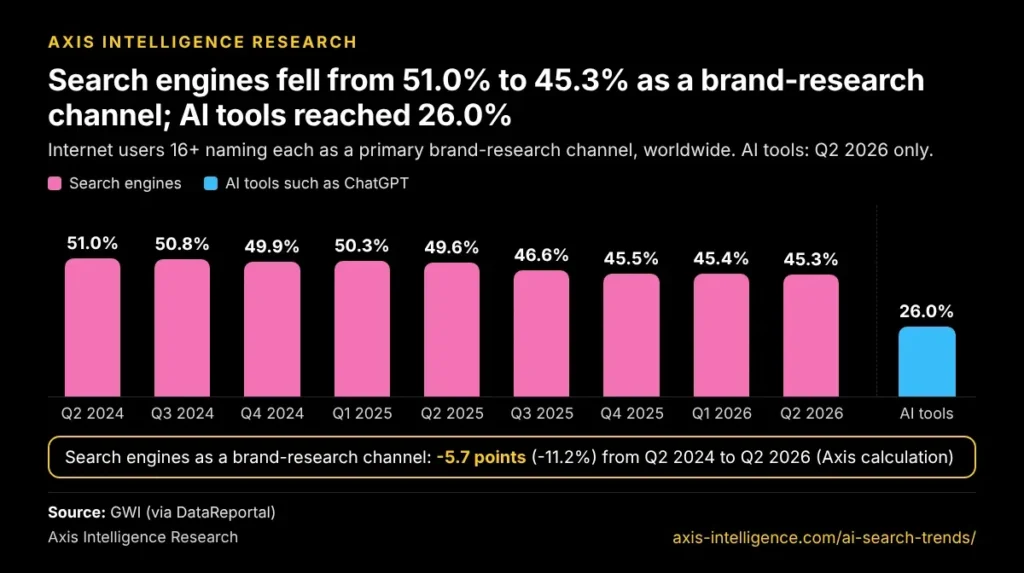
Elena Rodriguez, Marketing & Advertising lead at Axis Intelligence An 11% loss of brand-research share in two years is a media-mix problem before it is an SEO problem. Attribution models still credit the last Google click, so a buyer who shortlisted you in ChatGPT and then searched your brand name shows up as “branded search.” Expect branded search to look healthy in 2027 while unbranded discovery quietly moves upstream.
User counts for each assistant are kept on our ChatGPT user statistics, Google Gemini statistics and Perplexity statistics pages.
Why are clicks falling while searches rise?
Because the answer now sits on the results page. In Pew Research Center’s tracking of 900 U.S. adults during March 2025, Google users who saw an AI summary clicked a traditional result in 8% of visits, against 15% when no summary appeared; they clicked a link inside the summary in 1% of visits.
| Evidence | Finding | Period | Producer |
|---|---|---|---|
| Panel tracking, 900 U.S. adults | Traditional-result clicks: 8% of visits with an AI summary vs. 15% without; session ended on 26% of pages with a summary vs. 16% without | March 2025 | Pew Research Center |
| Publisher network analytics | Google Search referrals fell 21.9% year over year to July 2025, then 40.2% to July 2026; Google Search went from about 9% of pageviews (July 2024) to 5% (July 2026); direct traffic rose from 13.5% to 15.9% | July 2024 → July 2026 | Chartbeat, 2026 Publisher Playbook |
| Preregistered field experiment, N=1,100 U.S. Google users | Assignment to AI Mode-only search cut click-through to external sites by 18.8 percentage points; exposure to Google without AI Overviews raised it by 8.8 points | Recruited March 17–19, 2026; posted Aug. 18, 2026 | Wang et al., arXiv |
| Network traffic | Human traffic down as much as 40% in less than a year in some heavily crawled categories; 52% of crawler requests for AI training in June 2026, up from 22% in spring 2025 | 2025–2026 | Cloudflare |
The loss is not being replaced by chatbot referrals. In the same Chartbeat network, AI referrals grew eightfold in two years yet still account for about 0.01% of pageviews, and the playbook shows them declining across ChatGPT, Claude, Perplexity, Microsoft Copilot and Gemini in 2026. Axis Intelligence Research notes that the Google Search decline nearly doubled in pace, from 21.9% to 40.2% a year, in the same 12 months in which AI Mode passed 1 billion monthly users (Google, May 2026).
The sources disagree on cause, not on direction. Alphabet told investors on October 28, 2026 that the majority of AI Mode queries are incremental, meaning searches that would not otherwise have happened. The field experiment found the opposite effect on publishers, no improvement in user experience, and an 11.2-point rise in the share of AI Mode participants who also searched on Bing, DuckDuckGo or Yahoo. Our zero-click search statistics carry the AI-Summary Link Suppression (ALS) measure built on the Pew panel.
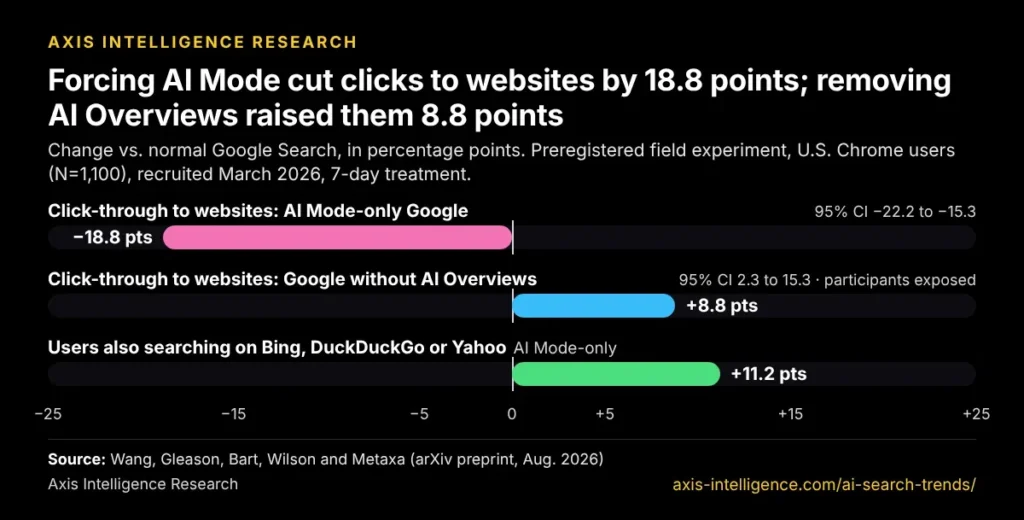
Elena Rodriguez, Marketing & Advertising lead at Axis Intelligence Google and the field experiment are both right, and that is the problem for publishers. Incremental queries can grow Google’s total while each AI-answered query sends fewer visits out. I would trust the experiment for the per-query effect, because it randomizes exposure, and trust Alphabet for total volume, because only Alphabet can count it. An 18.8-point drop in click-through is the number to put in a 2027 traffic forecast for any query class where AI Mode becomes the default answer.
Will ads move inside AI answers in 2027?
Yes, and the buying is already happening. OpenAI said on August 31, 2026 that ChatGPT Ads reached a $1 billion annualized revenue run rate in less than 200 days, with tens of thousands of advertisers and CPC or outcome-optimized bidding behind the majority of campaigns. On its October 28, 2026 call, Alphabet said it is scaling ads within AI Overviews and AI Mode to more users and queries, including international markets and multi-turn ads in the U.S.
| Signal | Reading | Period | Producer |
|---|---|---|---|
| ChatGPT Ads run rate | $1B annualized, under 200 days after launch | Aug. 31, 2026 | OpenAI |
| Google Search & other revenue | $63.3B, +12% year over year | Q3 2026 | Alphabet |
| Sponsored vs. organic product listings in AI Mode | Click-through rates already similar | Q3 2026 | Alphabet |
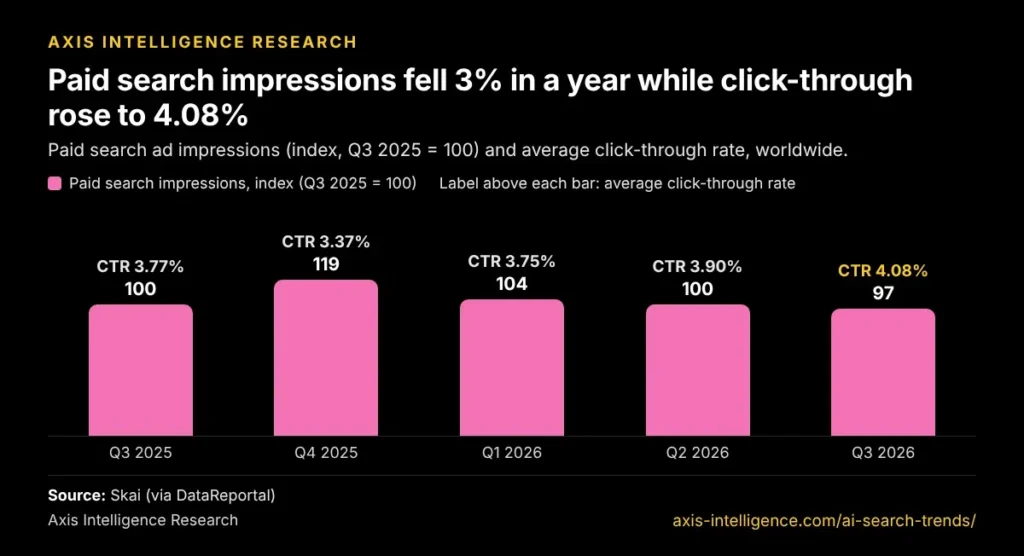
| Paid search impressions (index, Q3 2025 = 100) | 97 | Q3 2026 | Skai, via DataReportal |
| Average paid search click-through rate | 4.08%, vs. 3.77% a year earlier | Q3 2026 | Skai, via DataReportal |
Axis Intelligence Research reads the Skai rows together: paid impressions fell 3% year over year while click-through rose 0.31 points, or 8.2%. Fewer, better-matched ad slots is what a results page looks like once an AI answer takes the top of it. Alphabet also said strong AI Mode query growth weighed on Search because AI Mode monetized less, which is why ad load inside AI Mode is the number to watch. Spend trends sit in our Google Ads statistics and our digital marketing trends outlook.
Elena Rodriguez, Marketing & Advertising lead at Axis Intelligence A billion-dollar run rate in under 200 days tells me ChatGPT Ads cleared procurement, not that it proved incrementality. Run it as a holdout test in 2027: same keywords, same offers, a geo split, and judge it on new-customer rate, because a conversational ad that captures demand you would have bought on Google anyway is just a pricier CPC.
Will AI agents shop and browse for searchers in 2027?
Not at scale yet: both agentic trends score below 40 on the SSES. Google launched the Universal Commerce Protocol on January 11, 2026 to let shoppers check out from eligible U.S. retailers inside AI Mode and Gemini, and by October 2026 said it enabled direct checkout for hundreds of thousands of brands. No producer has published how many purchases agents completed.
| Event | Date | What it shows | Producer |
|---|---|---|---|
| Universal Commerce Protocol launch | Jan. 11, 2026 | Checkout inside AI Mode and Gemini for eligible U.S. retailers | |
| OpenAI steps back from Instant Checkout | Mar. 24, 2026 | Merchants run their own checkout; OpenAI focuses on product discovery | OpenAI |
| Chrome auto browse | Jan. 28, 2026 | Agentic browsing in preview for U.S. AI Pro and Ultra subscribers | |
| ChatGPT Atlas shut down | Aug. 9, 2026 | Standalone AI browser retired after launching in October 2025; features folded into the ChatGPT app | OpenAI, reported by Android Authority |
| UCP adoption | Q3 2026 | Direct checkout for hundreds of thousands of brands; Universal Cart launched | Alphabet |
The pattern across both rows is the same: the agent moves into the product people already use (ChatGPT, Chrome, AI Mode) and the merchant keeps the transaction. Adoption data for agent-led buying is tracked in our agentic commerce statistics, and enterprise agent adoption in our AI agents trends outlook.
Elena Rodriguez, Marketing & Advertising lead at Axis Intelligence This is where vendor claims break. “Hundreds of thousands of brands enabled” counts merchants who connected a feed, not shoppers who let an agent pay. The leading chatbot pulled native checkout within six months because merchants wanted the customer relationship back. For 2027, the work is clean product data and structured offers, so you are the item an agent recommends, not a checkout integration nobody uses.
How are visual and voice searches changing queries?
Queries are getting longer and less typed. Alphabet said on October 28, 2026 that AI Mode queries run three times longer than traditional searches on average, that one in five AI Mode searches worldwide uses voice, images or documents, and that visual searches now exceed 50 billion a month.
| Measure | Earlier | Latest | Change (Axis calculation) | Producer |
|---|---|---|---|---|
| Visual searches per month | Nearly 20B on Lens (Oct. 3, 2024) | Over 50B across Google (Oct. 28, 2026) | About 2.5× in two years; scope widened from Lens to all visual search | Google / Alphabet |
| AI Mode query length vs. traditional search | — | 3× longer on average (Q3 2026) | — | Alphabet |
| AI Mode searches using voice, images or documents | — | 1 in 5 (Q3 2026) | — | Alphabet |
A three-times-longer query carries more constraints: budget, size, location, use case. Pages that state those attributes plainly in text and product data are the ones an AI answer can match. Our voice search statistics cover the spoken side of the shift.
What control do publishers and brands get over AI search in 2027?
For the first time, an opt-out that does not cost classic rankings. The UK Competition and Markets Authority’s June 3, 2026 conduct requirement obliges Google to give publishers effective tools to keep their content out of AI features in search, to attribute content with clear links, and to report on compliance every six months in the first year. Google then shipped a Search Console toggle covering AI Overviews, AI Mode and AI Overviews in Discover, rolled out to all websites worldwide as of August 31, 2026.
| Control or report | Date | What it does | What it does not do |
|---|---|---|---|
| CMA publisher conduct requirement | June 3, 2026 | Opt-out from AI features in search, attribution with clear links, six-monthly compliance reports | Applies to Google’s general search services in the UK |
| Google Search Console generative AI toggle | Worldwide Aug. 31, 2026 | Removes a site from AI Overviews, AI Mode and AI Overviews in Discover; not used as a ranking signal outside those features | Opted-out sites get no traffic or impressions from those features |
| Google Search Console AI insights | Worldwide Aug. 31, 2026 | Impressions and the pages and countries appearing in AI responses | Google’s post does not describe click data |
| Bing Webmaster Tools AI Performance | Feb. 10, 2026 (public preview) | Citations, cited pages and sampled grounding queries across Copilot, Bing AI summaries and partners | The post does not mention clicks |
| Cloudflare crawl controls | July 1, 2026 | Pay Per Crawl reshaped toward Pay Per Use; more than 50 publisher-AI agreements signed since 2023 | No uptake figure published |
This trend scores 44 because availability is proven and use is not: no producer has published how many sites switched AI features off. Disputes over training and answer use are logged in our AI copyright lawsuits tracker, and citation-optimization data sits in our generative engine optimization statistics.
How accurate is AI search going into 2027?
Almost half of AI assistant answers about the news had at least one significant issue in the largest cross-market test so far, published by the European Broadcasting Union (EBU) and the BBC on October 21, 2025. Journalists at 22 public service media organizations in 18 countries and 14 languages reviewed more than 3,000 answers from ChatGPT, Copilot, Gemini and Perplexity: beyond the near-half with a significant issue, a third had serious sourcing problems and a fifth had major accuracy issues such as hallucinated or outdated details. No newer edition of the study had been published as of November 27, 2026.
The August 2026 field experiment adds the user side: participants pushed into an AI Mode-only Google for seven days reported a worse experience and lower trust in the information they found. Accuracy is the barrier that holds the top-scoring trend at 92 rather than 100, and the one most likely to slow it if a high-profile error lands in a regulated category such as health or finance.
What could change this outlook?
| Catalyst or risk | Date | Trend affected | What would move the score |
|---|---|---|---|
| D.C. Circuit hears Google’s search appeal | Not scheduled as of Oct. 21, 2026 | Courts reopen distribution | A ruling that keeps data sharing, plus a first certified Qualified Competitor, lifts Adoption above 5 |
| Google’s six-monthly compliance reports to the CMA | Every six months from June 3, 2026 | Site-owner controls; clicks decouple | Published opt-out rates or AI click metrics would raise Adoption, or lower Barriers |
| Alphabet quarterly results | Each quarter of 2027 | AI answers; ads in AI answers | A disclosed AI Mode share of queries or AI ad load |
| ChatGPT Ads market expansion | Ongoing since Aug. 31, 2026 | Ads in AI answers | A second disclosed run-rate milestone confirms Growth at 25 |
| Agent purchase data | None published | Agentic checkout | The first completed-purchase count moves Adoption from 15 to 25 |
| A major accuracy failure in health, finance or elections | Unpredictable | Chatbots; AI answers | Regulatory action would add a barrier and cut up to 7 points |
AI search in 2027: questions SEO and publishing teams ask
Is AI the future of SEO?
AI is changing what SEO optimizes for, from rank position to being cited inside an answer. Search engines remain the top brand-research channel at 45.3% of internet users, against 26.0% for AI tools (GWI, Q2 2026), so classic SEO still reaches more buyers in 2027. Both Google and Bing now report AI impressions or citations to site owners, which makes citation share a measurable target for the first time.
Should a publisher opt out of AI Overviews and AI Mode in 2027?
Only with a revenue model that does not depend on AI-surface visibility. Google’s toggle, live worldwide since August 31, 2026, removes a site from AI Overviews, AI Mode and AI Overviews in Discover without affecting classic rankings, but opted-out sites lose all traffic and impressions from those features. Google still accounts for roughly 88% of referral traffic on Cloudflare’s network, per Cloudflare’s July 1, 2026 report, so the test is whether licensing or direct audiences replace what those surfaces send.
Will AI Mode replace the classic Google results page in 2027?
Nothing Google has published says so. Alphabet described AI Overviews, AI Mode and traditional results as one experience on its October 28, 2026 call, and an August 2026 field experiment found that forcing users into AI Mode lowered satisfaction, cut external click-through by 18.8 percentage points and pushed 11.2 points more of them to try Bing, DuckDuckGo or Yahoo. The signal to watch is whether Google starts disclosing AI Mode’s share of total queries.
How should SEO teams measure AI search visibility in 2027?
Combine Google Search Console’s AI insights (impressions, pages and countries in AI responses, worldwide since August 31, 2026) with Bing Webmaster Tools’ AI Performance report (citations and sampled grounding queries, since February 10, 2026). Neither report, as described by Google and Microsoft, gives clicks from AI answers, so pair them with referral data in your own analytics.
Methodology
This page answers one question: which AI search trends have the evidence to matter in 2027. Each trend was kept only if a producer published dated evidence of use, growth, a launch or a rule; vendor forecasts were not used as inputs. The SSES rubric above was applied to the latest edition of each source, checked on November 27, 2026. Three comparability limits apply: Google’s AI Mode user figure changed scope between July 2025 (U.S. and India) and May 2026 (global), so it is shown but not used as a growth input; OpenAI’s 1.2 billion figure is described by OpenAI as “collective” weekly users, so the ChatGPT-only figure of more than 1 billion is used for Adoption; and the 2024 Lens figure covers Lens only, while the 2026 figure covers all visual searches. GWI removed Russia from all periods of its brand-research series, which keeps the 2024–2026 comparison consistent. Chartbeat’s network skews toward news and media publishers.
The 2027 edition of this page will grade every “signal to watch” in the lead table as confirmed, missed or still pending, and publish the change in each SSES.
Download the data: ai-search-trends.csv (CC BY 4.0 for Axis calculations).
Cite this page: Axis Intelligence Research, “AI Search Trends 2027: Chatbots Lead the Evidence, Agentic Checkout Lags”, data as of November 28, 2026, https://axis-intelligence.com/ai-search-trends/ [Copy]