

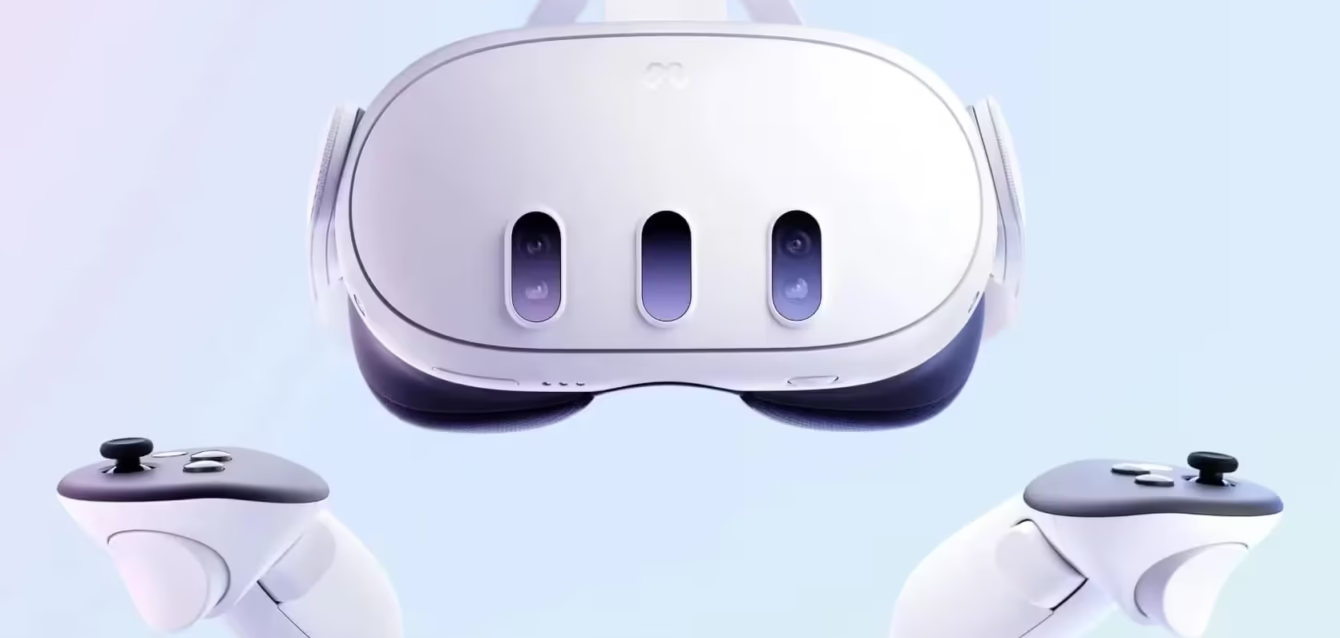
Meta Quest Statistics 2026
By Axis Intelligence Research
Co-author: Alex Rivera | Last updated: September 30, 2026 | License: CC BY 4.0
Meta headsets account for 71.67% of every VR headset connected to Steam, according to Axis Intelligence Research’s sum of Valve’s August 2026 survey. But 47.66% of that Meta base runs hardware Meta no longer sells new, a figure we call the Quest Legacy Load (QLL). The platform is dominant, and it is aging.
Quick Answer
How many Meta Quest headsets have been sold? Meta has never published Quest unit sales, so no verifiable lifetime total exists. What the primary record does show: Meta headsets hold 71.67% of Steam-connected VR headsets (Valve, August 2026), Meta held 68.7% of global XR headset and glasses shipments in Q2 2026 (IDC), and Axis Intelligence Research estimates headset shipments across the whole market fell about 23.1% year over year in that quarter.
Key Findings
- Meta and Oculus headsets made up 71.67% of all VR headsets connected to Steam in August 2026, according to Axis Intelligence Research’s sum of Valve’s Steam Hardware & Software Survey.
- The Quest Legacy Load (QLL) stood at 47.66% in August 2026, meaning nearly half of Meta’s Steam-connected base uses headsets outside Meta’s current Quest 3 and Quest 3S lineup, per Axis Intelligence Research.
- Axis Intelligence Research estimates global headset shipments fell 23.1% year over year in Q2 2026, derived from IDC’s reported 35.3% XR growth and the headset share drop from 27.1% to 15.4%.
- Meta raised the Meta Quest 3 price 20.0% on April 19, 2026, from $499.99 to $599.99, citing memory chip costs; the 128GB Quest 3S rose 16.7% to $349.99.
- Meta VR Glasses, announced September 23, 2026 for spring 2027, cost 2.17 times a Meta Quest 3 at $1,299.99, according to Axis Intelligence Research’s comparison of Meta’s list prices.
How Many Meta Quest Headsets Have Been Sold?
Meta does not disclose Quest unit sales, and it does not break out Quest revenue either. The company reports a single segment, Reality Labs, which its filings describe as virtual and augmented reality consumer hardware, software, and content. That segment now mixes Quest headsets with Ray-Ban Meta and other AI glasses.
Any “lifetime Quest sales” number you see online is an estimate whose origin cannot be traced to a document Meta or a tracker firm published. Axis Intelligence Research declined to publish one, and the declined figure is logged in the dataset as a retracted row with the reason stated.
What can be measured falls into three buckets:
- Where Quest shows up in use: Valve’s monthly Steam survey, which counts headsets connected by surveyed PC users.
- Where Quest shows up in shipments: IDC and Counterpoint Research tracker releases on units shipped into the channel.
- Where Quest shows up in money: Meta’s SEC filings, which state whether Quest sales rose or fell inside Reality Labs.
The direction from all three is the same in 2026. Meta’s own Form 10-Q for the quarter ended March 31, 2026 attributes a $10 million Reality Labs revenue decline to lower Meta Quest sales, partly offset by AI glasses. The June quarter 10-Q repeats the language: Reality Labs revenue rose 16% on AI glasses, “partially offset by lower Meta Quest sales.”
Alex Rivera’s read: Two consecutive filings saying the same words is the closest thing to a unit number Meta will give you. Quest volume is shrinking; glasses are the reason the segment line still points up.
What Is Meta Quest’s Share of PC VR on Steam?
Valve’s Steam Hardware & Software Survey for August 2026 is the only public, monthly, device-level measure of which VR headsets people actually plug in. Meta devices hold the top three spots.
Steam VR headset share by device, August 2026
| Headset | Share of Steam VR headsets | Month-over-month change | Source |
|---|---|---|---|
| Oculus Quest 2 | 26.97% | +0.30 pts | Valve, Aug 2026 |
| Meta Quest 3 | 26.01% | -0.24 pts | Valve, Aug 2026 |
| Meta Quest 3S | 11.50% | +0.05 pts | Valve, Aug 2026 |
| Valve Index HMD | 11.07% | n/a | Valve, Aug 2026 |
| Pico 4 | 4.48% | n/a | Valve, Aug 2026 |
| Oculus Rift S | 3.39% | -0.24 pts | Valve, Aug 2026 |
| HTC Vive | 2.39% | n/a | Valve, Aug 2026 |
| Sony PS VR2 | 2.24% | n/a | Valve, Aug 2026 |
| Windows Mixed Reality | 2.08% | n/a | Valve, Aug 2026 |
| Oculus Rift | 1.83% | -0.14 pts | Valve, Aug 2026 |
| Meta Quest Pro | 1.51% | +0.07 pts | Valve, Aug 2026 |
| Bigscreen Beyond | 1.25% | n/a | Valve, Aug 2026 |
| Oculus Quest | 0.44% | +0.02 pts | Valve, Aug 2026 |
Meta’s combined Steam VR share
According to Axis Intelligence Research, all eight Meta and Oculus devices in the survey sum to 71.67% of Steam VR headsets in August 2026, down slightly from 71.85% in July (July values are derived from August shares minus Valve’s reported monthly change). That is 6.47 times the share of Valve’s own Index headset, on Valve’s own storefront.
Context matters for the denominator. Only 1.49% of surveyed Steam users had a VR headset connected in August 2026, down 0.22 points from July. PC VR is a niche inside a niche, and Quest owns that niche.
Pico 4, from ByteDance’s hardware unit, is the largest non-Meta standalone at 4.48%. Our ByteDance statistics cover the parent company’s filed and reported figures.
The Quest Legacy Load (QLL): How Old Is the Meta Quest Install Base?
QLL, the Quest Legacy Load, is an original Axis Intelligence Research metric. It measures how much of Meta’s active headset base, as seen on Steam, runs on devices that are not part of Meta’s current new-device lineup (Meta Quest 3 and Meta Quest 3S, the two headsets on Meta’s store navigation as of September 2026).
Formula: QLL = (legacy Meta headset share on Steam ÷ total Meta headset share on Steam) × 100
Legacy devices: Oculus Quest 2, Oculus Rift S, Oculus Rift, Meta Quest Pro, Oculus Quest (first generation) and Oculus Rift DK2. Inputs are Valve’s published shares, so anyone can recompute the reading.
QLL readings
| As of | Legacy Meta share | Quest 3 + 3S share | Total Meta share | QLL | Source |
|---|---|---|---|---|---|
| July 2026 | 34.15% | 37.70% | 71.85% | 47.53% | Axis calculation from Valve |
| August 2026 | 34.16% | 37.51% | 71.67% | 47.66% | Axis calculation from Valve |
Axis Intelligence Research finding: According to Axis Intelligence Research, in August 2026 47.66% of Meta’s Steam-connected base used a headset Meta no longer sells new, and the reading ticked up 0.13 points in a month. According to Axis Intelligence Research, Oculus Quest 2 alone accounts for 37.63% of the Meta base on Steam, up from 37.12% in July.
Why QLL matters for developers, buyers and Meta
A rising QLL means the replacement cycle has stalled. Quest 2, a previous-generation device, regained first place on Steam in August 2026, edging past Quest 3. For a studio, QLL is a performance budget: nearly half of the Meta audience on PC is still on older silicon, controllers and displays. For Meta, it is a demand signal that the April 2026 price increase made worse, not better.
Scope. QLL reads the PC-tethered slice of the Quest base only (Quest Link, Air Link and third-party streaming to SteamVR). Standalone-only owners who never connect to Steam are not captured, and Valve’s survey is opt-in. The metric tracks direction and mix, not absolute headcount.
Alex Rivera’s read: Coming from a Quest 2, the upgrade math used to be easy: $299.99 for a Quest 3S. After April, it is $349.99, and the most-used headset on Steam is a previous-generation device. People are not upgrading; they are waiting to see what the glasses cost. Now they know.
How Much Does a Meta Quest Cost in 2026?
Meta announced on its official Quest pricing post that prices for Quest 3 and Quest 3S would rise starting April 19, 2026, citing a global surge in memory chip prices. The new U.S. figures were reported by TechCrunch: $50 more for each Quest 3S model and $100 more for Quest 3. Refurbished units rose too; accessories did not.
Meta Quest U.S. price increase, April 19, 2026
| Model | Price before | Price after | Change | Source |
|---|---|---|---|---|
| Meta Quest 3S 128GB | $299.99 | $349.99 | +16.7% | Meta; TechCrunch |
| Meta Quest 3S 256GB | $399.99 | $449.99 | +12.5% | Meta; TechCrunch |
| Meta Quest 3 512GB | $499.99 | $599.99 | +20.0% | Meta; TechCrunch |
Prior prices are derived from the new price minus the stated increase. According to Axis Intelligence Research, the flagship Quest 3 took the steepest relative increase of the lineup.
Meta’s own hardware demand sits upstream of the component squeeze. The same company guided 2026 capital expenditures of $130 billion to $145 billion in its Q2 2026 results, much of it for AI infrastructure that competes for the same memory supply.
Are Meta Quest Sales Falling in 2026?
Yes, on every public indicator. The trackers agree on direction and disagree on size, and that disagreement is worth publishing rather than averaging.
VR headset shipment change, Q2 2026
| Measure | Value | Source |
|---|---|---|
| VR headset shipments, year over year | -18% | Counterpoint Research, Sept 2026 |
| VR headset shipments, quarter over quarter | -16% | Counterpoint Research, Sept 2026 |
| Implied headset shipments, year over year | -23.1% | Axis estimate from IDC, Sept 2026 |
| Total XR shipments (headsets + glasses), year over year | +35.3% | IDC, Sept 2026 |
Counterpoint Research reported that VR headset shipments fell 18% year over year and 16% quarter over quarter in Q2 2026, and tied part of the slowdown to Meta’s price increase amid the memory price surge.
How Axis Intelligence Research derived the -23.1% figure
IDC’s September 16, 2026 market update reports total XR growth of 35.3% and a headset share of 15.4% in Q2 2026. It gives Q2 2025 shares for audio glasses (61.9%) and display glasses (11%), which leaves headsets at 27.1% a year earlier. Because all inputs come from the same IDC trackers, they can be combined:
(1.353 × 15.4 ÷ 27.1) − 1 = −23.1%
According to Axis Intelligence Research, this is an estimate: IDC rounds shares to one decimal, and IDC does not publish the unit totals behind them. The gap against Counterpoint’s -18% likely reflects category definitions (IDC’s headset bucket includes mixed reality devices; Counterpoint’s figure is VR-specific), so we publish both.
IDC had already forecast in its December 2025 release that mixed and virtual reality headset shipments would fall 42.8% in 2025, inside an XR market expected to reach 14.5 million units.
Alex Rivera’s read: A 35% growing market with a shrinking headset line is not a VR recovery. It is a glasses boom that happens to share a tracker with VR. The full breakdown sits in our smart glasses statistics.
What Is Meta’s Market Share in VR and XR?
IDC counts Meta’s Quest headsets and AI glasses together. On that combined basis, Meta held 68.7% of global XR headset and glasses shipments in Q2 2026, ahead of RayNeo (3.6%), Alibaba (2.6%), XREAL (2.5%) and Xiaomi (2.3%). In Q3 2025, IDC put Meta at 75.7% of the same combined market.
Meta share of XR shipments (IDC combined trackers)
| Period | Meta share | Source |
|---|---|---|
| Q3 2025 | 75.7% | IDC, Dec 11, 2025 |
| Q2 2026 | 68.7% | IDC, Sept 16, 2026 |
Meta’s share of headsets alone is not in IDC’s public releases. For comparison with Apple’s headset, which never reached the scale of either Quest line, see our Apple Vision Pro statistics, where IDC shipment estimates and our VPRW revenue weight show how small Vision Pro volumes stayed.
How Much Revenue Does Meta Quest Generate?
Quest revenue is inside Reality Labs, and Meta does not isolate it. The segment’s reported numbers, taken from Meta’s SEC exhibits, frame the ceiling.
Reality Labs revenue and operating loss
| Period | Revenue | Operating loss | Source |
|---|---|---|---|
| Q4 2024 | $1,083M | n/a | Meta 8-K, Jan 2026 |
| FY 2024 | $2,146M | n/a | Meta 8-K, Jan 2026 |
| Q4 2025 | $955M | -$6,021M | Meta 8-K, Jan 2026 |
| FY 2025 | $2,207M | -$19,193M | Meta 8-K, Jan 2026 |
| Q1 2026 | $402M | n/a | Axis calculation (H1 minus Q2) |
| Q2 2025 | $370M | n/a | Meta 8-K, Jul 2026 |
| Q2 2026 | $431M | -$4,619M | Meta 8-K, Jul 2026 |
| H1 2026 | $833M | -$8,647M | Meta 8-K, Jul 2026 |
Sources: Meta’s Q4 and full-year 2025 results and Q2 2026 results, both filed as Exhibit 99.1 on SEC EDGAR.
According to Axis Intelligence Research, the holiday quarter tells the Quest story most clearly. Q4 is when headsets sell, and Reality Labs revenue in Q4 2025 fell 11.8% year over year, from $1,083 million to $955 million, in a year when AI glasses were growing. Full-year 2025 segment revenue still rose, which Meta’s annual report attributes to AI glasses offsetting a decrease in Quest sales.
Reality Labs revenue was 0.71% of Meta’s total Q2 2026 revenue of $60,801 million, per Axis Intelligence Research. The segment’s losses, and our Reality Labs Burn Multiple, are tracked in detail on our Meta statistics and smart glasses pages, so this page stays on Quest.
How Much Do Developers Earn on the Meta Quest Store?
Meta’s developer relations team published the most detailed store figures of the year in The State of VR at GDC 2026 on March 12, 2026:
- Meta Horizon Store gross revenue was up very slightly in 2025 versus 2024, a year without a new headset launch.
- In-app purchase revenue grew by over 10%, and the number of IAP apps reaching $500,000 rose 20%.
- Over 100 titles generated $1 million or more in gross revenue in 2025.
- Meta Horizon+ passed 1 million subscribers and paid nearly $20 million to participating developers.
- Oculus Publishing helped ship over 140 games in 2025.
Meta also said Quest usage reached its highest-ever count of unique users in 2025, without giving the number, and named teens as the most active audience on Quest.
Axis Intelligence Research estimate: According to Axis Intelligence Research, Horizon+ payouts work out to at most about $20 per subscriber per year (nearly $20 million ÷ over 1 million subscribers). Since both inputs are bounded (“nearly,” “over”), the true figure sits below that ceiling.
Alex Rivera’s read: Flat store revenue in a no-launch year is respectable. Flat store revenue with record unique users says something else: more people, spending less each. Meta says as much when it describes early adopters as “spending less than they used to.”
What Comes After Quest 3? Meta VR Glasses
At Connect on September 23, 2026, Meta did not announce a Quest 4. It announced Meta VR Glasses: about 100 grams on the face, five times lighter than Quest 3 by Meta’s measure, with compute, battery and storage in a tethered puck. They go on sale in spring 2027 for $1,299.99.
Meta VR Glasses vs Meta Quest 3
| Spec | Meta VR Glasses | Meta Quest 3 | Source |
|---|---|---|---|
| U.S. price | $1,299.99 (spring 2027) | $599.99 | Meta; TechCrunch |
| Weight on face | About 100 g | 5x heavier (per Meta) | Meta Newsroom |
| Horizontal field of view | About 70 degrees | About 110 degrees | Meta developer blog |
| Sharpness | 37 pixels per degree | n/a | Meta Newsroom |
| Hand-only games at launch | 75+ | n/a | Meta Newsroom |
According to Meta’s Connect developer recap, VR Glasses run the same operating system, Store, payment platform and SDKs as Quest, and the Store will prioritize controller-free titles for owners without controllers.
Axis Intelligence Research finding: According to Axis Intelligence Research, Meta VR Glasses cost 2.17 times a Meta Quest 3 and 3.71 times a 128GB Quest 3S at current U.S. list prices. That positions them against Apple Vision Pro rather than as a Quest replacement.
Alex Rivera’s read: For a Quest 2 owner, the verdict is simple. If you game with controllers, a Quest 3S at $349.99 is still the buy. If you mostly watch video in bed or on flights, wait for spring and look hard at the $1,299.99 price. Nothing Meta announced makes the Quest 3 a smart upgrade from a Quest 3 you already own.
Meta Quest Timeline: 2026 Events That Moved the Numbers
| Date | Event | Source |
|---|---|---|
| Jan 28, 2026 | Reality Labs posts a -$6,021M Q4 2025 loss; Meta guides 2026 RL losses similar to 2025 | Meta 8-K |
| Mar 12, 2026 | Meta reports 2025 store revenue up very slightly, Horizon+ over 1M subscribers | Meta developer blog |
| Apr 19, 2026 | Quest 3 rises to $599.99; Quest 3S to $349.99 and $449.99 | Meta; TechCrunch |
| Jul 29, 2026 | Q2 Reality Labs revenue +16% on AI glasses; lower Quest sales | Meta 8-K and 10-Q |
| Aug 2026 | Quest 2 retakes first place on Steam at 26.97% | Valve |
| Sep 16, 2026 | IDC: headsets fall to 15.4% of XR shipments | IDC |
| Sep 23, 2026 | Meta VR Glasses announced, $1,299.99, spring 2027 | Meta Newsroom |
For the broader argument about why consumer VR platforms stalled while enterprise use held up, see our analysis of metaverse economics in 2026. More device datasets live in our consumer tech and hardware statistics hub.
Meta Quest Questions, Answered With Data
Is Meta discontinuing the Quest?
No. As of September 30, 2026, Meta sells Quest 3 and Quest 3S, raised their prices in April 2026, and announced Meta VR Glasses on the same OS and Store. Meta’s filings do report lower Quest sales in both Q1 and Q2 2026.
Is Quest 2 still the most used VR headset?
On Steam, yes. Valve’s August 2026 survey puts Oculus Quest 2 at 26.97% of connected VR headsets, just ahead of Meta Quest 3 at 26.01%, even though Quest 2 is no longer part of Meta’s new-device lineup.
What share of Meta Quest owners use older headsets?
Axis Intelligence Research’s Quest Legacy Load (QLL) puts it at 47.66% of Meta’s Steam-connected base in August 2026, up from 47.53% in July.
Why did the Meta Quest 3 price go up in 2026?
Meta cited the global surge in memory chip prices. On April 19, 2026, Quest 3 rose $100 to $599.99 (+20.0%) and both Quest 3S models rose $50.
Is Meta VR Glasses the Quest 4?
No. Meta did not announce a Quest 4 at Connect 2026. VR Glasses are a separate two-part device priced at $1,299.99, shipping spring 2027, that runs Quest apps from the same Store.
How much of Meta’s revenue comes from Quest?
Less than 1% for the whole Reality Labs segment, which also includes AI glasses: $431 million of $60,801 million in Q2 2026, or 0.71%, per Axis Intelligence Research.
Are VR headset sales declining worldwide?
Yes. Counterpoint Research measured an 18% year-over-year drop in Q2 2026, and Axis Intelligence Research estimates a 23.1% drop from IDC’s share data, while smart glasses drove total XR shipments up 35.3%.
Can developers still make money on Quest?
Some can. Meta says over 100 titles grossed $1 million or more in 2025, and in-app purchase revenue grew by over 10%, while total store revenue was roughly flat.
Methodology
Collection. Axis Intelligence Research compiled this dataset on September 30, 2026, from primary documents fetched that day: Valve’s Steam Hardware & Software Survey (August 2026 VR headset table); Meta Platforms’ Q4 2025 and Q2 2026 results exhibits and Q1 and Q2 2026 Form 10-Q filings on SEC EDGAR, plus the FY2025 annual report; IDC’s December 11, 2025 press release and September 16, 2026 market update; Counterpoint Research’s September 2026 XR market insight; Meta’s April 2026 pricing announcement (U.S. figures as reported by TechCrunch); Meta’s March 12, 2026 GDC developer post; and Meta’s September 23 and 24, 2026 VR Glasses announcements.
Calculations. Every Axis-calculated row in the CSV carries its formula in method_note. QLL = legacy Meta Steam share ÷ total Meta Steam share × 100. Meta Steam share = sum of eight Meta and Oculus device shares. July 2026 values = August share minus Valve’s reported monthly change. Implied headset shipment change = (1.353 × 15.4 ÷ 27.1) − 1, with 27.1% derived as 100 − 61.9 − 11.0. Q1 2026 Reality Labs revenue = H1 minus Q2. Arithmetic was run with exact rational numbers before rounding.
Scope. Steam figures measure PC-connected headsets among opt-in survey participants, not total ownership. IDC and Counterpoint count shipments into the channel. Reality Labs figures combine Quest, AI glasses and software.
What we declined to publish. A lifetime Quest unit total and a Quest-only revenue figure. Neither traces to a primary document; both are logged as retracted rows.
About This Dataset
The dataset meta-quest-statistics-2026.csv (112 rows) covers Steam VR device shares, the QLL index and its inputs, Reality Labs revenue and losses, IDC and Counterpoint shipment data, U.S. Quest pricing, Meta VR Glasses specifications and Meta Horizon Store developer metrics. Each row carries source organization, document, URL, retrieval date, a primary-source flag and, for Axis calculations, the formula. License: CC BY 4.0. Citation: Axis Intelligence Research, Meta Quest Statistics 2026, 2026.
Cite This Research
APA: Axis Intelligence Research, & Rivera, A. (2026, September 30). Meta Quest statistics 2026: Sales, market share, Steam share, prices and the Quest Legacy Load (QLL). Axis Intelligence. https://axis-intelligence.com/meta-quest-statistics/
MLA: Axis Intelligence Research, and Alex Rivera. “Meta Quest Statistics 2026: Sales, Market Share, Steam Share, Prices and the Quest Legacy Load (QLL).” Axis Intelligence, 30 Sept. 2026, axis-intelligence.com/meta-quest-statistics/.
Chicago: Axis Intelligence Research and Alex Rivera. “Meta Quest Statistics 2026: Sales, Market Share, Steam Share, Prices and the Quest Legacy Load (QLL).” Axis Intelligence, September 30, 2026. https://axis-intelligence.com/meta-quest-statistics/.