

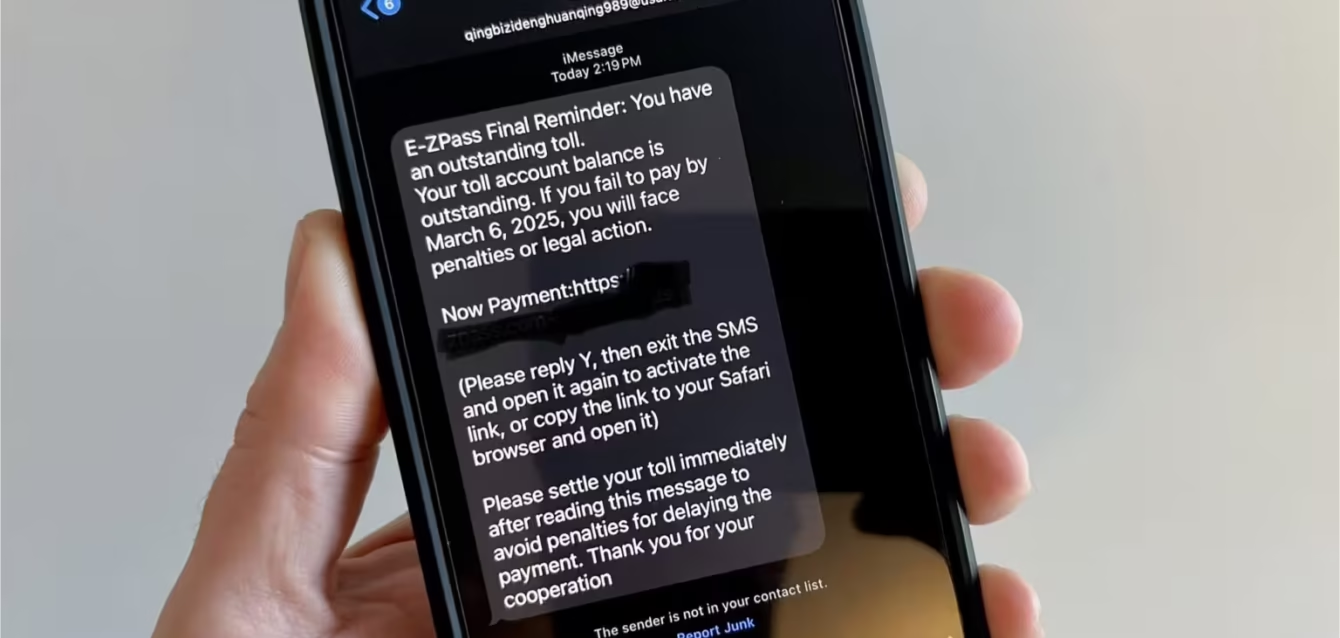
Toll Scam Statistics 2026
By Axis Intelligence Research
Co-author: Marcus Chen | Last updated: October 15, 2026 | License: CC BY 4.0
The FBI’s Internet Crime Complaint Center logged 59,271 toll scam complaints in 2024 with just $129,624 in reported losses — about $2.19 per complaint. Axis Intelligence Research calculates that the average IC3 complaint that year reported 8,858 times more loss. Toll texts don’t steal tolls. They harvest card numbers.
Quick Answer
Toll scam texts are the highest-volume, lowest-visible-loss fraud the FBI tracks. The 2024 IC3 Annual Report counted 59,271 toll scam complaints and $129,624 in losses. Toll themes account for roughly 46% of the 194,345 smishing domains Palo Alto Networks Unit 42 tied to the Smishing Triad, per an Axis Intelligence Research calculation.
Key Findings
- Axis Intelligence Research finds that FBI IC3 toll scam complaints reported $2.19 in losses each in 2024, against a $19,372 average across all IC3 complaints.
- The Axis Toll Smishing Harvest Gap (TSHG) reads 8,858× for 2024 — the baseline reading of a new Axis Intelligence Research metric comparing average IC3 loss to toll-scam loss per complaint.
- Axis Intelligence Research estimates that toll-agency impersonation accounts for about 46% of the 194,345 Smishing Triad domains Palo Alto Networks Unit 42 identified since January 2024.
- Axis Intelligence Research finds that FBI IC3 government impersonation complaints rose 86.7% in 2025, from 17,367 to 32,424, while losses rose 96.7% to $797.9 million.
- Axis Intelligence Research calculates that Georgia Peach Pass smishing complaints in the first 12 days of March 2025 ran at least 12.8 times the prior 14-month monthly average, per FBI Atlanta data.
How Many Toll Scam Texts Are Reported to the FBI?
According to the FBI’s 2024 IC3 Annual Report, toll scams generated 59,271 complaints in 2024 — a line item the bureau broke out under cyber-enabled fraud trends, citing its April 2024 road-toll smishing alert.
That alert, IC3 PSA I-041224-PSA, dated April 12, 2024, reported more than 2,000 complaints since early March 2024 from at least three states. Nine months later the yearly count stood near 59,000. The sample lure the FBI published asked for $12.51 and threatened a $50.00 late fee.
Toll scam complaints and losses vs. other IC3 categories, 2024
| Category | Complaints | Reported losses | Loss per complaint | Source |
|---|---|---|---|---|
| Toll scams | 59,271 | $129,624 | $2.19 (Axis calc.) | FBI IC3 2024 |
| Phishing/Spoofing | 193,407 | $70,013,036 | — | FBI IC3 2024 |
| Government Impersonation | 17,367 | $405,624,084 | — | FBI IC3 2024 |
| All IC3 complaints | 859,532 | $16.6 billion | $19,372 | FBI IC3 2024 |
IC3 does not merge toll scams into these categories in its published tables, and Axis Intelligence Research does not either: the toll line is a trend highlight, while phishing/spoofing and government impersonation are formal crime types. They sit side by side here, not summed.
Did the FBI publish a toll scam count for 2025?
No. The 2025 IC3 Annual Report does not carry a separate toll scam line. The closest 2025 signals are the categories toll texts feed into, covered below.
Marcus Chen: Read the 2024 toll line twice. Fifty-nine thousand people took the time to file a federal complaint, and the reported money lost would not cover one mid-size company’s monthly SaaS bill. That is not a cheap scam. That is a scam whose payout lands somewhere IC3 doesn’t measure — on a card statement weeks later, filed under a different crime type, or never filed at all.
Why Do Toll Scam Texts Show Almost No Reported Losses?
Because the $12.51 is the bait, not the haul. The FTC’s Top Text Scams of 2024 data spotlight states that toll-text scammers are really after credit card and even Social Security numbers. The stolen card is monetized later — and that later loss rarely gets traced back to the text that started it.
The Axis Toll Smishing Harvest Gap (TSHG)
The Toll Smishing Harvest Gap (TSHG) is an Axis Intelligence Research metric that measures how far a scam’s reported cash loss sits below the typical fraud complaint. A high TSHG means the scam’s visible take is tiny compared with its complaint volume — the signature of a data-harvesting operation rather than a direct-payment fraud.
Formula: TSHG = IC3 average reported loss per complaint ÷ (toll scam reported losses ÷ toll scam complaints)
2024 baseline reading: $19,372 ÷ ($129,624 ÷ 59,271) = $19,372 ÷ $2.19 = 8,858×
All three inputs come from the FBI’s 2024 IC3 Annual Report. This is the baseline reading; Axis Intelligence Research will republish the TSHG whenever IC3 or a state field office releases a new toll complaint and loss pair.
The TSHG does not say toll scams are harmless. It says the opposite: the harm is displaced. Google’s November 2025 lawsuit announcement against the Lighthouse phishing-as-a-service kit — which it ties to fake E-ZPass and USPS texts — estimated 12.7 million to 115 million U.S. credit cards stolen and more than 1 million victims across 120+ countries. Those are company estimates, and the spread between them is wide, but even the low end dwarfs anything in the toll complaint ledger.
Is the toll scam payout really that small at the state level?
Georgia’s data says yes. FBI Atlanta reported on March 12, 2025 that Peach Pass smishing complaints reached 1,573 in March to date, with reported losses of $3,643.42 — about $2.32 per complaint by Axis Intelligence Research’s arithmetic, almost identical to the national toll figure.
Marcus Chen: Two independent windows — a national year and a Georgia fortnight — land within thirteen cents of each other on loss per complaint. When two datasets agree that closely, the number is describing the attack’s design, not noise. The operator collects a card, a ZIP code and a CVV, and the $2 is incidental.
How Fast Did Toll Smishing Spread State by State?
The FBI warned in April 2024 that the campaign appeared to be moving state to state. Georgia gives the clearest measured surge.
Peach Pass: 14 months of complaints matched in 12 days
| Window | Peach Pass smishing complaints | Source |
|---|---|---|
| Jan 1, 2024 – Feb 28, 2025 (14 months) | 1,720 | FBI Atlanta |
| Prior monthly average | 122.9 (Axis calc.) | 1,720 ÷ 14 |
| Mar 1 – Mar 12, 2025 | 1,573 | FBI Atlanta |
| Surge multiple | ≥12.8× (Axis calc.) | 1,573 ÷ 122.9 |
Axis Intelligence Research labels the 12.8× a floor: twelve days of March are being compared against full-month averages.
Which toll systems do scam texts impersonate?
The FTC names SunPass in Florida and FasTrak in San Francisco in its 2024 text-scam spotlight, and its May 2026 consumer alert lists EZ-Pass, SunPass, FasTrak and TxTag. Unit 42’s indicator list includes lookalike domains for E-ZPass, E-ZPass New York, E-ZPass New Jersey, SunPass and PikePass, plus Michigan and Utah state-government lookalikes.
How Big Is the Infrastructure Behind Toll Scam Texts?
Palo Alto Networks Unit 42 attributed the toll and package-misdelivery campaign to the Smishing Triad and identified 194,345 fully qualified domain names across 136,933 root domains registered since January 1, 2024. Toll services were the single most impersonated category, with nearly 90,000 dedicated phishing FQDNs; USPS was the most impersonated single brand at 28,045.
Toll share of Smishing Triad domains
| Metric | Value | Source |
|---|---|---|
| Total campaign FQDNs | 194,345 | Unit 42, Oct 23, 2025 |
| Toll-category FQDNs | nearly 90,000 | Unit 42 |
| USPS FQDNs | 28,045 | Unit 42 |
| Toll share of FQDNs | ~46% (Axis estimate) | 90,000 ÷ 194,345 |
| Root domains via Dominet (HK) Limited | 68.06% (93,197) | Unit 42 |
| DNS query volume to U.S.-hosted infrastructure | 58% | Unit 42, Figure 7 |
How long does a toll scam domain stay live?
Not long enough for a blocklist built on weekly refreshes.
| Domain lifetime (pDNS) | Share of domains | Source |
|---|---|---|
| 2 days or less | 29.19% | Unit 42 |
| Under 1 week | 71.3% | Unit 42 |
| 2 weeks or less | 82.6% | Unit 42 |
| Active beyond 3 months | under 6% | Unit 42 |
Marcus Chen: Here’s what actually happened to defenders. Registration runs through a Hong Kong registrar and Chinese nameservers, but most of the DNS traffic resolves to U.S. cloud IPs, and seven in ten domains are gone inside a week. A domain-reputation feed that takes five days to score a new name is scoring corpses. Carrier-level filtering on the message template — the near-identical “outstanding toll amount” language the FBI flagged in 2024 — is the control that survives the churn.
Are Toll Scams Driving the Rise in Government Impersonation Fraud?
The FTC says they are a contributor. In its May 7, 2026 consumer alert, the FTC reported that government imposter reports rose 40% in 2025, “thanks in part to messages about overdue tolls,” and that overall imposter losses rose nearly 20% to $3.5 billion.
The FBI’s numbers moved harder.
Government impersonation, FBI IC3, 2024 vs. 2025
| Metric | 2024 | 2025 | Change | Source |
|---|---|---|---|---|
| Complaints | 17,367 | 32,424 | +86.7% (Axis calc.) | IC3 2025 |
| Losses | $405,624,084 | $797,943,193 | +96.7% (Axis calc.) | IC3 2025 |
The FTC and FBI count different things — FTC Consumer Sentinel reports versus IC3 complaints — so Axis Intelligence Research publishes both growth rates side by side rather than blending them. Neither agency isolates toll texts inside the 2025 figure, so the toll share of this growth is not measurable from published data.
Are older adults reporting more of these texts?
FBI IC3 phishing/spoofing complaints from people 60 and older rose from 23,252 in 2024 to 48,064 in 2025, a 106.7% increase by Axis Intelligence Research’s calculation, while all-age phishing/spoofing complaints held nearly flat (193,407 to 191,561). IC3’s phishing/spoofing definition covers unsolicited email, text messages and calls, so this is a channel-wide signal, not a toll-only one.
How Much Do Americans Lose to Text Message Scams Overall?
The FTC’s Consumer Sentinel data put reported text-scam losses at $470 million in 2024, more than five times the 2020 figure, per the FTC data spotlight. Toll notices ranked fourth among the top five text scams the FTC identified by hand-coding a random sample of 1,000 text fraud reports.
Share of FTC text scam reports with money lost
| Year | Share reporting a loss | Source |
|---|---|---|
| 2020 | 5% | FTC Data Spotlight, fn. 2 |
| 2021 | 4% | FTC |
| 2022 | 6% | FTC |
| 2023 | 9% | FTC |
| 2024 | 11% | FTC |
In 2025, consumers filed 3 million fraud reports with $15.9 billion in losses, according to the FTC’s March 25, 2026 congressional testimony release. The FTC testimony identified text messages as the top reported contact method when consumers named one.
Marcus Chen: The toll text is a volume play inside a channel that is getting more profitable per message. More text reports end in a loss every year since 2021. The toll lure feeds that funnel: it validates a live number and a live card, and the expensive scams come next.
Toll Scam Text Statistics at a Glance
| Statistic | Value | As of | Source |
|---|---|---|---|
| FBI IC3 toll scam complaints | 59,271 | 2024 | FBI IC3 |
| FBI IC3 toll scam losses | $129,624 | 2024 | FBI IC3 |
| Axis TSHG baseline reading | 8,858× | 2024 data | Axis Intelligence Research |
| Smishing Triad FQDNs | 194,345 | Oct 2025 | Unit 42 |
| Toll share of those FQDNs | ~46% | Oct 2025 | Axis estimate |
| Domains dead within a week | 71.3% | Oct 2025 | Unit 42 |
| FTC text scam losses | $470M | 2024 | FTC |
| FTC government imposter report growth | +40% | 2025 | FTC |
| IC3 government impersonation losses | $797.9M | 2025 | FBI IC3 |
| Lighthouse U.S. cards stolen (company estimate) | 12.7M–115M | Nov 2025 |
Methodology
Axis Intelligence Research assembled this dataset on October 15, 2026, exclusively from primary sources fetched that day: FBI IC3 annual reports for 2024 and 2025, IC3 PSA I-041224-PSA, the FBI Atlanta Peach Pass release, the FTC’s 2024 text-scam data spotlight, FTC press and consumer-alert releases from 2026, Palo Alto Networks Unit 42 research, and Google’s lawsuit announcement. No aggregator or competitor statistics page was used as a source.
Axis calculations:
- Toll loss per complaint = $129,624 ÷ 59,271 = $2.19.
- TSHG = $19,372 ÷ $2.19 = 8,858× (baseline reading, 2024 data).
- Peach Pass surge = 1,573 ÷ (1,720 ÷ 14) = 12.8× (floor; 12-day window).
- Toll share of Smishing Triad FQDNs = 90,000 ÷ 194,345 ≈ 46% (estimate; Unit 42 states “nearly 90,000,” so the true share is at or slightly below 46%).
- Government impersonation growth: (32,424 − 17,367) ÷ 17,367 = 86.7%; ($797,943,193 − $405,624,084) ÷ $405,624,084 = 96.7%.
- 60+ phishing/spoofing growth: (48,064 − 23,252) ÷ 23,252 = 106.7%.
IC3 and FTC figures are self-reported complaints and are never added together here. IC3 notes that some complainants file more than once.
About This Dataset
- File:
toll-scam-statistics.csv— 58 rows, long format, one observation per row, with source organization, document, URL, retrieval date, primary flag and Axis-calculation flag on every row. - License: CC BY 4.0.
- Cite as: Axis Intelligence Research, Toll Scam Text Statistics 2026, 2026.
Cite This Page
- APA: Axis Intelligence Research, & Chen, M. (2026, October 15). Toll scam text statistics 2026. Axis Intelligence. https://axis-intelligence.com/toll-scam-statistics/
- MLA: Axis Intelligence Research, and Marcus Chen. “Toll Scam Text Statistics 2026.” Axis Intelligence, 15 Oct. 2026, axis-intelligence.com/toll-scam-statistics/.
- Chicago: Axis Intelligence Research and Marcus Chen. “Toll Scam Text Statistics 2026.” Axis Intelligence, October 15, 2026. https://axis-intelligence.com/toll-scam-statistics/.
Toll Scam Text FAQ
Do E-ZPass or other toll agencies ever text you for payment?
Real toll operators publish how they contact customers, and many say they do not text demands for payment. E-ZPass Virginia, for example, lists the specific numbers its texts come from. If a text pushes a link to settle a toll, check your balance on the agency’s own site or app instead.
Why did I get a toll text if I never drove on a toll road?
The FBI and FTC both describe these texts as sent nationwide regardless of travel. The lures are mass-sent; residents of states without toll roads receive them too.
What do toll scam texts actually steal?
According to the FTC, toll-text scammers are after credit card numbers and even Social Security numbers. Axis Intelligence Research’s TSHG of 8,858× shows why: the reported cash loss averages about $2.19, so the payment page is a data-capture form, not the real payout.
I entered my card on a fake toll site — what now?
Call your card issuer to cancel the card and dispute charges, then file at ic3.gov with the sender’s number and the link, as the FBI PSA advises. If you shared your Social Security number, report it to the FTC.
Where should I report a toll scam text?
Forward it to 7726 (SPAM) so your carrier can block similar messages, report it at ReportFraud.ftc.gov, and file at ic3.gov — the FTC and FBI both list these steps.
Who is behind the fake toll texts?
Palo Alto Networks Unit 42 attributes the campaign to the Smishing Triad, a China-linked phishing-as-a-service ecosystem. Google sued the operators of the related Lighthouse kit in November 2025.
Why do toll scam links stop working so quickly?
Unit 42 found 71.3% of campaign domains were active less than a week and 29.19% lasted two days or less, so operators rotate links faster than many blocklists update.
Are toll scams growing in 2026?
The FTC’s May 2026 alert says government imposter reports rose 40% in 2025, partly from overdue-toll messages. The FBI’s 2025 report shows government impersonation complaints up 86.7%. Neither agency has published a 2026 toll-only count yet.