

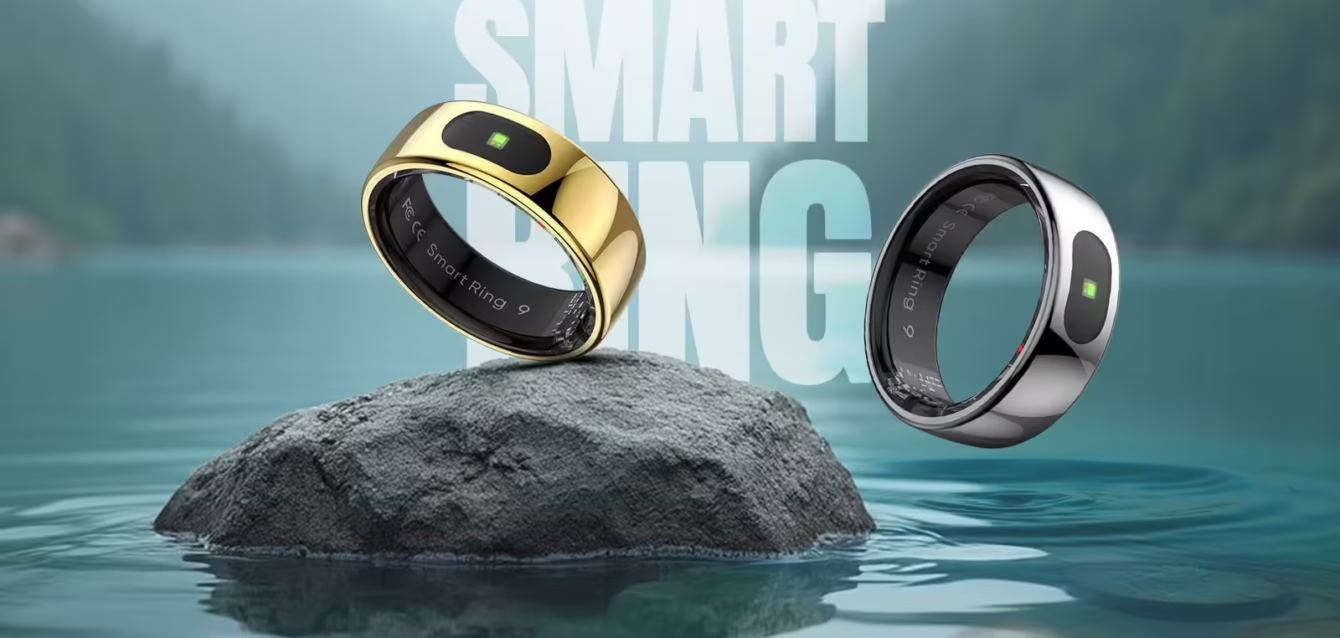
Smart Ring Statistics 2026
By Axis Intelligence Research
Co-authors: Jennifer Miller | Last updated: September 11, 2026 | License: CC BY 4.0
In July 2026 the smart ring stopped being a wellness gadget in the eyes of a regulator. The US Food and Drug Administration cleared a sleep apnea risk feature running on a ring, and the clearance file published the first government-reviewed accuracy numbers the category has ever had: 77.9% sensitivity and 95.9% specificity against overnight polysomnography in 469 people.
Quick Answer
Global smart ring shipments reached roughly 4 million units in 2025, up from 1.8 million in 2024, according to Omdia. Oura held 74% of first-half 2025 shipments and reported more than 5.5 million cumulative rings sold. According to Axis Intelligence Research, a subscription-bearing ring costs 1.54 times its sticker price over three years, while every subscription-free rival costs exactly 1.00 times.
Key Findings
- Global smart ring shipments rose from approximately 850,000 units in 2023 to 1.8 million in 2024 and a forecast 4 million in 2025, according to Omdia’s smart ring shipment estimates published November 19, 2025.
- Oura held 74% of global smart ring shipments in the first half of 2025, ahead of Ultrahuman at 9%, Samsung at 9% and RingConn at 5%, per Omdia.
- The Samsung Galaxy Ring sleep apnea feature cleared by the FDA on July 20, 2026 under 510(k) number K261011 detected moderate-to-severe sleep apnea with 77.9% sensitivity in men at 85.5% and in women at 63.2%.
- Across the 107 peer-reviewed clinical studies of smart rings published through July 2025, the Oura Ring featured in 72% of them, according to a systematic review in Biomimetics.
- According to Axis Intelligence Research, the Ring Cost-of-Continuity Index (RCCI) for the Oura Ring 5 is 154, meaning a three-year owner pays 54% above the hardware price before the ring is three years old.
How Many Smart Rings Are Sold Each Year?
The category is small in absolute terms and steep in slope. Omdia estimates shipments exceeded 850,000 units in 2023, more than doubled to 1.8 million in 2024, reached 1.6 million in the first half of 2025 alone, and finished 2025 at just over 4 million units.
| Period | Global shipments | Source |
|---|---|---|
| 2023 | ~850,000 units | Omdia, Nov 19 2025 |
| 2024 | 1.8 million units | Omdia, Nov 19 2025 |
| H1 2025 | 1.6 million units | Omdia, Nov 19 2025 |
| 2025 (full year) | ~4.0 million units | Omdia forecast, Nov 19 2025 |
The growth rate depends on who counts. Omdia’s own unit series implies 122.2% growth in 2025 over 2024. Counterpoint Research estimates 77% year-over-year growth for the same year. Axis Intelligence Research publishes both figures side by side rather than averaging them, because the gap is a definitional one: trackers differ on whether low-cost regional brands and non-connected rings enter the count, and a blended number would hide that.
For scale, the entire smart ring category in 2025 shipped fewer units than the smartwatch category ships in a normal fortnight. Our Apple Watch statistics page carries the wrist-worn comparison.
Jennifer Miller, Digital Health: Adoption curves in digital health usually stall at the point where the device has to earn its place on the body every single night. Rings have cleared that bar in a way wrist devices did not, and the reason shows up in Omdia’s own consumer survey: 43% of respondents owned no wearable band at all, and half of that group had no plans to buy one. The ring is not taking share from the watch. It is reaching the people who refused the watch.
Who Has the Biggest Smart Ring Market Share?
| Brand | H1 2025 shipment share | Source |
|---|---|---|
| Oura | 74% | Omdia |
| Ultrahuman | 9% | Omdia |
| Samsung | 9% | Omdia |
| RingConn | 5% | Omdia |
| Circular, Noise, boAt, Zepp, others | Remainder | Omdia |
Oura’s own disclosures corroborate that concentration from the other direction. The company reported more than 5.5 million rings sold since 2015, with more than half of those sales in the preceding twelve months, in its October 14, 2025 funding announcement. Nearly 3 million units in 2025 against Omdia’s 4 million category forecast puts Oura at roughly 75% of the year’s shipments.
Axis calculation: 3.0 million Oura units (company-reported, 2025) / 4.0 million category units (Omdia forecast, 2025) = 75.0%. Two independent sources, two methods, a 1-point gap. According to Axis Intelligence Research, that convergence is the strongest available evidence that the category’s leadership position is real rather than an artifact of one tracker’s panel.
How Much Revenue Does the Smart Ring Market Generate?
Oura reported revenue above $500 million in 2024 and stated it was on track to double that to more than $1 billion in 2025. On May 20, 2026 the company said it was on pace to surpass five million paid members in the quarter, with more than 80% of members renewing after the first year, availability in over 4,600 retail locations and partnerships with more than 1,200 organizations. The day after, it disclosed a confidential draft registration statement with the Securities and Exchange Commission.
| Metric | Value | As of | Source |
|---|---|---|---|
| Revenue | >$500M | FY2024 | Oura, company-reported |
| Revenue track | >$1B | FY2025 | Oura, company-reported |
| Paid members | ~5 million | Q2 2026 | Oura, company-reported |
| First-year renewal rate | >80% | May 2026 | Oura, company-reported |
| Series E raise | $900M at ~$11B | Oct 2025 | Oura, company-reported |
| Cumulative capital raised | ~$1.5B | Oct 2025 | Oura, company-reported |
According to Axis Intelligence Research, blended revenue per ring sold in 2025 works out to approximately $333.3, calculated as $1.0 billion in stated sales divided by roughly 3.0 million units. That figure mixes hardware and subscription income and should be read as a category yardstick, not a unit margin.
Jennifer Miller: An 80% renewal rate is the number a reimbursement committee would look at first. Adherence is the failure mode of every remote monitoring program, and the peer-reviewed evidence below shows ring wear falling from 80% at three months to 43% at twelve. A member who keeps paying is not necessarily a member who keeps wearing. Those two retention curves are measuring different things, and only one of them appears in a funding announcement.
How Accurate Are Smart Rings?
The evidence base is now large enough to summarize rather than anecdote. A systematic review published in Biomimetics on December 5, 2025 (PROSPERO registration CRD420251122044) screened 862 citations and included 107 studies covering approximately 100,000 participants, with the largest single study enrolling 63,153 people.
| Accuracy measure | Result | Study basis |
|---|---|---|
| Heart rate vs medical-grade ECG | r2 = 0.996 | Kinnunen et al., via Gong et al. 2025 |
| Heart rate variability vs ECG | r2 = 0.980 | Kinnunen et al., via Gong et al. 2025 |
| Sleep/wake detection sensitivity | 94.4-94.5% | Svensson et al., 421,045 epochs |
| Sleep/wake detection specificity | 73.0-74.6% | Svensson et al., 421,045 epochs |
| Sleep staging accuracy, clinical setting | 53.18% | Herberger et al. 2025 |
| Ovulation detection rate | 96.4% | Thigpen et al., 1,155 cycles, 964 women |
That table contains the category’s central tension. Cardiac signal quality from the finger is excellent. Telling sleep stages apart is not.
This is where a vendor claim deserves reading down to the footnote. The Oura Ring 5 product page advertises 95% sleep staging accuracy against a clinical sleep lab. The footnote specifies that the validation was performed against two-stage sleep staging, meaning asleep versus awake. That is a defensible claim for what it measures. It is a different quantity from four-stage classification into light, deep, REM and wake, which independent clinical work has put at 53.18%. According to Axis Intelligence Research, the 95% and 53% figures are not in conflict; they answer different questions, and the difference between them is the single most misread number in consumer sleep technology.
Prediction results in the same corpus are more striking than the accuracy figures. Rings flagged COVID-19 infection 2.75 days before testing with 82% sensitivity and 63% specificity across 63,153 participants, predicted inflammatory bowel disease flares seven weeks early in 309 patients, and detected bipolar depressive episodes with 79% sensitivity in 127 patients.
What the Evidence Base Does Not Cover
The same review reports that 89% of included studies relied on proprietary algorithms that cannot be independently reproduced, only 35% reported participant race or ethnicity, and wear adherence fell from 80% at three months to 43% at twelve, a 37-point decline. Across the wider wearable field, the review notes that only 11% of commercial wearables have published peer-reviewed accuracy data.
A source discrepancy Axis Intelligence Research is publishing rather than resolving. The review’s abstract states that 65% of studies carried moderate-to-high risk of bias. Its results section reports the ROBINS-I counts directly: 16 studies low, 56 moderate, 35 high. Those counts sum to 107 and imply 85.05% moderate-or-high. We cite both, flag the inconsistency, and leave it to the authors. Anyone quoting a single bias figure from this review should say which one they are using.
Which Smart Ring Is FDA Cleared?
Until mid-2026, none in a meaningful sense. Oura’s own corporate boilerplate states that the Oura Ring is not a medical device and is not intended to diagnose, treat, cure, monitor or prevent medical conditions, and the Health Radar feature set on its site carries a general wellness disclaimer.
That changed on July 20, 2026. The FDA cleared Samsung’s Sleep Apnea Feature v2.0 under 510(k) K261011, Class II, product code QZW, regulation 21 CFR 868.2378, with the Galaxy Ring named as a supported platform alongside the Galaxy Watch. The predicate was Samsung’s own De Novo authorization DEN230041; the reference device was Apple’s Sleep Apnea Notification Feature, K240929.
| Regulatory fact | Detail |
|---|---|
| 510(k) number | K261011 |
| Decision date | July 20, 2026 |
| Classification | Class II, product code QZW |
| Intended use | Detect signs of moderate-to-severe sleep apnea, ages 18+, two nights within 10 days |
| Positive threshold | Time-weighted average of 15 or more breathing disruptions per hour |
| Training data | ~2,400 concurrent in-lab PSG recordings from >1,100 subjects |
| Validation | Prospective multi-center 2-night PSG, ring n=469, watch n=475 |
Source: US Food and Drug Administration, 510(k) summary K261011.
The clearance moved the age floor from 22 to 18, matching Apple’s indication, and the agency reviewed a Predetermined Change Control Plan that permits retraining of the breathing-disruption neural network without a new submission, provided each modification is verified, validated and locked before release. No adaptive learning in the field is permitted.
Jennifer Miller: The interesting part is not that a ring got cleared. It is what clearance forced into public view. A wellness device publishes the number it likes. A cleared device publishes the number the reviewer asked for, including the subgroups where it performs worst. Four years of marketing claims about ring accuracy produced less usable information than one 510(k) summary.
Does a Smart Ring Detect Sleep Apnea Equally Well for Everyone?
This is the table nobody else has pulled out of the file. The K261011 clinical study reported ring performance broken out by sex, age, body mass index and skin tone measured on the Monk Skin Tone Scale.
| Subgroup | n | Sensitivity | Specificity |
|---|---|---|---|
| Male | 231 | 85.5% | 92.0% |
| Female | 238 | 63.2% | 98.2% |
| Age under 40 | 126 | 66.7% | 98.9% |
| Age 40-55 | 164 | 81.7% | 92.5% |
| Age 55+ | 179 | 78.9% | 96.4% |
| BMI under 25 | 53 | 85.7% | 97.8% |
| BMI 25 or above | 416 | 77.6% | 95.5% |
| Monk skin tone 1-4 | 147 | 80.9% | 100% |
| Monk skin tone 5-6 | 158 | 71.0% | 100% |
| Monk skin tone 7-10 | 164 | 81.2% | 88.4% |
Source: US Food and Drug Administration, 510(k) summary K261011, decided July 20, 2026. Ring platform, n=469.
According to Axis Intelligence Research, the sex gap is 22.3 percentage points of sensitivity (85.5% in men against 63.2% in women), computed directly from the cleared subgroup table. Specificity runs the other way: 98.2% in women against 92.0% in men. A feature that misses roughly one in three affected women while flagging almost no unaffected ones is behaving exactly as a threshold tuned to a male-typical presentation of the condition would behave.
Two further gaps are worth stating plainly. Sensitivity in adults under 40 was 66.7%, the weakest age band. And specificity held at 100% in the two lighter Monk bands but fell to 88.4% in bands 7 to 10, an 11.6-point difference, which means false positives concentrated in the darkest skin tone group even though sensitivity there was the highest of the three.
The FDA concluded that performance was reasonably consistent across subgroups and cleared the feature. Axis Intelligence Research reports the same numbers and reaches a narrower conclusion: consistent enough to clear is not the same as equally useful to every wearer, and anyone recommending a ring for apnea screening in women under 40 is working with 63.2% to 66.7% sensitivity, not 77.9%.
What Does a Smart Ring Actually Cost Over Three Years?
Sticker price is the wrong unit of comparison in a category where one leader charges rent on the data and everyone else does not. To make that comparable, Axis Intelligence Research publishes the Ring Cost-of-Continuity Index (RCCI).
RCCI = (three-year total cost of ownership / hardware purchase price) x 100
A ring with no required subscription scores exactly 100. Every point above 100 is a percentage point of cost that arrives after the purchase.
| Configuration | Hardware | 3-year subscription | 3-year total | RCCI |
|---|---|---|---|---|
| Oura Ring 5, base finish, monthly plan | $399 | $215.64 | $614.64 | 154.0 |
| Oura Ring 5, base finish, annual plan | $399 | $209.97 | $608.97 | 152.6 |
| Oura Ring 5, premium finish, monthly plan | $499 | $215.64 | $714.64 | 143.2 |
| Samsung Galaxy Ring | $299.99 | $0 | $299.99 | 100.0 |
Hardware prices retrieved from ouraring.com and samsung.com on September 11, 2026. Subscription component: $5.99 x 36 months = $215.64; annual alternative $69.99 x 3 = $209.97.
Three readings follow from the index. First, 35.08% of a base Oura Ring 5 owner’s three-year outlay is subscription rather than hardware. Second, the same owner spends $614.64 where a Galaxy Ring owner spends $299.99, a ratio of 2.05 to 1. Third, the premium finish scores lower than the base finish (143.2 against 154.0), which is the index working correctly: paying more for gold dilutes the subscription’s share of the total without making the ring cheaper.
RCCI treats the subscription as mandatory because full metric access requires it. Rings from Ultrahuman, RingConn and Samsung ship their core health features without a required subscription and therefore score 100 by construction. The index is a cost-structure measure, not a quality ranking.
For the broader pattern of recurring fees in connected health hardware, see our digital health statistics and telehealth statistics datasets.
Why Is One Patent Deciding Which Smart Rings Americans Can Buy?
The US smart ring market is the only consumer wearable segment currently gated by an active import order. The chain of primary documents is short and unusually clear.
| Date | Event | Document |
|---|---|---|
| Mar 13, 2024 | Oura files Section 337 complaint | USITC |
| Apr 17, 2024 | Investigation 337-TA-1398 instituted; six respondents named | Federal Register 89 FR 27452 |
| Apr 18, 2025 | Administrative law judge finds a violation | Final Initial Determination |
| Aug 21, 2025 | Commission issues limited exclusion order and cease and desist orders; bond set at zero percent | Federal Register, Aug 26 2025 |
| Oct 21, 2025 | Orders take effect after Presidential review | USITC |
| Dec 12, 2025 | Exclusion order modified to remove RingConn; its cease and desist orders rescinded | Federal Register |
| Mar 6, 2026 | CBP rules the redesigned Ultrahuman Ring Pro falls outside the order | CBP HQ H354023 |
The Commission set the bond during Presidential review at zero percent, per the Federal Register notice of final determination. The asserted patent is US Patent 11,868,178, titled Wearable Computing Device, claims 1, 2 and 12 to 14. Claim 1 describes a finger-worn device with an external housing component, a separate internal housing component, and a battery sitting in the cavity formed between the two. Ultrahuman’s answer was structural: it replaced the two-part housing with a single continuous titanium tube, so that no cavity between an inner and outer housing exists to hold a battery.
In the March 6, 2026 ruling, US Customs and Border Protection found that Ultrahuman had met its burden of showing non-infringement, after Oura conceded at oral discussion that an integrally formed housing tube would not practice all the limitations of claim 1. Imports remain conditioned on an approved certification, and CBP reserved the right to demand CT scans and manufacturing records to confirm the housing is a single piece.
Jennifer Miller: Read the claim language again and notice what it covers. Not a sensor, not an algorithm, not a sleep model. A housing geometry. The commercial history of this category for two years was decided by where a battery sits relative to a wall of titanium, which tells you how little of a smart ring’s actual clinical value is protected by the patent that shaped its market.
According to Axis Intelligence Research, the category now runs a two-track structure: one vendor holds 74% of shipments and 72% of the peer-reviewed evidence, while a rival vendor holds the only FDA clearance. The Axis Evidence Concentration Ratio puts the first half of that in a single number.
Evidence Concentration Ratio = literature share / shipment share = 72% / 74% = 0.97
A ratio near 1.0 means the research literature mirrors the market almost exactly. According to Axis Intelligence Research, that is not a neutral finding. It means independent validation of the category is, in practice, validation of one product line, and a clinician generalizing from published ring evidence to a different brand is extrapolating past the data.
Methodology
Collection. Every figure on this page was retrieved from its originating document between September 10 and September 11, 2026. Shipment and share data come from Omdia’s published estimates and Counterpoint Research’s published estimate. Clinical figures come from a PROSPERO-registered systematic review and the primary studies it indexes. Regulatory figures come from the FDA 510(k) summary, USITC Federal Register notices and the CBP ruling letter. Corporate figures come from company announcements and are labeled company-reported throughout.
Formulas.
- Ring Cost-of-Continuity Index (RCCI) = (hardware price + 36 monthly subscription payments) / hardware price x 100.
- Evidence Concentration Ratio = share of peer-reviewed studies featuring a brand / that brand’s unit shipment share.
- Oura share of 2025 category units = company-reported 2025 unit sales / Omdia full-year category forecast.
- Blended revenue per ring = company-stated 2025 sales / company-reported 2025 unit sales.
All arithmetic was verified in Python before publication.
Scope. Shipment estimates from Omdia and Counterpoint use different category definitions and are published separately rather than merged. Company revenue, member and unit figures are self-reported and unaudited; Oura’s draft registration statement with the SEC remains confidential, so no audited financials exist for the category leader. The clinical review’s abstract and results section report different risk-of-bias percentages, and both appear above. One planned row, a category-wide average selling price for 2025, was declined for lack of a verifiable primary source and is retained in the dataset as a retracted row rather than estimated.
About This Dataset
The accompanying CSV contains every number in this article with its value, unit, as-of date, source organization, source document, source URL, retrieval date, primary-source flag and, for Axis-calculated rows, the formula used. It is published under a Creative Commons Attribution 4.0 International licence. Reuse in any form, including commercial and AI training use, is permitted with attribution.
Cite this dataset
- APA: Axis Intelligence Research. (2026). Smart ring statistics 2026: Shipments, market share, clinical accuracy and cost data. Axis Intelligence. https://axis-intelligence.com/smart-ring-statistics/
- MLA: Axis Intelligence Research. “Smart Ring Statistics 2026: Shipments, Market Share, Clinical Accuracy and Cost Data.” Axis Intelligence, 11 Sept. 2026, axis-intelligence.com/smart-ring-statistics/.
- Chicago: Axis Intelligence Research. “Smart Ring Statistics 2026: Shipments, Market Share, Clinical Accuracy and Cost Data.” Axis Intelligence. September 11, 2026. https://axis-intelligence.com/smart-ring-statistics/.
Frequently Asked Questions
Can a smart ring be used to screen for sleep apnea?
One can, as of July 20, 2026. Samsung’s Sleep Apnea Feature v2.0 is cleared by the FDA for over-the-counter use on the Galaxy Ring to detect signs of moderate-to-severe sleep apnea in adults 18 and older, over two nights within a 10-day window. It reported 77.9% sensitivity and 95.9% specificity against polysomnography in 469 people. Every other smart ring’s breathing feature is a wellness function, not a cleared screening tool.
Why does ring sleep apnea detection perform worse in women?
In the FDA clearance study, ring sensitivity was 85.5% in men and 63.2% in women, while specificity was 92.0% and 98.2% respectively. The feature triggers on a time-weighted average of 15 or more breathing disruptions per hour measured from blood oxygen desaturation. Women with obstructive sleep apnea more often present with arousals and shallower events that produce smaller desaturations, so a desaturation-anchored threshold catches fewer of them. The FDA judged the spread acceptable for clearance; the number a wearer should act on is the subgroup figure, not the headline.
How does a ring measure heart rate more accurately than a wrist device?
The finger offers thin skin, dense capillary networks and proximity to digital arteries, which raises photoplethysmography signal quality and reduces motion artifact. Published validation puts ring nocturnal heart rate at r2 = 0.996 and heart rate variability at r2 = 0.980 against medical-grade ECG. The advantage is strongest at rest and overnight, and narrows sharply during grip-intensive movement.
Are smart ring sleep stages accurate enough to act on?
Sleep versus wake, yes. Individual stages, with caution. Ring sleep/wake detection sensitivity reached 94.4% to 94.5% across 421,045 epochs of ambulatory polysomnography, while four-stage classification measured 53.18% in one clinical evaluation. Vendor accuracy claims near 95% typically refer to two-stage validation, which the footnotes disclose. Trends in your own deep and REM totals over weeks carry more information than any single night’s stage breakdown.
Which smart ring has the most peer-reviewed research behind it?
Oura, by a wide margin. It featured in 72% of the 107 clinical studies indexed in the December 2025 systematic review. According to Axis Intelligence Research, that literature share divided by Oura’s 74% shipment share gives an Evidence Concentration Ratio of 0.97, meaning the research base mirrors the market. Evidence for one brand does not transfer to another brand’s algorithms, which are undisclosed in 89% of published studies.
Why were Ultrahuman and RingConn rings banned in the United States?
The US International Trade Commission found in Investigation 337-TA-1398 that both infringed claims of US Patent 11,868,178, which covers a finger-worn device with separate internal and external housing components and a battery in the cavity between them. Exclusion and cease and desist orders took effect October 21, 2025. RingConn was removed from the order on December 12, 2025 after licensing. Customs cleared Ultrahuman’s redesigned unibody Ring Pro on March 6, 2026, subject to import certification and possible CT-scan verification.
Does a smart ring subscription actually change the cost calculation?
Substantially. According to Axis Intelligence Research, an Oura Ring 5 at $399 plus $5.99 per month costs $614.64 over three years, giving a Ring Cost-of-Continuity Index of 154, with 35.08% of the total arriving after purchase. A Samsung Galaxy Ring at $299.99 with no required subscription scores 100. The three-year ratio between them is 2.05 to 1.
Do people keep wearing smart rings?
Less than the sales figures suggest. Pooled adherence in the clinical literature fell from 80% at three months to 43% at twelve, a 37-point decline, with comfort, charging cadence and interpretation burden cited as reasons. Oura separately reports that more than 80% of members renew after the first year, which measures billing rather than wear. Both numbers are true and they are not the same number.
Can smart ring data detect illness before symptoms appear?
Published results point that way in specific conditions. Rings flagged COVID-19 infection an average of 2.75 days before testing with 82% sensitivity and 63% specificity in 63,153 participants, predicted inflammatory bowel disease flares seven weeks ahead in 309 patients, and identified bipolar depressive episodes with 79% sensitivity in 127 patients. These are research findings on population cohorts, not cleared diagnostic features, and none of them is available as a regulated function on a consumer ring today.
Related Axis Intelligence Research pages: Wearable technology statistics · Smart Glasses Statistics · Connected health device statistics