


GLP-1 Trends 2027
By Axis Intelligence Research
Co-author: Jennifer Miller | Last updated: November 26, 2026 | License: CC BY 4.0
11% of US adults were taking a GLP-1 drug for weight loss in mid-2026, up from 3% in 2024 (Gallup National Health and Well-Being Index, fieldwork May 28–June 5, 2026; published July 7 and revised September 8, 2026). Going into 2027, demand is still rising, but the way people get the drugs is changing: weekly pens billed to employer plans at list price are giving way to daily pills, cash prices and government-negotiated deals. On the Axis GLP-1 Shift Evidence Score (GSES), three shifts tie for the strongest evidence at 85 out of 100: the price reset, the employer pullback and the move to pills.
Axis Intelligence Research calculates that weight-loss use rose 37.5% in a year (8% to 11% of adults, Gallup) while the share of employers with 5,000 or more workers covering GLP-1s for weight loss fell 23.3% (43% to 33%, KFF 2026 Employer Health Benefits Survey, October 22, 2026). More people are taking the drugs while fewer of the largest employers pay for them.
This analysis describes data. It is not medical advice.
Which GLP-1 trends matter most for 2027?
Eleven shifts have dated evidence behind them. The table ranks them by GSES; the stage reflects how far each shift has reached the market (definitions below the table).
| # | Trend | Dated evidence | Stage | Who it affects | Signal to watch in 2027 | GSES |
|---|---|---|---|---|---|---|
| 1 | Prices reset around cash and government deals | Wegovy and Ozempic list price drops to $675/month on Jan. 1, 2027 (Novo Nordisk, Feb. 24, 2026); Medicare’s negotiated semaglutide price of $274 takes effect January 2027 (KFF, Nov. 26, 2025); about 35% of US Wegovy injection fills went through the self-pay channel in Q3 2026 (Novo Nordisk, Nov. 4, 2026) | Scaling | Patients with coinsurance or high deductibles, PBMs, telehealth sellers | Whether net prices fall as fast as list prices in Q1 2027 results | 85 |
| 2 | Large employers pull back from weight-loss coverage | Coverage at firms with 5,000+ workers: 43% (2025) → 33% (2026) (KFF, Oct. 22, 2026); Business Group on Health members: 72% → 60%, and 14% have dropped or will drop it in 2027 | Mainstream | Employees, benefits managers, brokers | 2027 plan-year renewals and the next KFF survey | 85 |
| 3 | Daily pills take volume | Wegovy pill: about 3.6 million US prescriptions in Q3 2026 and more than 8 million since its January launch (Novo Nordisk); Foundayo approved April 1, 2026, $184 million in Q3 revenue (Lilly) | Scaling | Primary care, telehealth, people who avoid injections | Wegovy pill in 20+ markets in 2027 (Novo Nordisk) | 85 |
| 4 | Use becomes mass-market | 11% of adults taking a GLP-1 for weight loss (Gallup, 2026); 12% taking one for any condition (KFF, fieldwork Oct. 27–Nov. 2, 2025) | Mainstream | Health systems, payers, employers | Gallup’s 2027 wave | 80 |
| 5 | Food and retail spending resets | Grocery spending down 5.3% within six months of starting (Cornell/Numerator, Dec. 2025); 30% of US households report a current user (Circana, Nov. 10, 2026) | Mainstream | Food makers, grocers, restaurants, apparel | Circana’s third-year spending data | 80 |
| 6 | Generic semaglutide arrives outside the US | India’s semaglutide patent expired March 20, 2026, with generics from ₹1,290/month; Canada approved the first G7 generic on April 28, 2026 | Emerging | Novo Nordisk’s international business, governments | Health Canada’s pending generic reviews | 75 |
| 7 | Stop-start use becomes the norm | About 4 in 10 people stopped within a year and nearly 6 in 10 within two (ENDO 2026, claims of 60,000+ adults with type 2 diabetes); 20% restarted and 27% switched drugs within a year of stopping (Cleveland Clinic, March 12, 2026) | Mainstream | Payers, prescribers, plan actuaries | Persistence data for the pills | 70 |
| 8 | Medicare starts paying for obesity treatment | Medicare GLP-1 Bridge runs July 1, 2026–Dec. 31, 2027 with a $50 copay (CMS, KFF); Lilly’s Bridge prescriptions rose from about 222,000 in July to 527,000 in September 2026, and 80% of its Bridge patients are new to incretins (Lilly, Oct. 29, 2026) | Scaling | Adults 65+, Part D plans | CMS’s own utilization data; a Medicare start date for BALANCE | 70 |
| 9 | The compounded market holds on | 18% of current weight-loss users take compounded versions (Gallup, 2026); FDA sent 30 warning letters in March 2026 and 25 more in June | Mainstream (contested) | Telehealth platforms, compounding pharmacies | FDA enforcement and brand litigation | 65 |
| 10 | Obesity is treated as a chronic disease worldwide | First WHO guideline on GLP-1s for obesity, Dec. 1, 2025; WHO projects the drugs will reach fewer than 10% of those who could benefit by 2030 | Emerging | Health ministries, public payers | National guideline adoption, pooled procurement | 40 |
| 11 | The next-generation efficacy race | Retatrutide: up to 22.6% weight loss at 80 weeks, FDA filing planned for Q1 2027 (Lilly); CagriSema: US decision listed for Q4 2026, launch planned for early 2027 if approved (Novo Nordisk) | Emerging | Obesity specialists, payers | FDA decisions on CagriSema and retatrutide | 25 |
| — | Watch list: GLP-1s for Alzheimer’s disease | Oral semaglutide failed to slow progression in the phase 3 evoke and evoke+ trials (Nov. 24, 2025) | Not scored | Neurology | No 2027 trigger | — |
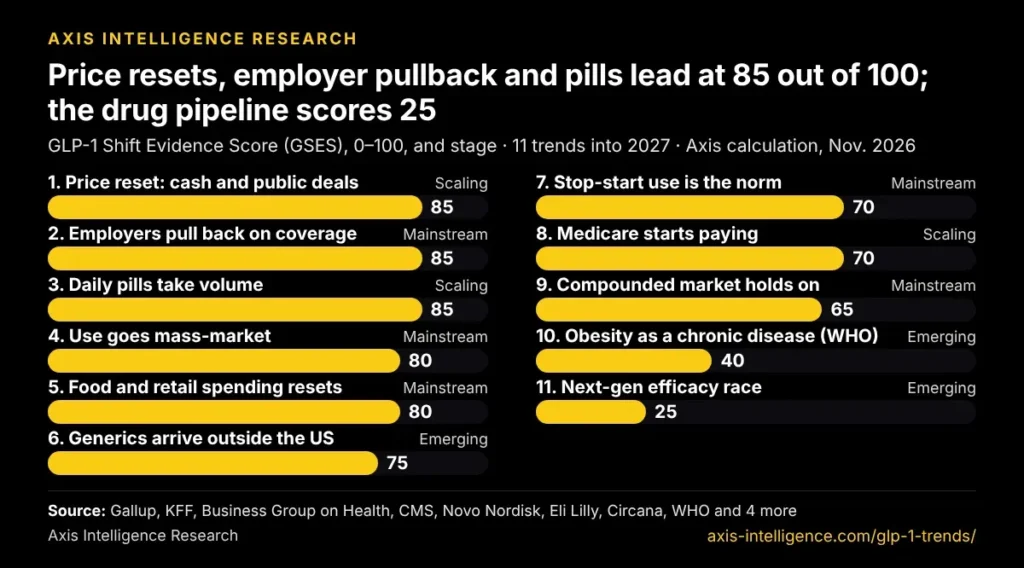
How the GLP-1 Shift Evidence Score (GSES) works. Each trend gets four sub-scores from 0 to 5, each tied to a sourced figure in the dataset: adoption (how much of the relevant population the shift has measurably reached), pace (the latest observed or contracted change in its lead indicator), maturity (from trial data to more than a year in market) and barrier clearance (5 minus one point for each documented force working against it). GSES = (adoption + pace + maturity + barrier clearance) × 5, as of November 26, 2026. Stage follows from two sub-scores: mainstream means maturity 5 and adoption 4 or higher; scaling means maturity 4 or higher and adoption 3 or higher; everything else is emerging. The full rubric is in the methodology, and every input is a row in the CSV.
Jennifer Miller, healthcare and biotechnology analyst at Axis Intelligence The strongest evidence for 2027 is about who pays and how the drug is delivered, not about new molecules. Retatrutide’s 22.6% is the most repeated number in obesity medicine this year, and it scores 25 because no patient outside a trial has received it. Employer pullback scores 85 because two surveys built on different samples, KFF’s and Business Group on Health’s, show it falling by double digits in the same year. If your 2027 plan is built around the pipeline, rebuild it around the payer mix.
How many Americans take GLP-1s going into 2027?
11% of US adults were currently taking a GLP-1 for weight loss in 2026, and 15% had ever taken one (Gallup, n=5,065, fieldwork May 28–June 5, 2026). Current use was 3% in 2024 and 8% in 2025, so it has nearly quadrupled in two years. Awareness of the drugs reached 90%, up from 80% in 2024.
| Measure (US adults) | 2024 | 2025 | 2026 | Source |
|---|---|---|---|---|
| Currently taking a GLP-1 for weight loss | 3% | 8% | 11% | Gallup |
| Ever taken one for weight loss | 6% | 12% | 15% | Gallup |
| Currently taking one for any condition | — | 12% | — | KFF (Oct.–Nov. 2025) |
| Households with a current user | — | — | 30% | Circana (2026 survey) |
Three surveys measure three different things. Gallup asks about weight-loss use only; the KFF Health Tracking Poll (published November 14, 2025) counts any indication and found 12% currently taking a GLP-1, including 45% of adults ever diagnosed with diabetes and 9% of adults 65 and older. Circana counts households, so its 30% is naturally higher than any per-person figure: one user anywhere in the home counts.
Gallup also tracks a self-reported adult obesity rate that peaked at 39.9% in 2022 and stands at 36.4% in its 2026 table (the article’s text gives 36.8%). The decline runs alongside rising GLP-1 use, but a self-reported BMI series cannot by itself show that the drugs caused it. Prescriptions point the same way: total US prescriptions for incretin drugs (GLP-1s and GLP-1/GIP dual agonists) grew 32% in Q3 2026 from a year earlier, according to IQVIA data in Lilly’s Q3 2026 earnings materials (October 29, 2026). Revenue and prescription volumes behind this use are tracked in our GLP-1 market statistics.
Jennifer Miller, healthcare and biotechnology analyst at Axis Intelligence Gallup and KFF ask different questions seven months apart and land one point apart, 11% and 12%. Two probability samples agreeing that closely is rare in this field, so I treat “about one adult in nine” as settled for 2027 planning. The figure I would not put in a headline yet is the obesity rate: Gallup’s own text and table disagree, and nothing in a BMI survey separates a drug effect from everything else that changed after 2022.
Are GLP-1 pills replacing injections?
The Wegovy pill reached about 3.6 million US prescriptions in Q3 2026 and more than 8 million since its January launch, which Novo Nordisk calls the strongest GLP-1 volume launch in the US (Novo Nordisk 9M 2026 report, November 4, 2026). The pill brought in DKK 5,394 million in Q3, of which DKK 4,178 million came from the US. Axis Intelligence Research calculates that Q3 pill sales were 97.1% above the average of the first two quarters (9M sales of DKK 10,868 million minus Q3 leaves DKK 5,474 million for H1).
Pills have not replaced injections, though. In the same quarter, Novo’s Wegovy injection sales were DKK 20.4 billion, close to four times the pill. The shift is in new starts and in access: a daily tablet sold through pharmacies and telehealth at cash prices reaches people a weekly pen tied to a prior authorization did not.
| Oral GLP-1 for obesity | FDA approval | Weight loss in pivotal trial | Latest commercial data |
|---|---|---|---|
| Wegovy pill (oral semaglutide 25 mg) | Dec. 22, 2025 | 13.6% at 64 weeks, all participants; 16.6% for those who stayed on treatment (OASIS 4) | ~3.6M US prescriptions in Q3 2026 (Novo Nordisk) |
| Foundayo (orforglipron) | April 1, 2026 | 12.4% at the highest dose for those who stayed on treatment (ATTAIN-1) | $184M revenue in Q3 2026 (Lilly) |
Foundayo, Lilly’s small-molecule pill, can be taken any time of day without food or water restrictions and launched at a self-pay price starting at $149 a month for the lowest dose (Lilly, April 1, 2026); By the end of Q3 2026 it had launched in the UAE, Mexico, Saudi Arabia and the UK and was under review in more than 40 countries, with $281 million in revenue over the first nine months (Lilly Q3 2026 release and earnings slides). Novo expects the Wegovy pill to be available in more than 20 markets in 2027. Company-level figures are in our Novo Nordisk statistics and Eli Lilly statistics.
Will GLP-1s get cheaper in 2027?
Yes for most payers: Novo Nordisk’s US list price for Wegovy, Ozempic and Rybelsus drops to $675 a month on January 1, 2027, a cut of about 50% for Wegovy and 35% for Ozempic (Novo Nordisk, February 24, 2026). The same month, Medicare’s negotiated price for semaglutide, $274 for a 30-day supply, takes effect (KFF, November 26, 2025). Novo says the list cut does not change its direct-to-patient self-pay prices.
To show how far apart the 2027 price points are, Axis Intelligence Research set each one against the $675 list price:
| 2027 price point (monthly) | Price | Share of the $675 list | Source |
|---|---|---|---|
| Wegovy/Ozempic list price from Jan. 1, 2027 | $675 | 100% | Novo Nordisk |
| Medicare negotiated price, semaglutide (from Jan. 2027) | $274 | 40.6% | CMS, via KFF |
| Medicare price under the administration’s deal with Novo (Bridge) | $245 | 36.3% | KFF |
| Lowest self-pay entry price for a branded obesity pill (Foundayo, lowest dose) | $149 | 22.1% | Lilly |
| Medicare GLP-1 Bridge copay paid by the beneficiary | $50 | 7.4% | KFF |
Axis calculation: price ÷ $675. The $149 row is a different molecule (orforglipron) and the lowest dose; it shows where the cash market now opens, not a like-for-like semaglutide price.
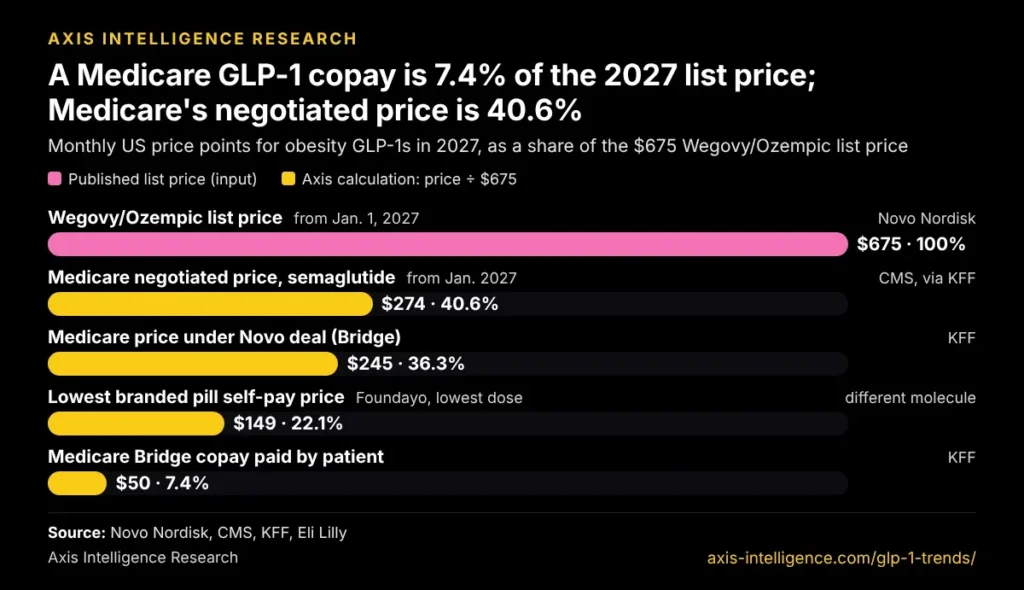
Prices are already falling where they are measured. Lilly reported a 15% drop in realized prices worldwide in Q3 2026 against a 53% rise in volume; in the US, prices fell 7% while volume rose 41%, mainly on Zepbound (Lilly, October 29, 2026). The cash channel is already large. About 35% of Novo’s US Wegovy injection fills in Q3 2026 went through the self-pay channel via retail and telehealth (Novo Nordisk, November 4, 2026). Affordability is still the main complaint: 56% of GLP-1 users told KFF in late 2025 that the drugs were difficult to afford. Dose-by-dose cash prices and first-year costs are in our analysis of what GLP-1s cost without insurance.
Jennifer Miller, healthcare and biotechnology analyst at Axis Intelligence A $675 list price mostly helps people whose coinsurance or deductible is calculated from list, and Novo itself says self-pay prices do not move. The number that changes behavior is further down the ladder: a branded pill that opens at 22.1% of list and a Medicare copay at 7.4%. When a patient’s own price is that low, adherence depends less on cost and more on tolerability, which is where the stop-start data below starts to matter.
Are employers dropping GLP-1 coverage for 2027?
Among US firms with 5,000 or more workers, 33% covered GLP-1s for weight loss in 2026, down from 43% in 2025 (KFF Employer Health Benefits Survey, 1,937 firms, published October 22, 2026). Across all firms with 200 or more workers, coverage was 18%, against 19% a year earlier. Of the larger firms that do not cover the drugs, 12% stopped in the last 12 months and 79% say they are not likely to start in the next year.
| Survey | Population | 2025 | 2026 | Looking to 2027 |
|---|---|---|---|---|
| KFF EHBS | Firms with 5,000+ workers | 43% | 33% | — |
| KFF EHBS | Firms with 200+ workers | 19% | 18% | 79% of non-covering firms not likely to start |
| Business Group on Health | Large employer members | 72% | 60% | 14% have dropped or plan to drop coverage in 2027 |
The firms that keep coverage are adding conditions. KFF finds 40% of covering firms, and 59% of those with 5,000 or more workers, require a meeting with a dietitian, case manager or therapist, or a lifestyle program. Business Group on Health reports that 69% of its members validate eligibility with biometrics. For 61% of the largest covering firms, KFF says the drugs had a “significant” impact on prescription drug spending. Premium context is in our health insurance cost breakdown and our healthcare costs statistics.
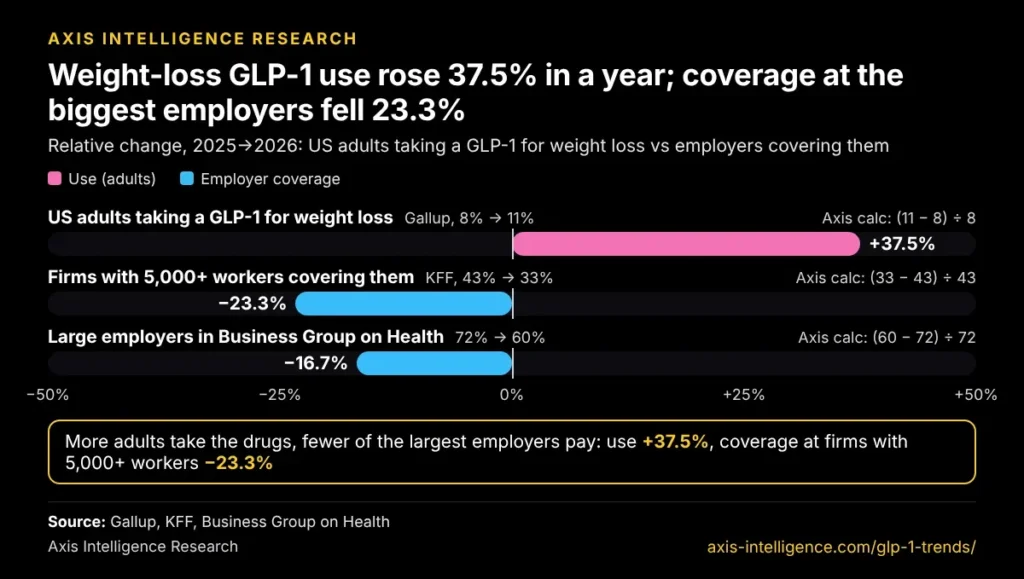
Jennifer Miller, healthcare and biotechnology analyst at Axis Intelligence KFF’s 33% and Business Group on Health’s 60% do not contradict each other. Business Group on Health surveys its own members, large and mostly self-funded employers that cover more of everything; KFF samples firms nationally. Trust KFF for the national rate and Business Group on Health for what the most generous plans are doing. Both fell by double digits in the same year, and that direction is what a benefits team should plan around for 2027.
Will Medicare cover GLP-1s for weight loss in 2027?
Yes, through a temporary program: the Medicare GLP-1 Bridge covers selected obesity GLP-1s for eligible Part D enrollees from July 1, 2026 to December 31, 2027 (CMS, page updated September 29, 2026), with a $50 copay (KFF, April 23, 2026). The BALANCE model, meant to move that coverage into Part D plans, will not launch in Medicare in 2027; KFF reports that plan sponsor interest fell short of CMS’s target. Its Medicaid track lets state agencies join from May 2026 through January 1, 2027.
Uptake was fast. Lilly’s own Bridge prescriptions rose from about 222,000 in July 2026 to 396,000 in August and 527,000 in September, more than 500,000 patients were getting a Lilly obesity medicine through the Bridge, 80% of them new to incretin drugs, and 7 in 10 new Bridge patients chose a Lilly product (Lilly Q3 2026 earnings slides, company and IQVIA data). Axis Intelligence Research calculates that Lilly’s monthly Bridge volume grew 33.1% from August to September and totaled about 1.15 million prescriptions in the first three months. These are one manufacturer’s figures; adding Novo Nordisk’s Wegovy volume would raise them.
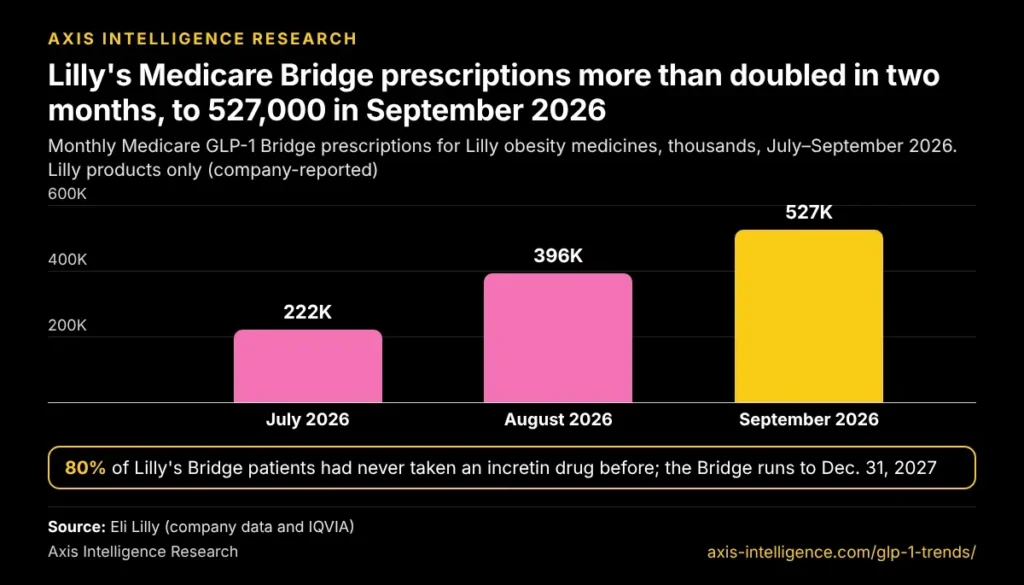
This is the first time Medicare has paid for obesity drugs. Before the Bridge, only 9% of adults 65 and older reported currently taking a GLP-1 for any condition (KFF, late 2025), against 22% of adults 50 to 64. Covering obesity drugs under Part D has been estimated at $25 billion to $35 billion over 10 years; CMS has not published its own projection. Coverage rules for older adults sit alongside the rest of our US health insurance statistics.
Jennifer Miller, healthcare and biotechnology analyst at Axis Intelligence The Bridge’s most important number is 80%: four in five of Lilly’s Bridge patients had never taken an incretin. That is new demand the program created, not commercial patients changing payer, and the September volume was still climbing. The risk is the calendar. The Bridge is a demonstration that ends December 31, 2027, so every one of those starts is a patient whose coverage in 2028 depends on a CMS decision not yet made.
Where is generic semaglutide available?
Generic semaglutide is on sale in India and Canada, not in the US. India’s key semaglutide patents expired on March 20, 2026, and NATCO launched vials the same day at ₹1,290 to ₹1,750 a month, which it describes as nearly 90% below the originator (Business Today, March 20, 2026). Health Canada approved the first generic in the G7, from Dr. Reddy’s, on April 28, 2026, with eight more submissions under review (Health Canada); its third approval, on June 29, 2026, was the first generic for weight loss.
| Market | First generic | Status | Price signal |
|---|---|---|---|
| India | March 20, 2026 (patent expiry) | Multiple Indian makers launched | NATCO vials from ₹1,290/month |
| Canada | April 28, 2026 (Dr. Reddy’s); May 1 (Apotex) | 3 approvals by June 29, 2026, including one for weight loss | Apotex said about one-third of Ozempic’s price (company statement reported by Global News) |
| United States | None | No approved generic | Brand prices only |
Novo Nordisk confirms the effect in its accounts: loss of exclusivity in Canada has lowered realized prices, and Wegovy prices fell mainly in China after list price cuts in late 2025 (9M 2026 report).
Are compounded GLP-1s going away?
No. 18% of current weight-loss users took a compounded or custom-mixed version in 2026, against 66% on brand-name drugs and 13% unsure (Gallup text; its table rounds to 19%, 68% and 12%). Movement runs toward compounded products: 36% of compounded users had switched from a brand, while 11% of brand users had switched from compounded. Among brand-to-compounded switchers, 53% cited cost or insurance as the main reason.
The FDA has answered with enforcement on marketing rather than a ban: 30 warning letters to telehealth companies in March 2026 and 25 more in June, mostly for claims implying compounded products are the same as approved drugs (Bloomberg Law, June 16, 2026). How these products reach buyers is covered in our online pharmacy statistics and telehealth statistics.
Do people stay on GLP-1s?
About 4 in 10 people stopped their GLP-1 within the first year and nearly 6 in 10 within two years, in insurance claims for more than 60,000 US adults with type 2 diabetes (Endocrine Society, ENDO 2026, June 14, 2026; Komodo Health data, January 2019 to June 2025). Many come back: the release reports restart rates of 41.5% within one year and 58% within two among those who stopped. People on tirzepatide were 41% less likely to discontinue than those on older drugs; Medicaid and Medicare enrollees, Black patients and people with gastrointestinal side effects were more likely to stop.
| Evidence | Population | Finding | Source |
|---|---|---|---|
| ENDO 2026 claims study | 60,000+ adults with type 2 diabetes | ~4 in 10 stop in year 1; nearly 6 in 10 by year 2 | Endocrine Society |
| KFF Health Tracking Poll | US adults, Oct.–Nov. 2025 | 14% of users stopped because of cost; 13% because of side effects | KFF |
| Cleveland Clinic cohort | 7,938 adults in Ohio and Florida who stopped injectable semaglutide or tirzepatide within 3–12 months | Within a year: 27% switched to another drug, 20% restarted, 14% moved to lifestyle visits, under 1% had bariatric surgery | Cleveland Clinic, March 12, 2026 |
Stopping did not mean losing the benefit on average. In the Cleveland Clinic cohort, people treated for obesity had lost 8.4% of body weight before stopping and regained 0.5% a year later, with 45% stable or still losing; researchers attribute the small regain to restarts and switches, and name cost or insurance limits as the main reason for stopping. For a plan actuary, this changes the unit of cost: a member is less likely to be a continuous 12-month claimant than a series of treatment episodes. The ENDO figures cover adults with type 2 diabetes only; no comparable claims release for people treated for weight alone was among the sources opened for this edition.
How are GLP-1s changing what people buy?
Households cut grocery spending by an average of 5.3% within six months of starting a GLP-1, by more than 8% in higher-income households, and spending at fast-food and coffee chains fell about 8% (Cornell University, Journal of Marketing Research, December 18, 2025; Numerator panel of about 150,000 households). Savory snacks fell about 10%; yogurt, fresh fruit, nutrition bars and meat snacks rose.
Circana’s two-year view points the other way (Circana, November 10, 2026). 37% of surveyed US households report that someone has used a GLP-1 (17% in 2024) and 30% report a current user. Against non-user households, and relative to their own pre-treatment baseline:
| Spending index change for GLP-1 households (points vs pre-treatment baseline) | Year 1 | Year 2 |
|---|---|---|
| Restaurants | −4.3 | within 0.5 |
| Retail food and beverage | — | −1.9 |
| Candy | — | +5.7 |
| Frozen dessert | — | +5.3 |
| Apparel | +2.9 | +6.4 |
| Wearables and health technology | +4.9 | +15.2 |
Index points relative to non-user households, not percentage changes in spending (Circana purchase data, August 2023–July 2026).
Circana projects that households with a GLP-1 user could account for 40% of US food and beverage units purchased by 2030, assuming 35% to 40% of households have an active user by then. The jump in wearables spending connects to the device data in our consumer health tech adoption statistics.
Jennifer Miller, healthcare and biotechnology analyst at Axis Intelligence Cornell measures each household against its own spending and matched non-users in the first six months; Circana reports index points against non-users over two years. Both can hold: a sharp early cut, then a partial return. Use Cornell’s 5.3% to model a new user’s first year and Circana’s year-two gap for category planning. Neither supports a permanent collapse in snack demand.
Jennifer Miller, healthcare and biotechnology analyst at Axis Intelligence Candy spending in GLP-1 households sat 5.7 points above baseline in year two, the most counterintuitive number on this page. The appetite effect is strongest in the first months; by year two, a household has often lowered a dose, paused treatment or simply adapted. For a food maker, volume risk sits in first-year households, and the Medicare Bridge and the cheaper pills are adding new ones in 2027.
What comes after Wegovy and Zepbound?
Retatrutide, Lilly’s triple GIP, GLP-1 and glucagon agonist, produced average weight loss of up to 22.6% at 80 weeks in adults with severe obesity and cardiovascular disease, and Lilly plans to file it with the FDA in Q1 2027 (Lilly, July 23, 2026). In adults with type 2 diabetes, the highest dose reached 20.8%. Novo Nordisk lists a US decision on CagriSema (cagrilintide plus semaglutide) for Q4 2026 and is preparing a launch in early 2027, subject to approval (9M 2026 report). Novo also launched a 7.2 mg Wegovy pen in the UK in June 2026.
| Candidate | Company | Mechanism | Best reported weight loss | Next regulatory step |
|---|---|---|---|---|
| Retatrutide | Lilly | GIP/GLP-1/glucagon | 22.6% at 80 weeks (TRIUMPH-3, 12 mg) | FDA filing planned Q1 2027 |
| CagriSema | Novo Nordisk | Amylin + GLP-1 | 22.7% at 68 weeks for those on treatment; 20.4% for all participants (REDEFINE 1) | US decision listed for Q4 2026 |
These are trial results under controlled conditions; the persistence data above shows how far real-world use can sit from a trial protocol. Wider pipeline context is in our biotechnology statistics.
Outside the US, the World Health Organization issued its first guideline on GLP-1s for obesity on December 1, 2025, with a conditional recommendation for long-term use in adults, excluding pregnancy (WHO). WHO projects the drugs will reach fewer than 10% of the people who could benefit by 2030. One expected expansion did not happen: in the phase 3 evoke and evoke+ trials, oral semaglutide did not slow Alzheimer’s disease progression (Novo Nordisk, November 24, 2025), which keeps neurology on the watch list.
What could change this outlook in 2027?
| Date | Event | What it would change |
|---|---|---|
| Q4 2026 to early 2027 | FDA decision on CagriSema | A third obesity mechanism on the US market; trend 11 moves from filed to in market |
| Jan. 1, 2027 | $675 list price for Wegovy, Ozempic and Rybelsus; $274 Medicare negotiated price | First quarter in which list and Medicare prices both reset (trend 1) |
| Q1 2027 | Retatrutide FDA filing (Lilly) | Starts the review clock for the highest-efficacy candidate |
| 2027 plan year | Employer renewals; 14% of Business Group on Health members have dropped or plan to drop coverage | Tests whether the 2026 pullback deepens (trend 2) |
| During 2027 | Health Canada decisions on pending generic semaglutide filings | More generics typically lower Canadian prices further (trend 6) |
| Dec. 31, 2027 | Medicare GLP-1 Bridge ends unless extended; BALANCE has no Medicare start date | Medicare coverage could lapse or become permanent (trend 9) |
Two risks could reverse the ranking: a safety signal tied to long-term or high-dose use, which WHO cites as a reason its recommendation is conditional, and an FDA move on compounding that removes the low-price alternative for the 18% of users who rely on it.
GLP-1s in 2027: what benefits, retail and policy teams ask
Is everyone on a GLP-1 now?
No, but the share is large and rising. 11% of US adults were taking a GLP-1 for weight loss in mid-2026, up from 3% in 2024 (Gallup), and 30% of US households report a current user (Circana, November 2026). The household figure is higher because a single user anywhere in the home counts.
Will the $675 list price lower what our health plan pays for Wegovy in 2027?
Not necessarily. Novo Nordisk’s list price cut takes effect January 1, 2027, and mainly lowers out-of-pocket costs for members whose coinsurance or deductible is based on list price. What a plan pays depends on its net price after rebates, which list price changes do not set on their own.
Which countries have generic semaglutide?
India and Canada, as of November 2026. India’s patents expired March 20, 2026, with generics launched the same day from ₹1,290 a month, and Health Canada approved the first G7 generic on April 28, 2026. There is no approved generic semaglutide in the United States.
How should a food brand read the 5.3% drop in grocery spending?
As a first-year effect. Cornell found a 5.3% cut within six months of starting a GLP-1 (December 2025), while Circana found GLP-1 households’ food and beverage index only 1.9 points below baseline in year two and restaurant spending back near baseline (November 2026). Model the dip on new users, not on the whole user base.
Does Medicare pay for weight-loss GLP-1s?
Yes, temporarily. The Medicare GLP-1 Bridge covers selected obesity GLP-1s for eligible Part D enrollees with a $50 copay from July 1, 2026 to December 31, 2027 (CMS, KFF). Lilly alone filled about 527,000 Bridge prescriptions in September 2026. The permanent BALANCE model will not launch in Medicare in 2027.
When could retatrutide reach US patients?
Not before an FDA review that has yet to begin. Lilly plans to file retatrutide with the FDA in Q1 2027 after phase 3 results showing up to 22.6% average weight loss at 80 weeks (July 23, 2026). A US launch depends on the length and outcome of that review.
Methodology {#methodology}
This edition, written for Axis Intelligence’s Industry Outlooks, uses figures opened on November 26, 2026 at their producers: Gallup’s 2026 Health and Well-Being Index release; KFF’s November 2025 Health Tracking Poll, 2026 Employer Health Benefits Survey and Medicare analyses; Business Group on Health; CMS; Novo Nordisk’s 9M 2026 report (SEC Form 6-K) and February 24, 2026 price release; Lilly’s April 1, July 23 and October 29, 2026 releases and Q3 2026 earnings call slides; Health Canada; the WHO; the Endocrine Society; Cleveland Clinic; Cornell University; and Circana. Two facts first reported by the press are attributed to the outlet: NATCO’s Indian launch price (Business Today) and the FDA’s June 2026 warning letters (Bloomberg Law). Survey figures are self-reported; company figures, including Lilly’s Medicare Bridge counts, are company-reported.
GLP-1 Shift Evidence Score (GSES). GSES = (A + P + T + B) × 5, range 0–100, as of November 26, 2026.
- A, adoption (0–5): 5 = reached 10% or more of the relevant population in a probability survey, company filing or claims/panel data on 50,000+ people; 4 = 1 million or more people or prescriptions measured; 3 = measured below those thresholds; 2 = approvals, launches or policies without adoption data; 1 = trial data only; 0 = announcements only.
- P, pace (0–5): latest observed or contracted change in the trend’s lead indicator, in the trend’s direction: 5 = 50% or more (or growth from zero); 4 = 20–49%; 3 = 5–19%; 2 = under 5%; 1 = moving the opposite way; 0 = no time series.
- T, maturity (0–5): 5 = in market or in effect for more than 12 months; 4 = in market for less than 12 months; 3 = scheduled for a fixed 2027 date; 2 = filed or under review; 1 = phase 3 data; 0 = earlier.
- B, barrier clearance (0–5): 5 minus one point for each documented force working against the trend (cost, coverage, regulation or law, supply, tolerability or persistence, evidence gaps).
Ties are listed by adoption, then pace. The CSV gives each sub-score with its evidence. Price shares are Axis calculations (price ÷ $675); relative changes are (2026 − 2025) ÷ 2025.
Grade-back: the 2028 edition of this page will compare each 2027 signal above with what happened, before setting new scores.
Dataset: glp-1-trends.csv — every figure, sub-score and calculation on this page, CC BY 4.0.
Cite this page: Axis Intelligence Research, “GLP-1 Trends 2027: Use Reaches 11% of US Adults as Pills, Price Cuts and Employer Pullbacks Redraw Access”, data as of November 26, 2026, https://axis-intelligence.com/glp-1-trends/ [Copy]
This analysis describes data. It is not medical advice. Next review: after Gallup’s 2027 GLP-1 release or the January 1, 2027 price changes, whichever comes first.