


Mobile Gaming Trends 2027
By Axis Intelligence Research
Co-authors: Noah Mc | Last updated: November 27, 2026 | License: CC BY 4.0
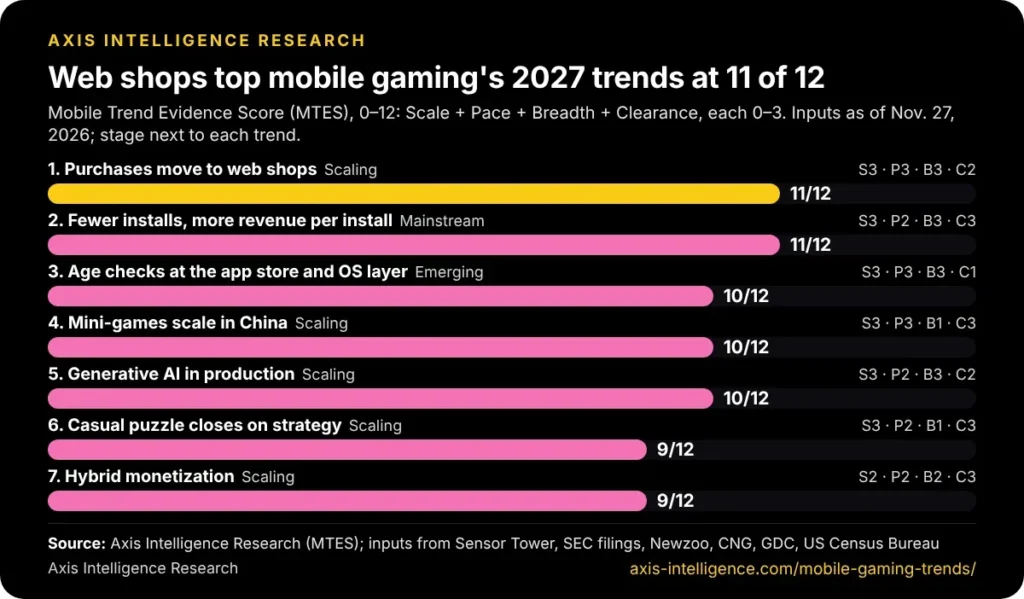
The strongest mobile gaming trend for 2027 is spending moving off the app stores. Playtika booked 40.8% of its Q3 2026 revenue through its own payment channels, up from 31.0% a year earlier (Axis Intelligence Research calculation from Playtika’s Q3 2026 earnings release filed with the SEC), while store-tracked mobile game in-app purchase (IAP) revenue slipped 2% to $39.8 billion in H1 2026, according to Sensor Tower’s H1 2026 Gaming Digital Market Index. Axis Intelligence Research graded seven shifts on the Mobile Trend Evidence Score (MTES), a 0–12 measure of how much hard 2026 evidence stands behind each one.
| Rank | Trend for 2027 | MTES (/12) | Strongest dated evidence | Stage | Who it hits first | Signal to watch in 2027 |
|---|---|---|---|---|---|---|
| 1 | Purchases move to web shops and direct payment | 11 | Playtika D2C at 40.8% of revenue, Q3 2026 (31.0% in Q3 2025) — SEC filings | Scaling | Casino, casual and RPG publishers; Apple; Google | Supreme Court argument in Apple v. Epic, January 11, 2027 |
| 2 | Fewer installs, more revenue per install | 11 | Downloads −12% to 24 billion, IAP −2%, playtime flat at 221 billion hours, H1 2026 — Sensor Tower | Mainstream | UA teams, ad networks, live-ops teams | Sensor Tower’s full-year 2026 download count (January 2027) |
| 3 | Age checks move to the app store and OS layer | 10 | State laws covering 21.8% of US residents by May 2027 — Axis calculation from Census data | Emerging | Every US publisher with minors in its audience | California’s Digital Age Assurance Act, operative January 1, 2027 |
| 4 | Mini-games scale in China | 10 | RMB 31.657 billion in H1 2026, +36.01% — China Game Industry Report | Scaling in China, emerging elsewhere | Chinese publishers, WeChat and Douyin ecosystems | Full-year 2026 China Game Industry Report (December) |
| 5 | Generative AI moves into production work | 10 | 40% of game professionals use gen AI at work (36% a year earlier); 70% of mobile-only studio workers — GDC, November 2026 | Scaling | Art, code, marketing and live-ops teams at mobile and free-to-play studios | GDC Festival of Gaming, March 1–4, 2027 |
| 6 | Casual puzzle closes on strategy | 9 | Puzzle IAP +17% to over $4 billion vs strategy at $4.4 billion, Q2 2026 — Sensor Tower | Scaling | 4X studios, casual publishers | The first quarter in which puzzle out-earns strategy |
| 7 | Hybrid monetization: ads and purchases in the same game | 9 | Hybridcasual IAP +23% to $2.4 billion, H1 2026 — Sensor Tower; ads 33.2% of China mini-game revenue | Scaling | Hybridcasual studios, ad mediation | Sensor Tower’s full-year 2026 gaming ad data |
Noah Mc, Gaming Specialist at Axis Intelligence Store charts are now underreporting the healthiest part of the business. Playtika’s total revenue was flat year over year in Q3 2026 while its direct-to-consumer line grew 31.4%, so a tracker that sees only App Store and Google Play receipts would have shown a shrinking publisher. For 2027 planning, I would treat any store-only revenue estimate for a casino or casual title as a floor, not a total.
Key stats
- DoubleDown Interactive’s direct-to-consumer share reached 58.0% of social casino revenue in Q3 2026, up from 20.9% a year earlier, per its Form 6-K filed November 11, 2026.
- Store revenue per download rose about 11% year over year in H1 2026, to roughly $1.66 from $1.49, by Axis Intelligence Research’s calculation from Sensor Tower data.
- Apple told the Supreme Court on August 12, 2026 that it is charging no commission on link-out purchases from US iOS apps while the case is pending.
- China’s mini-game revenue equaled 23.4% of its mobile game revenue in H1 2026, by Axis Intelligence Research’s calculation from the China Game Industry Report.
How did Axis score the 2027 trends?
The Mobile Trend Evidence Score (MTES) grades each trend from 0 to 12 by adding four criteria scored 0 to 3: Scale, Pace, Breadth and Clearance. Axis Intelligence Research built it so a reader can see why a trend ranks where it does and recompute it from the ledger in minutes.
MTES = Scale + Pace + Breadth + Clearance (each 0–3; inputs as of November 27, 2026)
| Criterion | 3 points | 2 points | 1 point | 0 points |
|---|---|---|---|---|
| Scale — size of the trend’s lead indicator | ≥20% of its base, or ≥$10 billion a year | 5–20%, or $1–10 billion | Measured but smaller | Not measured |
| Pace — latest year-over-year change in that indicator | ≥ +25%, or ≥ +10 share points | +10% to +25%, or +3 to +10 points | 0 to +10%, or under +3 points | Flat, falling or not measured |
| Breadth — independent primary producers showing the shift in 2026 | 3 or more | 2 | 1 | Vendor claims only |
| Clearance — what could stop it in 2027 | Nothing pending | A pending decision could slow it | An active challenge could reverse it | Blocked |
| Trend | Scale | Pace | Breadth | Clearance | MTES |
|---|---|---|---|---|---|
| Purchases move to web shops | 3 (Playtika D2C 40.8%) | 3 (Playtika D2C revenue +31.4%) | 3 (Playtika, DoubleDown, Newzoo, Sensor Tower) | 2 (Supreme Court; link-out commission still open) | 11 |
| Fewer installs, more revenue per install | 3 ($39.8B half-year market) | 2 (revenue per download +11%) | 3 (Sensor Tower, Playtika, China Game Industry Report) | 3 | 11 |
| Age checks at the store and OS layer | 3 (21.8% of US residents) | 3 (+12.5 points, May 2026 to May 2027) | 3 (Texas, California, Utah laws) | 1 (Texas law still in merits litigation) | 10 |
| Mini-games scale in China | 3 (23.4% of China mobile) | 3 (+36.01%) | 1 (China Game Industry Report) | 3 | 10 |
| Generative AI in production | 3 (40% of professionals) | 2 (+4 points in a year) | 3 (GDC, Google Cloud/Harris Poll, China Game Industry Report) | 2 (55% of professionals see a negative impact) | 10 |
| Casual puzzle closes on strategy | 3 (>$4B a quarter) | 2 (+17%) | 1 (Sensor Tower) | 3 | 9 |
| Hybrid monetization | 2 ($2.4B half-year) | 2 (+23%) | 2 (Sensor Tower, China Game Industry Report) | 3 | 9 |
Ties are ordered by Pace, then Scale, then Breadth. A trend backed only by vendor announcements does not get a score; those sit in the watch list further down.
Noah Mc, Gaming Specialist at Axis Intelligence The score rewards proof, not volume of press coverage, and that changes the order most trend lists would give you. Generative AI gets the most conference airtime in mobile, yet it ranks fifth: usage rose only four points in a year and more than half the industry is pushing back, while a dull-sounding change in payment routing tops the table because two SEC filers report it every quarter.
Will more players pay outside the App Store and Google Play in 2027?
Yes: the two US-listed mobile publishers that disclose direct-to-consumer (D2C) revenue both pushed their D2C share sharply higher in Q3 2026, and the legal path for US link-outs stayed open going into 2027.
| Company (filing) | D2C metric | Q3 2025 | Q3 2026 | Change |
|---|---|---|---|---|
| Playtika (8-K, Nov 5, 2026; Q3 2025 release) | D2C revenue | $209.3M | $275.1M | +31.4% |
| Playtika | D2C share of total revenue (Axis calculation) | 31.0% | 40.8% | +9.8 points |
| DoubleDown Interactive (6-K, Nov 11, 2026) | D2C revenue | $16.6M | $44.6M | +169% (Axis calculation) |
| DoubleDown Interactive | D2C share of social casino revenue (company-reported) | 20.9% | 58.0% | +37.1 points |
Playtika’s total revenue was $673.8 million in Q3 2026 against $674.6 million a year earlier, so the D2C gain came from where players paid, not from extra spending. DoubleDown defines D2C as purchases made through company-owned channels, including web storefronts. Beyond these two filers, Newzoo’s 2026 Global Games Market Report (September 2026) found that four of the five publishers it tracks drew at least 39% of their gaming revenue directly from consumers by Q1 2026, and lists direct-to-consumer among the growth drivers of mobile revenue.
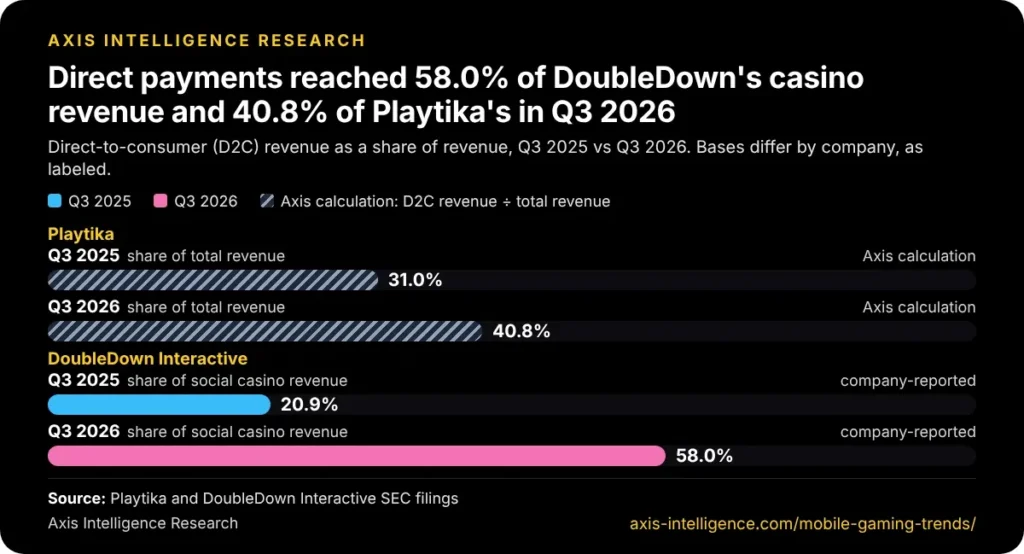
Noah Mc, Gaming Specialist at Axis Intelligence DoubleDown went from roughly a fifth to well over half of its social casino revenue in twelve months, and that is the figure on this page I would not have predicted. Social casino is the ideal test case: an older, high-spending payer base that will follow a “better value on the web” prompt. Midcore and RPG publishers should expect a slower curve, because their spenders are younger and more mobile-first, but the direction is the same.
The rules behind the shift, as of November 2026:
- Google Play. Under the fee model Google set out on March 4, 2026 and detailed on June 24, 2026, the service fee starts at 10% on a developer’s first $1 million in annual earnings whether the purchase runs through Play billing, alternative billing or an external web link. A separate 5% billing fee applies only to Play billing in the US, UK and European Economic Area, and the IAP service fee for new installs drops to 20%. The new structure started June 30, 2026 in the US, EEA and UK, and Google plans to reach the rest of the world by September 30, 2027.
- Apple, United States. Apple stated in its August 12, 2026 stay application to the Supreme Court that it is charging no commission on link-out purchases while the case proceeds. The Court denied that stay on August 13, 2026 and set oral argument for January 11, 2027, on a grant limited to the first question in Apple’s petition.
For a publisher, the open question for 2027 is not whether link-outs are allowed but what Apple may eventually charge on them. The Supreme Court is reviewing the contempt ruling; the commission rate itself remains a separate issue. Store-side fee and download data by platform are in our App Store statistics and Android statistics, and the payment-side view is in our mobile commerce statistics.
Why are mobile game downloads falling while revenue holds?
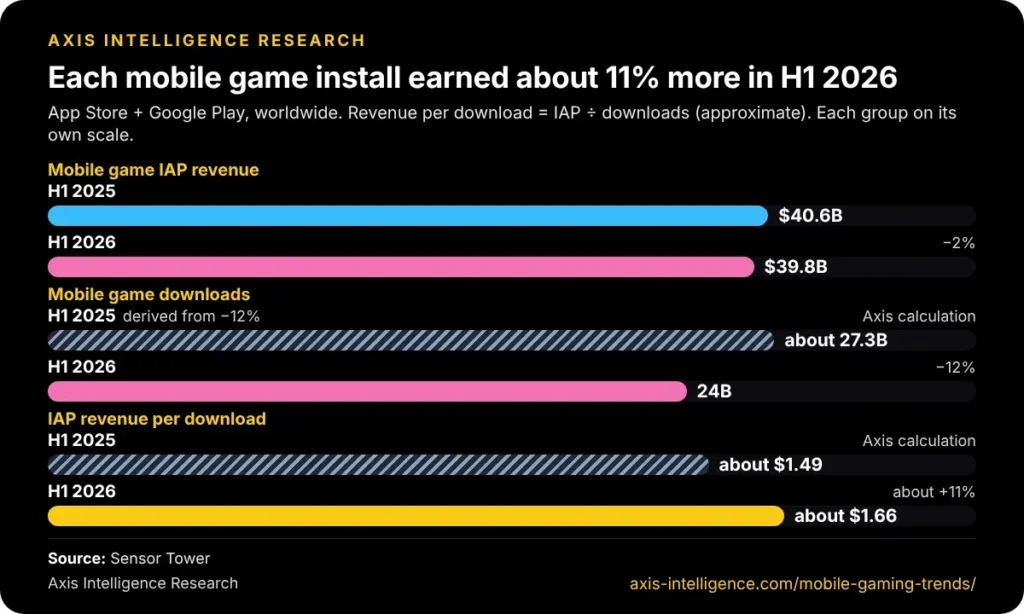
Mobile game downloads fell 12% to 24 billion in H1 2026 while store IAP revenue fell only 2%, to $39.8 billion from $40.6 billion, and playtime held at 221 billion hours, according to Sensor Tower. Each install is earning more.
| Indicator (iOS + Google Play, worldwide) | H1 2025 | H1 2026 | Change | Source |
|---|---|---|---|---|
| Mobile game IAP revenue | $40.6B | $39.8B | −2% | Sensor Tower |
| Mobile game downloads | about 27.3B (Axis, derived from −12%) | 24B | −12% | Sensor Tower |
| Playtime | — | 221B hours | flat | Sensor Tower |
| IAP revenue per download | about $1.49 | about $1.66 | about +11% | Axis calculation |
Revenue per download = IAP revenue ÷ downloads for the same half-year. Sensor Tower publishes downloads rounded to the billion, so the result is approximate.
Company filings show the same mechanism inside one portfolio. Playtika’s average daily paying users fell 5.9% year over year to 333,000 in Q3 2026, while payer conversion rose to 4.7% from 4.3% and average revenue per daily active user (ARPDAU) rose to $1.03 from $0.89. In China, the China Game Industry Report for H1 2026 counted 684 million players, up 0.82%, against domestic game revenue up 12.17%: the same pattern of a flat audience and deeper spending.
Newzoo reaches the same diagnosis from the other side of the ledger, with different numbers. Its September 2026 report forecasts mobile game revenue of $121.1 billion for 2026, up 6.8%, from 3.10 billion players, up 3.9%, and attributes the growth to deeper monetization offsetting falling downloads.
| Measure | Sensor Tower | Newzoo (2026 report) |
|---|---|---|
| Mobile game revenue | −2% (H1 2026 actual, App Store + Google Play IAP) | +6.8% to $121.1B (2026 full-year forecast) |
| Mobile game downloads | −12% to 24B (H1 2026) | −25% (H1 2026, AppTweak data cited by Newzoo) |
| Cost per install | — | +30% to $0.56 (Adjust data cited by Newzoo) |
| Mobile growth outlook | — | 4.6% a year for 2026–2029, after 8.0% a year for 2023–2026 (compound annual rates) |
Noah Mc, Gaming Specialist at Axis Intelligence The two firms agree on direction and disagree on size, and both gaps are explainable. On downloads, Sensor Tower and AppTweak run different estimation panels, so I would take Sensor Tower’s −12% for the level, because it publishes the absolute count, and treat AppTweak’s −25% as the warning that the true decline may be steeper. On revenue, an H1 store actual at −2% and a full-year forecast at +6.8% can only both hold if a large share of 2026 growth arrives outside App Store and Google Play receipts, which is exactly what Newzoo’s own note on direct-to-consumer says.
The full-year 2025 baseline, in which Sensor Tower put mobile game revenue up 1% to $82 billion despite slowing downloads, is broken down by country, platform and retention in our mobile gaming statistics. For 2027, the practical consequence is that user acquisition (UA) budgets will be judged on payer depth and day-30 value rather than install volume.
Is casual puzzle about to overtake strategy as mobile’s top-grossing genre?
Almost: puzzle IAP revenue rose 17% to more than $4 billion in Q2 2026, against $4.4 billion for strategy, according to Sensor Tower’s Q2 2026 Digital Market Index, which also found puzzle to be the only major genre with positive download growth (+1%).
That is a sharp reversal from 2025, when Sensor Tower’s annual review named strategy the only genre to gain in revenue, downloads and time spent, led by 4X titles Last War: Survival and Whiteout Survival. By H1 2026, Sensor Tower measured mid-core genres at about $20.6 billion, down roughly 7%, while casual held near $16.5 billion. In Q3, it described casual puzzle as having “strengthened their global lead” in its Q3 2026 index.
| Signal | Value | Period | Source |
|---|---|---|---|
| Puzzle IAP revenue | over $4B, +17% YoY | Q2 2026 | Sensor Tower |
| Strategy IAP revenue | $4.4B | Q2 2026 | Sensor Tower |
| Mid-core IAP revenue | about $20.6B, about −7% | H1 2026 | Sensor Tower |
| Casual IAP revenue | about $16.5B | H1 2026 | Sensor Tower |
Download charts point the same way. In June 2026, Arrows – Puzzle Escape, Arrows GO! and Block Blast! sat in the global top five by downloads behind Roblox and Free Fire. Puzzle wins installs cheaply; the 2027 test is whether live-ops calendars borrowed from 4X keep those players paying past the first month.
Are in-game ads and hybridcasual coming back?
Yes, in the form of games that mix ads and purchases: Sensor Tower measured hybridcasual IAP revenue up about 23% to $2.4 billion in H1 2026, while mid-core fell about 7%, gaming digital ad spend rose 8% to $7 billion and ad impressions rose 14% to 1.4 trillion.
China supplies the clearest measurement of the ad side. In H1 2026, according to the China Game Industry Report, ads accounted for 33.2% of mini-game revenue (RMB 10.520 billion, up 31.94%) and 33% of casual mobile game revenue (RMB 6.002 billion of RMB 18.205 billion). A third of revenue from ads is a business model, not a fallback.
The rise in ad impressions also matters on the buying side. More game advertisers bidding for the same audiences pushes up acquisition costs, which is one more reason studios want a second revenue line inside the game. Ad-funded engagement data for the largest cross-platform title are in our Roblox statistics.
How big are mini-games, and will they spread beyond China?
China’s mini-game market, meaning games that run inside super-apps such as WeChat and Douyin without a store install, earned RMB 31.657 billion in H1 2026, up 36.01%, according to the China Game Industry Report released July 30, 2026. China’s mobile game market as a whole grew 7.9% to RMB 135.21 billion over the same period.
| Indicator (China, H1 2026) | Revenue (RMB) | YoY | Share |
|---|---|---|---|
| Mobile games | 135.21B | +7.9% | — |
| Mini-games | 31.657B | +36.01% | equal to 23.4% of mobile (Axis calculation) |
| — of which purchases | 21.137B | +38.12% | 66.8% of mini-games |
| — of which ads | 10.520B | +31.94% | 33.2% of mini-games |
| Casual mobile games | 18.205B | +10.74% | 33% from ads |
Noah Mc, Gaming Specialist at Axis Intelligence The report does not say whether the mini-game line sits inside the mobile total, and that detail decides the story. If it does, mini-games supplied about 85% of China’s mobile growth in the half and the rest of the market grew around 1.5%; if it does not, China has a second channel the size of a quarter of its app-store business growing more than four times as fast. Either reading tells Western studios the same thing for 2027: no-install distribution inside a platform you do not own is where China’s growth came from.
Outside China, Axis found no producer that measures in-app instant games as a market, so the trend scores 1 on Breadth and stays “emerging” for the West.
How are game studios actually using generative AI?
Forty percent of game industry professionals now use generative AI tools in their job, up from 36% a year earlier, and mobile is where usage runs highest. GDC’s State of the Game Industry: November 2026, a survey of more than 2,600 professionals in 69 countries (margin of error ±3 points), found 70% usage among workers at mobile-only studios and 58% among those working on free-to-play games, against 32% on premium games and 29% at older indie studios.
| Group (GDC, November 2026) | Uses gen AI tools in their job | A year earlier |
|---|---|---|
| All respondents | 40% | 36% |
| Based in the US | 38% | 36% |
| Based outside the US | 44% | 37% |
| Mobile-only studio workers | 70% | — |
| Free-to-play games | 58% | — |
| Business operations or services | 63% | — |
| Premium games | 32% | — |
| Older indie studios | 29% | — |
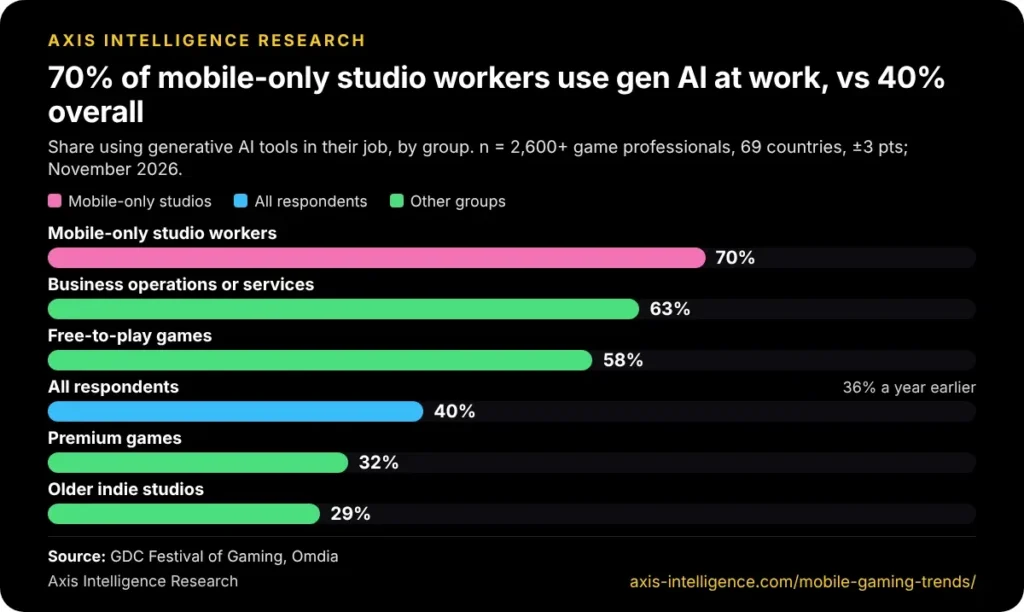
Usage and approval are moving apart. In the same survey, 55% said generative AI is having a negative impact on the game industry, against 54% in the prior edition as corrected by GDC; 35% called the impact mixed and 8% positive. GDC also reports that 27% of AAA workers are encouraged or pressured to use the tools.
A Google Cloud study run by The Harris Poll among 615 developers in the US, South Korea, Norway, Finland and Sweden, fielded June 20 to July 9, 2025, put the figure at 90% using “some form of AI” in their workflows.
| Survey | Who was asked | What was counted | Result |
|---|---|---|---|
| GDC, November 2026 | 2,600+ game industry professionals, all roles, 69 countries | Generative AI tools used as part of their job | 40% |
| Google Cloud / Harris Poll, August 2025 | 615 developers, 5 countries | Any form of AI in development workflows | 90% |
Noah Mc, Gaming Specialist at Axis Intelligence The 40% and the 90% are not measuring the same thing, and I would quote GDC’s number. “Any form of AI” sweeps in code completion and analytics tools studios have used for years, and that survey was commissioned by a company selling AI infrastructure; GDC asks about generative tools in a respondent’s own job, across every discipline. The figure that matters for mobile is GDC’s 70% at mobile-only studios: free-to-play live ops, with its constant stream of events, offers and store art, is the workload these tools absorb first, which is why mobile will set the industry’s adoption curve in 2027 while the US average barely moves.
China’s industry report states that AI has penetrated the full game value chain, but gives no usage share. Usage across other industries is tracked in our generative AI statistics and AI adoption by industry.
Which new rules will mobile games face in 2027?
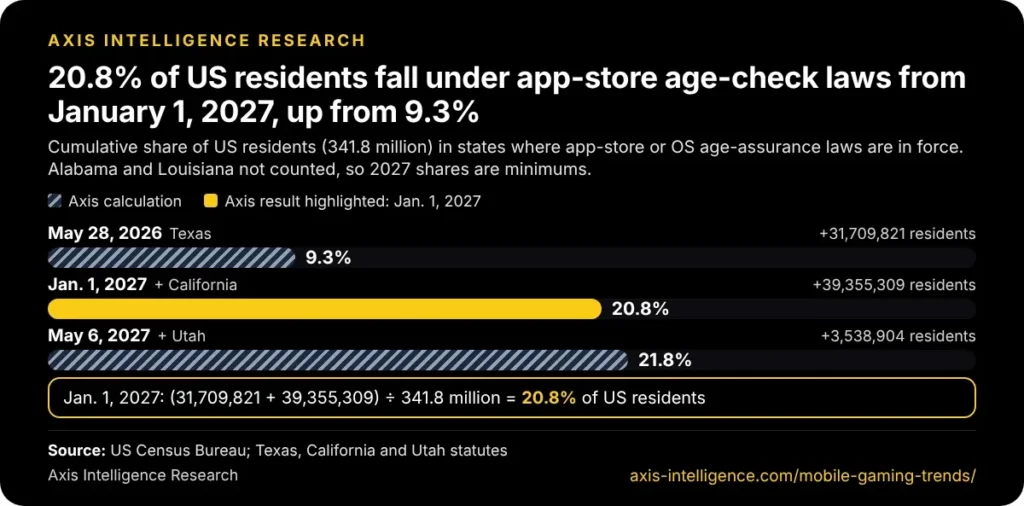
App-store and operating-system age checks become law across a fifth of the US in early 2027. By Axis Intelligence Research’s calculation from Census Bureau Vintage 2025 estimates, states with such laws in force will hold 20.8% of US residents on January 1, 2027 and 21.8% by May 6, 2027, up from 9.3% today.
| Date | Law | Status | Cumulative share of US residents (Axis) |
|---|---|---|---|
| May 28, 2026 | Texas App Store Accountability Act | In force after the Fifth Circuit stayed an injunction; merits appeal continues (Wiley) | 9.3% |
| January 1, 2027 | California Digital Age Assurance Act (AB 1043, Chapter 675), approved October 13, 2025 | Operative (Civil Code §1798.505) | 20.8% |
| January 1, 2027 | Alabama app store accountability law | Takes effect (Wiley) | not counted |
| May 6, 2027 | Utah App Store Accountability Act | Compliance deadline (Wiley) | 21.8% |
| July 1, 2027 | California AB 1043, existing devices and apps | Deadline for OS providers to add the age interface on older devices, and for apps updated since January 1, 2026 to request a signal | — |
| July 1, 2027 | Louisiana app store accountability law | Delayed to this date by H.B. 977 (Wiley) | not counted |
Share = sum of the July 1, 2025 populations of Texas (31,709,821), California (39,355,309) and Utah (3,538,904) ÷ US population of 341.8 million. Alabama and Louisiana are excluded because their Vintage 2025 counts were not verified in this session, so the true share by July 2027 is higher.
California’s law puts the operating system in charge and makes the developer act on it. OS providers must offer an interface at account setup where the account holder enters the user’s age or birth date, then send developers a signal placing the user in one of four brackets: under 13, 13 to 15, 16 to 17, or 18 and over. Developers must request that signal when the app is downloaded and launched, and once they receive it they are treated as having actual knowledge of the user’s age range across every platform the game runs on. Violations carry civil penalties of up to $2,500 per affected child for negligent violations and $7,500 for intentional ones, enforced by the state Attorney General.
Noah Mc, Gaming Specialist at Axis Intelligence The penalty is counted per affected child, and that is the line that should worry a mobile studio more than any store policy. A free-to-play title with a large teenage audience in California can no longer claim it did not know who was playing once the signal arrives, so age-gated offers, chat defaults and ad targeting need to be wired to the bracket before January 1, 2027, not after the first enforcement letter. Audience data on the youngest players are in our Gen Alpha statistics.
What looks overhyped for 2027?
These ideas get coverage but lack measured 2026 evidence, so they are not scored:
- Streaming console-grade games to phones. No producer we could verify published 2026 usage for cloud play on mobile specifically; what exists is in our cloud gaming statistics.
- AI-driven characters at runtime. The 2026 evidence is about production tools, not live features in top-grossing games.
- PC–mobile cross-play outside China. China’s industry report credits cross-device titles for part of its 2026 growth, without a separate figure; Western evidence is anecdotal. Platform context is in our PC gaming statistics.
Grade-back: Axis Intelligence Research will grade each of the seven calls against full-year data in the 2028 edition of this page, at the same URL, and open that edition with the scorecard. The wider industry picture is in our video game industry statistics and the Consumer Tech, Media & Gaming outlooks.
Mobile games in 2027: questions publishers and analysts ask
Can a US iOS game send players to a web shop without paying Apple a commission?
As of November 2026, yes. Apple told the Supreme Court on August 12, 2026 that it is charging no commission on link-out purchases while the litigation continues. The Court hears argument on January 11, 2027, and the rate Apple may eventually charge is a separate question still before the district court.
What does Google Play charge on purchases made through a game’s own website?
Under the model Google started on June 30, 2026 in the US, UK and EEA, the service fee starts at 10% on a developer’s first $1 million in annual earnings for Play billing, alternative billing and web links alike. The extra 5% billing fee applies only when the purchase runs through Google Play billing.
Do Sensor Tower’s mobile game revenue estimates include web shop sales?
No. Sensor Tower’s headline IAP figures cover purchases on the iOS App Store and Google Play, which is why its H1 2026 total of $39.8 billion falls while companies such as Playtika report their direct-to-consumer revenue rising 31.4% year over year in Q3 2026.
Are mobile game downloads still falling in 2026?
Yes. Sensor Tower counted 24 billion mobile game downloads in H1 2026, down 12% year over year, with puzzle the only major genre growing downloads in Q2 2026, at +1%.
What will California’s age law require from mobile games in 2027?
From January 1, 2027, a game must request an age-bracket signal from the operating system or app store when it is downloaded and launched, under California’s AB 1043. Once received, the signal counts as actual knowledge of the player’s age range, and violations carry civil penalties of up to $2,500 per affected child, or $7,500 if intentional.
Methodology
Every figure on this page comes from a document opened on November 26 or 27, 2026: Sensor Tower’s H1, Q2 and Q3 2026 indices and its 2025 annual reports; Playtika’s and DoubleDown Interactive’s SEC filings; Google’s Android Developers Blog; the US Supreme Court docket; the China Game Industry Report as published by Xinhua; GDC’s November 2026 State of the Game Industry; Newzoo’s 2026 Global Games Market Report (free edition); Google Cloud; the US Census Bureau; the text of California AB 1043; and a law-firm summary of other state statutes. Sensor Tower figures are estimates of App Store and Google Play activity and exclude third-party Android stores, ads and web shops. Company figures are company-reported. Yuan figures are not converted to dollars.
Axis Intelligence Research calculated: Playtika’s D2C share (D2C revenue ÷ total revenue); revenue per download (IAP ÷ downloads, with H1 2025 downloads derived from Sensor Tower’s −12%); the mini-game-to-mobile ratio; the US population share under age-assurance laws; and every MTES score, using the rules in the scoring table. All inputs are in the dataset.
Dataset: Download the CSV (mobile-gaming-trends.csv) · CC BY 4.0 for Axis calculations; third-party figures remain attributed to their producers.
Cite this page: Axis Intelligence Research, “Mobile Gaming Trends 2027: The Seven Shifts the 2026 Data Actually Supports”, data as of November 27, 2026, https://axis-intelligence.com/mobile-gaming-trends/ [Copy]