

Agentic Commerce Trends 2027
By Axis Intelligence Research
Co-authors: Sarah Davis & Sarah Mitchell | Last updated: November 28, 2026 | License: CC BY 4.0
AI agents now start far more purchases than they finish. In McKinsey’s June 2026 survey of about 21,000 consumers in 11 markets, 53% had used AI for shopping in the past three months, but only 14% of those AI users had completed a purchase through an AI tool. Salesforce data published November 19, 2026 shows the same split for personal agents: 31% of consumers have tried one, 8% have let it buy.
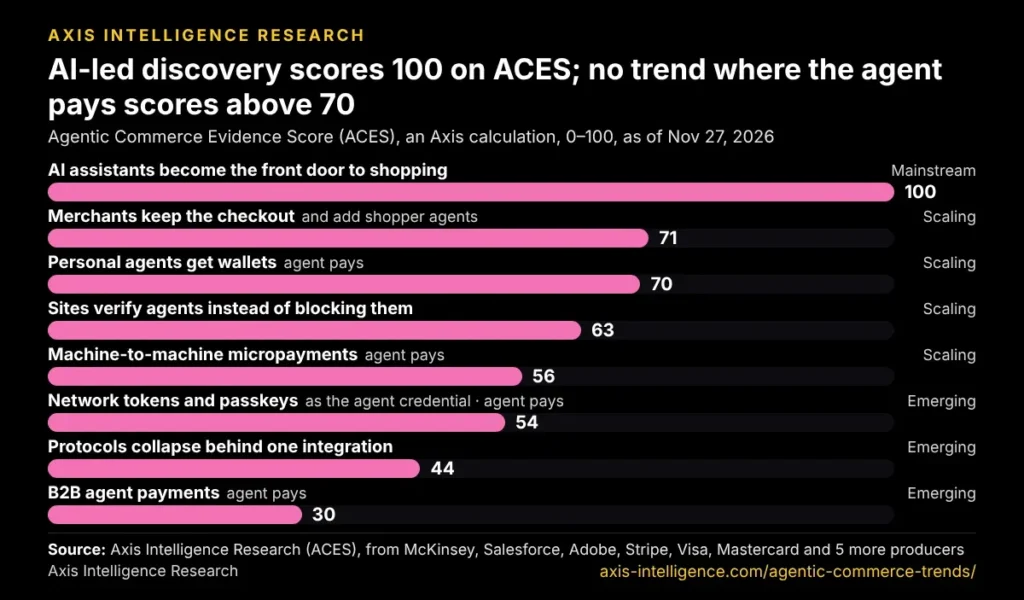
Axis Intelligence Research scored eight agentic commerce trends and one watch-list claim on the Agentic Commerce Evidence Score (ACES), a 0–100 rating of how well each 2027 trend is evidenced by measured use, measured pace, availability, and cleared barriers. AI-led product discovery scores 100. Every trend in which an agent itself moves money scores 70 or less, and B2B agent payments score 30.
Sarah Davis, Banking, Fintech & Payments co-author at Axis Intelligence The 2027 money question is not whether agents shop; it is who stays merchant of record when they do. Whoever books the sale eats the chargeback, the return and the sales tax. The one platform that took the checkout, OpenAI, handed it back to merchants within six months, and Google wrote UCP so the retailer never gives it up. Plan 2027 budgets for agents that find and recommend, then pass the payment step to a checkout the merchant already controls.
Which agentic commerce trends will matter most in 2027?
Eight trends clear the evidence bar for 2027, led by AI-led discovery (ACES 100) and merchant-controlled checkout (ACES 71), as of November 27, 2026. The table ranks them by the score; the stage follows from it.
| # | Trend | ACES | Stage | Strongest dated evidence | Who it affects | Signal to watch in 2027 |
|---|---|---|---|---|---|---|
| 1 | AI assistants become the front door to shopping | 100 | Mainstream | 53% of consumers used AI for shopping (McKinsey, June 2026); AI-driven traffic to US retail sites +127% YoY in August 2026 (Adobe) | Brands, retail media, search teams | AI-referred share of retail sessions in Adobe’s 2027 data |
| 2 | Merchants keep the checkout and add their own shopper agents | 71 | Scaling | OpenAI lets merchants use their own checkout (Mar 24, 2026); retailer stays seller of record in Google’s UCP checkout (Jan 11 and May 20, 2026) | Retailers, PSPs, marketplaces | UCP checkout rollout to Canada, Australia and the UK |
| 3 | Personal agents get wallets | 70 | Scaling | Agentic purchases on Stripe’s Link up 38x in a month (Sep 29, 2026); 8% of consumers have had a personal agent buy (Salesforce, Nov 19, 2026) | Issuers, wallets, consumers | Share of consumers letting an agent pay in Salesforce’s 2027 holiday data |
| 4 | Sites verify agents instead of blocking them | 63 | Scaling | Ninth Circuit vacates Amazon’s injunction against Perplexity (Aug 4, 2026); Personal Agent Protocol 1.0 live on every Shopify store (Nov 13, 2026) | Marketplaces, bot management, legal teams | Outcome of the remand in Amazon v. Perplexity |
| 5 | Machine-to-machine micropayments | 56 | Scaling | 138 million+ x402 transactions on Base (Chainalysis, Oct 14, 2026); agents only 0.6%–7.5% of screened x402 value (TRM Labs, Sep 9, 2026) | API sellers, stablecoin issuers | Value, not count, of agent-attributed payments |
| 6 | Network tokens and passkeys become the agent’s credential | 54 | Emerging | Live agentic transactions with 30+ European issuers, all passkey-authenticated (Visa, Jul 2, 2026) | Issuers, acquirers | First network disclosure of agent-initiated volume |
| 7 | Protocols collapse behind one integration | 44 | Emerging | Visa Intelligent Commerce Connect accepts TAP, MPP, ACP and UCP in one integration, in pilot (Apr 8, 2026) | PSPs, commerce platforms | Merchants live on Connect after the pilot |
| 8 | B2B agent payments | 30 | Emerging | First live pilot of agents paying supplier invoices (Visa, BILL, Billtrust, Oct 20, 2026) | AP/AR teams, B2B networks | Any disclosed pilot volume |
| W | Set-and-forget purchasing with no human approval | 8 | Watch list | No live consumer flow documented; Muse via Link asks the shopper to approve each total (Stripe, Sep 8, 2026) | Consumers, issuers | A mainstream agent that pays without per-purchase approval |
How is each trend scored?
ACES = Adoption + Pace + Availability + Barrier clearance, each 0–25, computed by Axis Intelligence Research from the sourced rows in the dataset.
| Component | 25 | 15 | 8 | 0 |
|---|---|---|---|---|
| Adoption (A) | ≥10% of the relevant population measured by an independent producer or representative survey, or ≥$10B measured annual value | Measured share of 1–10%, or $100M–$10B | Measured below 1% or <$100M, or company-reported live transactions without volume | Announcements only |
| Pace (P) | Trend’s own indicator more than doubled in its latest comparable period | Grew 25–100% (scored 18) · grew under 25% (scored 12) | No measured series; 2026 launches only (scored 6) | Declined |
| Availability (V) | Generally available on mainstream consumer surfaces or rails in at least one major market | Live but limited to select merchants, partners or developer ecosystems | Pilot | Specification or announcement |
| Barrier clearance (B) | Main barrier documented as cleared | Barrier identified, remedy live or rolling out | Barrier identified, no remedy live | Blocking event in force |
Stages: mainstream ≥85, scaling 55–84, emerging 30–54, watch list under 30. A score rates the evidence, not the dollar size: machine micropayments outscore network tokens because onchain rails are measured by three analytics firms, while the card networks have published no agent-initiated volume.
Sarah Davis, Banking, Fintech & Payments co-author at Axis Intelligence The scores line up with who publishes data. Discovery gets a full 100 because McKinsey, Adobe and Salesforce all measure it; tokens sit at 54 even though Visa and Mastercard have the most volume capacity in the market, because neither has released an agent-initiated transaction count. For an issuer, the first quarterly number from either network is the event that moves trend 6 up a stage, and I would not size a 2027 agentic P&L line before it exists.
How much shopping now starts with an AI assistant?
More than half: 53% of consumers in 11 markets used AI for shopping in the past three months, per McKinsey’s June 2026 agentic commerce survey, published October 28, 2026; the US figure is 48%. The supply side confirms it. Adobe’s 2026 holiday forecast reports AI-driven traffic to US retail sites up 127% year over year in August 2026 and projects 130% growth for the season. Salesforce puts AI-referred traffic to retailer sites up 104% year over year and says those visitors are twice as likely to convert.
The audience behind those numbers is large. The Digital 2027 Global Overview Report (DataReportal with Meltwater and We Are Social, October 21, 2026) counts 3.24 billion monthly active generative AI users, 38.9% of the world’s population, with the caveat that the count may include duplicate accounts.
| Indicator | Value | Period | Producer |
|---|---|---|---|
| Consumers who used AI for shopping, past 3 months | 53% (US 48%) | June 2026 | McKinsey |
| AI users who trust AI chat and search tools | 73% | June 2026 | McKinsey |
| AI-driven traffic to US retail sites, YoY | +127% | August 2026 | Adobe |
| AI-driven traffic, holiday forecast, YoY | +130% | Nov–Dec 2026 | Adobe |
| Monthly active generative AI users | 3.24 billion | October 2026 | DataReportal (Manochi) |
Who leads: OpenAI (ChatGPT) and Google (AI Mode and Gemini) on the assistant side; Adobe and Salesforce on measurement. What would show it is overhyped: AI-referred visits stalling as a share of total retail sessions while raw growth rates stay high. The per-country picture, including where AI tools already rival search engines for brand research, is in our agentic commerce statistics; conversion and traffic benchmarks sit in the AI shopping statistics dataset, and the wider online retail outlook is in e-commerce trends for 2027.
Who will own the checkout when an AI agent shops?
The merchant, on the 2026 evidence. On March 24, 2026, OpenAI said the first version of Instant Checkout had not delivered the flexibility it wanted and that merchants could use their own checkout while ChatGPT concentrated on product discovery. Instant Checkout had launched on September 29, 2025 with US Etsy sellers and more than a million Shopify merchants listed as “coming soon.” Axis Intelligence Research calculates 176 days between OpenAI’s launch post and the post that moved merchants back to their own checkout.
Google built the opposite assumption into its protocol from day one. When it announced the Universal Commerce Protocol (UCP) on January 11, 2026, co-developed with Shopify, Etsy, Wayfair, Target and Walmart, the retailer remained seller of record on purchases made in AI Mode and Gemini. Its May 20, 2026 update kept that rule for a cross-retailer Universal Cart and set UCP checkout to reach Canada and Australia in the coming months, then the UK.
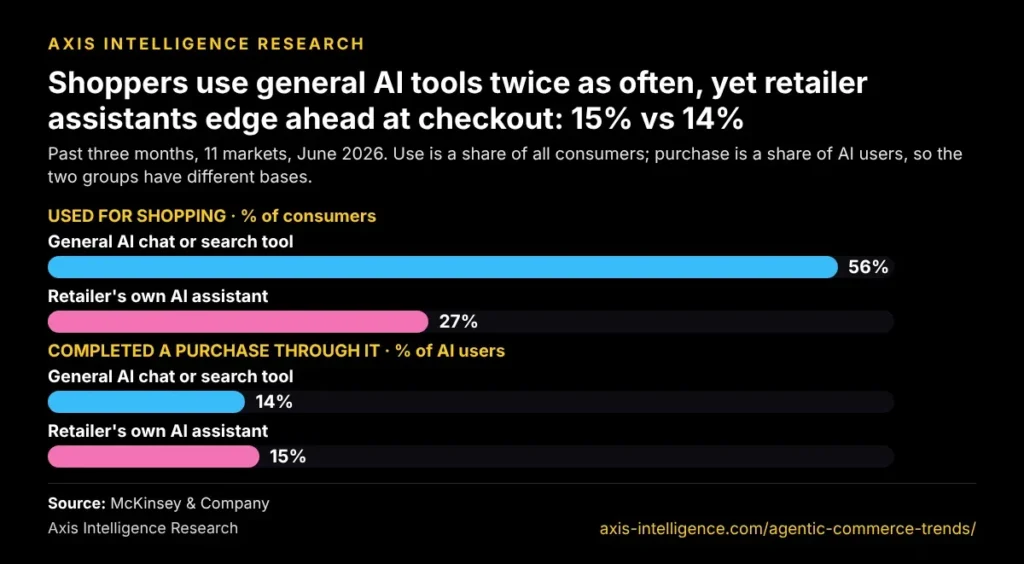
Retailers are also bringing the agent home. McKinsey finds 56% of consumers used a general AI chat or search tool for shopping versus 27% who used a retailer’s own assistant, yet at the moment of purchase retailer assistants edge ahead, 15% of AI users against 14%. Salesforce expects one in three retailers to run a shopper agent on its site by Cyber Week 2026, and reports that shoppers who engage with one spend 8% more per order.
| Checkout model | Who is merchant of record | Status | Source |
|---|---|---|---|
| ChatGPT Instant Checkout (ACP) | Merchant, payment inside ChatGPT | Scaled back Mar 24, 2026; merchants may use own checkout | OpenAI |
| Google UCP checkout in AI Mode and Gemini | Retailer | Select US merchants; Canada, Australia, UK next | |
| Retailer shopper agent on own site | Retailer | 1 in 3 retailers expected by Cyber Week 2026 | Salesforce |
Who leads: Google, Shopify, Walmart and Target through UCP; Salesforce on retailer-side agents. What would show it is overhyped: UCP checkout staying limited to select US merchants through 2027. The share of US retail flowing through Shopify stores is covered in our Shopify statistics.
Sarah Davis, Banking, Fintech & Payments co-author at Axis Intelligence 176 days is the most telling number on this page. A platform that owns checkout inherits refunds, disputes and tax remittance on goods it never touched, for a fee whose rate OpenAI never published; Google avoided that by writing seller-of-record into UCP. Expect 2027 agent flows to hand off at the payment step rather than absorb it, which keeps interchange and chargeback economics exactly where acquirers already price them.
Will shoppers hand an AI agent their card?
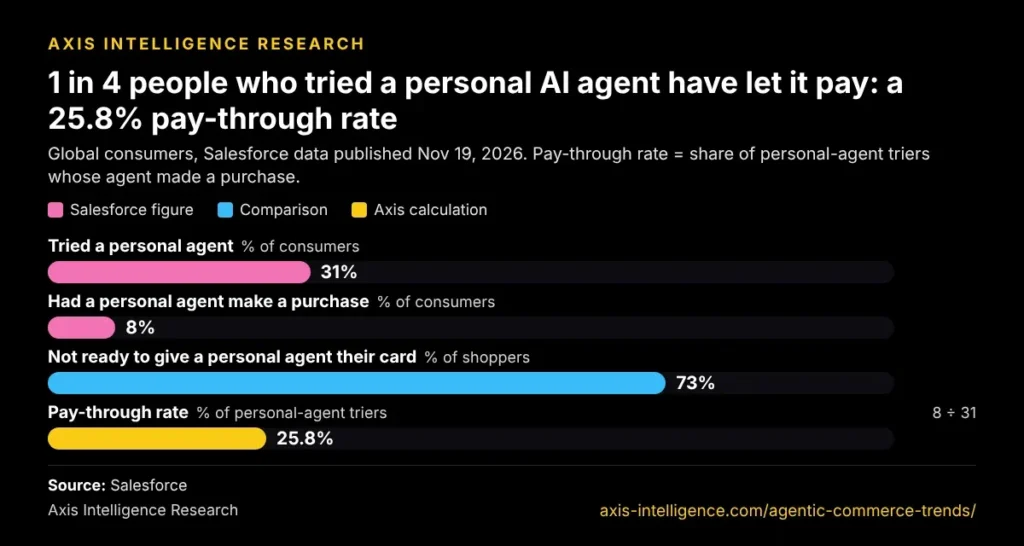
A minority already have, and the rest want a human tap on every purchase. Salesforce reports that 31% of consumers have tried a personal agent and 8% have had one make a purchase, while 73% are not ready to give a personal agent their card details. Axis Intelligence Research calculates a personal-agent pay-through rate of 25.8% (8 ÷ 31, same survey and population): about one in four people who tried a personal agent have let it pay.
The payment industry’s answer is to keep the card out of the agent’s hands. Stripe launched Link wallets for agents on April 29, 2026, with a one-time card per task and user approval of each payment; Link has more than 250 million users. On September 8, 2026, Meta’s Muse agent began buying through Link at more than 1 million businesses that accept it, with a single-use virtual card elsewhere and the shopper approving each total in the chat. Three weeks later, Stripe reported that agentic purchases made with Link had grown 38x over the past month and added purchase protections covering damage, lost items, price drops and returns.
| Indicator | Value | Date | Producer |
|---|---|---|---|
| Consumers who tried a personal agent | 31% | Nov 2026 | Salesforce |
| Consumers whose agent made a purchase | 8% | Nov 2026 | Salesforce |
| Pay-through rate (8 ÷ 31) | 25.8% | Nov 2026 | Axis calculation |
| Shoppers not ready to give an agent their card | 73% | Nov 2026 | Salesforce |
| US AI users who completed a purchase via AI tool | 17% (10% in Dec 2025) | June 2026 | McKinsey |
| Agentic purchases on Link, month-over-month | 38x | Sep 2026 | Stripe (company-reported) |
Who leads: Stripe (Link), Meta (Muse), Salesforce on measurement. What would show it is overhyped: the 38x month proving a one-off launch effect, with no second disclosed multiple in 2027. Stripe’s broader payment volume and merchant base are tracked in our Stripe statistics.
Sarah Davis, Banking, Fintech & Payments co-author at Axis Intelligence A 25.8% pay-through rate is high for a product only 31% of people have touched, so the bottleneck is not willingness once people try. It is authority: a single-use card limits the loss on one bad order, but it does not tell the issuer the agent was told to buy that item. Until mandates travel with the token, issuers will keep pricing agent orders like card-not-present risk, and every flow will keep asking the human to approve the total.
Can retailers still block AI shopping agents like Perplexity’s Comet?
Not through federal anti-hacking law, for now. On August 4, 2026, the Ninth Circuit vacated the preliminary injunction that had barred Perplexity’s Comet agent from shopping on Amazon, holding that the user, helped by the assistant, is the one who “accesses” Amazon’s computers. The panel stressed it was not creating a new legal regime for agentic AI and remanded the case, so the merits remain open.
The industry response is identification, not exclusion. Cloudflare reported on July 1, 2026 that more than half of internet traffic is now non-human, and Salesforce expects nonhuman traffic to reach 20% of holiday shopping traffic. Meta and Sierra announced the Personal Agent Protocol on October 6, 2026 with six named partners (Genesys, Instinct, Rocket, Shopify, Stripe, Walmart), built on OAuth so a customer grants an agent read or write access and the business sets limits. Version 1.0 shipped November 13, 2026 with more than 100 design partners: every Shopify store now publishes a protocol file automatically, and Muse looks for it first on each site.
Who leads: Sierra and Meta (Personal Agent Protocol), Cloudflare and Visa on signed-agent identity. What would show it is overhyped: large marketplaces staying outside the protocol while the remand drags on. The security side, including prompt-injection risk when agents hold accounts, is covered in our AI agent security statistics and the browser agent security guide; Perplexity’s user base is in Perplexity statistics.
Sarah Davis, Banking, Fintech & Payments co-author at Axis Intelligence I read the Ninth Circuit ruling as moving the fight from the courtroom to the login page. If the user is the one accessing the site, a retailer that wants control has to authenticate the agent and scope what it may do, which is exactly what Personal Agent Protocol sells. The risk that hides here is liability: an OAuth grant proves the customer allowed an agent in, not that the customer wanted the order it placed.
Will agents pay with cards or stablecoins?
Both rails are live, but they serve different purchases. Card networks carry consumer purchases with tokens and passkeys; stablecoin protocols carry sub-dollar machine payments. Neither has yet produced measured volume large enough to change a 2027 forecast.
Cards: tokens and passkeys clear the European hurdle
On July 2, 2026, Visa announced live agentic transactions with over 30 European issuers at independent merchants including lastminute.com and Frasers, every one authenticated with Visa Payment Passkeys to support Strong Customer Authentication (SCA), the EU rule requiring two-factor checks on most online card payments. That clears the main regulatory barrier for agent purchases in Europe, which is why the token trend scores the maximum on barrier clearance. What it lacks is volume: neither Visa nor Mastercard has published an agent-initiated transaction count. Market-by-market go-lives are logged in our agentic payments statistics, and network-level volumes in Visa statistics.
Stablecoins and machine payments: real activity, tiny value
Three analytics firms measure the x402 protocol, and their figures diverge on purpose:
| Producer | Published | Scope | Figure | Average payment (Axis calculation) |
|---|---|---|---|---|
| Artemis, in a Visa-funded study | Jul 14, 2026 (data to Apr 21) | x402, adjusted for wash and test activity | $15.0M across 109.6M transactions | $0.137 |
| Artemis, same study | Jul 14, 2026 | MPP, first weeks after mid-March 2026 launch | about $25,000 across about 115,000 transactions | about $0.22 |
| TRM Labs | Sep 9, 2026 | x402 on Base, Solana, Polygon since May 2025 | $52.7M across 198.9M settlements; $25.62M screened commerce | $0.265 (unscreened) |
| Chainalysis | Oct 14, 2026 | x402 on Base, 12 months to July 1, 2026 | 138M+ transactions; over 87% between $0.0001 and $0.10 | not derivable |
TRM Labs attributes only 0.6% to 7.5% of its screened $25.62 million to AI agents. Axis Intelligence Research calculates that range at $0.15 million to $1.92 million of agent-made value since May 2025. Chainalysis counts the transactions, not the agents, and puts the US at 30% of geolocated agent-to-service transactions. Mastercard’s Agent Pay for Machines, announced June 10, 2026 with more than 30 supporters including Stripe, Coinbase and Cloudflare, promises settlement across cards, accounts and stablecoins but gives no availability date. The stablecoin side of this story is scored in our stablecoin trends for 2027.
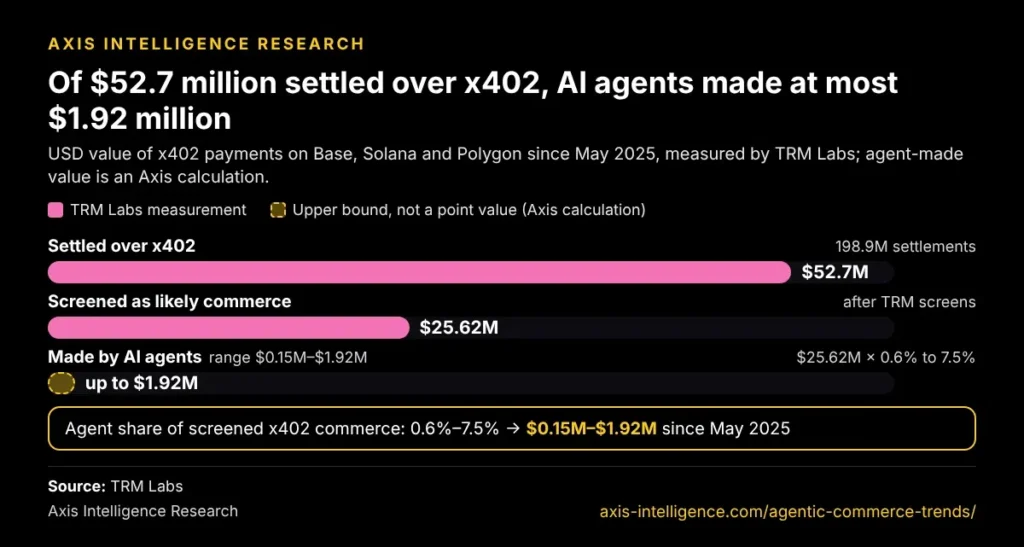
Sarah Davis, Banking, Fintech & Payments co-author at Axis Intelligence Visa’s own study calls the average x402 payment “a fraction of a cent,” yet its adjusted totals divide to about 14 cents; the most likely reading is that a few large transfers drag the mean far above a sub-dime typical payment, which Chainalysis’s 87% under ten cents supports. For any question about commerce, I would cite TRM’s screened figure, because it is the only one that tries to separate agents from scripts. On that basis, agent-made value on x402 is somewhere between $0.15 million and $1.92 million in more than a year, against the $75.8 billion of sales Salesforce expects AI and agents to influence in a single Cyber Week. The machine rail works; the shoppers are not on it.
Which agentic commerce protocols matter in 2027?
The ones a payment processor will accept for you. Between September 2025 and November 2026, at least six standards launched for agent shopping or agent payments, and in April 2026 Visa started accepting four of them through a single integration, Intelligent Commerce Connect, still in pilot with partners including AWS and Highnote.
| Protocol | Backers | Covers | Earliest date verified for this page | Status, Nov 2026 |
|---|---|---|---|---|
| Agentic Commerce Protocol (ACP) | OpenAI, Stripe | Product feed and checkout in ChatGPT | Sep 29, 2025 | Extended to discovery Mar 24, 2026 |
| Universal Commerce Protocol (UCP) | Google with Shopify, Etsy, Wayfair, Target, Walmart; 20+ endorsers | Discovery, cart, checkout in AI Mode and Gemini | Jan 11, 2026 | Every Shopify store supports it by default (Sierra, Nov 13) |
| Trusted Agent Protocol (TAP) | Visa | Merchant verification of a signed agent | Named in Visa release Apr 8, 2026 | Used in Visa B2B pilot, Oct 20, 2026 |
| Machine Payments Protocol (MPP) | Stripe, Tempo, with Visa contributions | Machine-to-machine payment | Mid-March 2026 | About $25,000 settled in first weeks |
| Agent Pay for Machines (AP4M) | Mastercard, 30+ supporters | Machine payment settlement | Jun 10, 2026 | No availability date |
| Personal Agent Protocol | Meta, Sierra, 100+ design partners | Agent identity and permissions with a business | Oct 6, 2026 | 1.0 on Nov 13, 2026 |
The Visa release lists TAP, MPP, ACP and UCP as accepted protocols. That is the 2027 pattern to plan for: merchants integrate once with their processor, and the processor speaks whatever protocol the agent uses. Who leads: Visa and Stripe as aggregators; Google and Shopify as the default catalog layer. What would show it is overhyped: Connect staying in pilot past 2026, its own stated rollout window. Fee and routing pressure on card acceptance is covered in our payment trends for 2027.
Is B2B where agents spend real money first?
Not yet on the evidence. The first live pilot of AI agents paying approved supplier invoices through supplier portals started on October 20, 2026, with BILL’s payment agent registered through Visa’s Trusted Agent Protocol and Billtrust recognizing it on the supplier side. The release discloses no pilot volume or buyer count, which is why the trend scores 30.
The forecasts are far ahead of that pilot. Gartner predicted in October 2025 that by 2028, 90% of B2B buying will be AI-agent intermediated, pushing over $15 trillion of spend through agent exchanges. Forrester’s 2027 predictions (October 23, 2026) expect one in 10 dollars to disappear from B2B selling budgets as buyers take control. Neither firm’s figure can be checked against disclosed transaction data today. Enterprise agent adoption and costs outside commerce are covered in our AI agents trends for 2027.
Which agentic commerce predictions are overhyped?
Fully autonomous, no-approval buying. Every live consumer flow documented on this page asks the shopper to approve the total or confines the agent to a single-use card, and 73% of shoppers are not ready to hand over card details (Salesforce). The claim scores 8 on ACES and stays on the watch list.
The analyst consumer forecasts look closer to reality than the B2B ones, once definitions line up:
| Forecast or measure | Value | Definition | Source |
|---|---|---|---|
| Forrester prediction for 2027 | 1 in 20 US and UK consumers | Replace traditional shopping with conversations | Forrester, Oct 23, 2026 |
| McKinsey measurement, June 2026 | 17% of US AI users; about 5–10% of the US population | Completed at least one purchase through an AI tool in three months | McKinsey, Oct 28, 2026 |
Sarah Davis, Banking, Fintech & Payments co-author at Axis Intelligence These two numbers do not contradict each other. McKinsey counts anyone who bought once through an AI tool in three months; Forrester asks who replaces how they shop, a much higher bar, so a 2027 figure near 5% for replacement sits comfortably under a 5–10% figure for trial. I would trust both and quote neither as “agentic commerce adoption” without its definition attached.
What could change this outlook in 2027?
- A card network publishes agent-initiated volume. A disclosed agent-initiated dollar volume above $100 million from Visa or Mastercard would lift trend 6’s adoption score from 8 to 15.
- The remand in Amazon v. Perplexity. A merits ruling for Amazon on control of the agent would reopen blocking as a strategy and cut trend 4’s barrier score.
- UCP checkout outside the US. Google set Canada and Australia for “the coming months” and the UK later; delivery in 2027 would push trend 2 toward mainstream.
- Salesforce and Adobe 2027 holiday data. A personal-agent purchase share above the 8% measured in November 2026 confirms trend 3; a flat reading suggests the 38x month was a launch spike.
- Visa Intelligent Commerce Connect leaving pilot. Its release set rollout “this year”; a 2027 delay keeps trend 7 emerging.
Grade-back: Axis Intelligence Research will re-score every trend with 2027 data in the November 2027 edition of this page, starting with a line-by-line comparison against these scores.
Agent checkout in 2027: what merchants, issuers and PSPs ask
Does OpenAI charge merchants a fee on ChatGPT sales?
At launch on September 29, 2025, OpenAI said merchants pay a fee on each completed Instant Checkout sale but did not publish the rate. Since March 24, 2026, merchants can use their own checkout instead, which keeps the sale under their existing processor pricing.
How are AI agent purchases meeting Strong Customer Authentication in Europe?
Through passkeys. Visa said on July 2, 2026 that every agentic transaction in its Agentic Ready program, with over 30 European issuers, was secured with Visa Payment Passkeys, which support compliance with the EU’s SCA rules.
Can a retailer sell through Google AI Mode checkout today?
Only selected merchants. Google’s UCP checkout is open to eligible US retailers that apply, with the retailer kept as seller of record; Google said on May 20, 2026 that it will reach Canada and Australia in the coming months and the UK after that.
How much payment volume does agentic commerce process today?
No producer publishes a total. Visa and Mastercard have disclosed live agentic transactions but no volume, and Stripe gives growth multiples only. The one measured rail is x402: TRM Labs counted $52.7 million across 198.9 million settlements since May 2025 (published September 9, 2026), of which it attributes 0.6% to 7.5% of the screened $25.62 million to AI agents.
Is the 38x growth in Stripe agent purchases a volume figure?
No. Stripe reported on September 29, 2026 that agentic purchases made with Link grew 38x over one month, a growth multiple without a base, so it confirms direction but cannot be converted into dollars or orders.
Do AI shopping agents have to identify themselves to a website?
No federal rule requires it after the Ninth Circuit’s August 4, 2026 decision in Amazon v. Perplexity, which treated the user as the party accessing the site. Identification is spreading by standard instead: Personal Agent Protocol 1.0, released November 13, 2026, is published automatically by every Shopify store.
Methodology and data
ACES uses only figures logged with their source and publication date and retrieved on November 27, 2026. Each component follows the rule table above; when two producers disagree, the score uses the more conservative one, and both appear on the page. Company-reported figures (Stripe, Sierra, Visa, Mastercard) count as adoption evidence only at the 8-point tier unless they include volume. Survey figures come from McKinsey (about 21,000 consumers, 11 markets, June 2026) and Salesforce (release of November 19, 2026; its predictions draw on data covering more than 1.5 billion shoppers, and the release does not state a separate survey base for the personal-agent figures). The dataset holds every ACES component, every input and every Axis calculation with its formula.
Download the dataset: agentic-commerce-trends.csv (CC BY 4.0).
Cite this page: Axis Intelligence Research, “Agentic Commerce Trends 2027: AI Agents Own Discovery, Merchants Keep the Checkout, and the Payment Rails Run Ahead of Demand”, data as of November 27, 2026, https://axis-intelligence.com/agentic-commerce-trends/ [copy]