

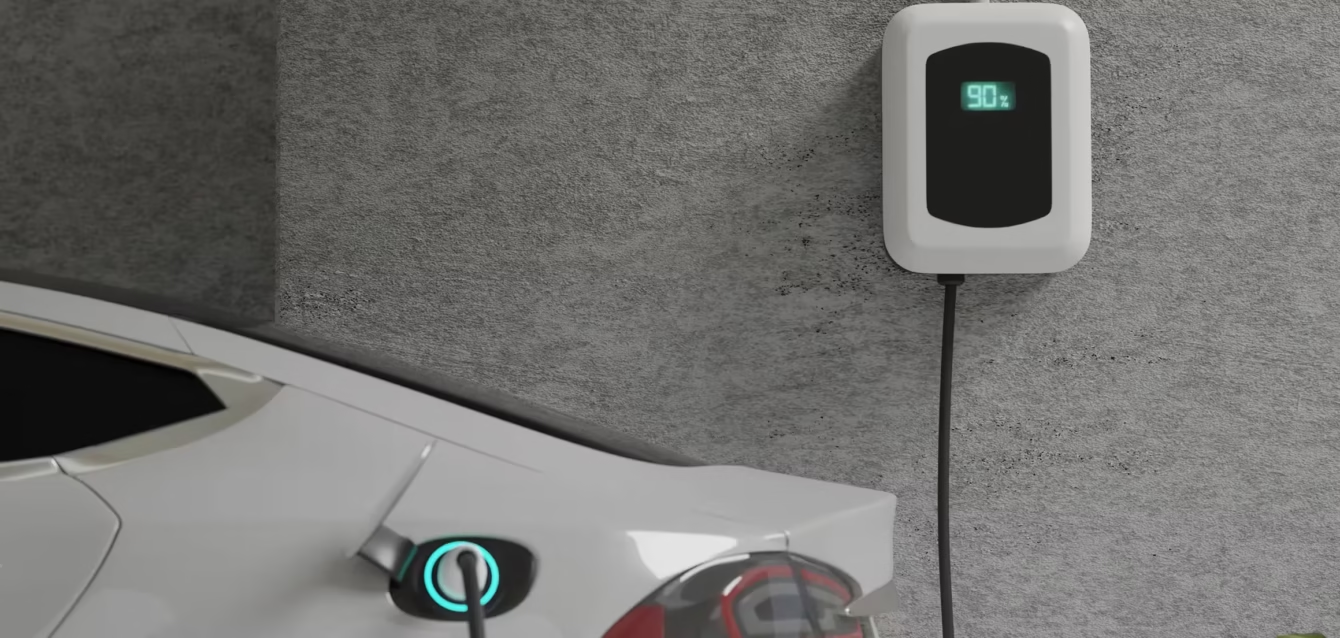
EV Charger Installation Cost 2026
By Axis Intelligence Research
Co-author: Aidan Jad | Last updated: October 7, 2026 | License: CC BY 4.0
A Level 2 EV charger installed on a new dedicated circuit costs $1,050 to $2,160 in 2026, with an Axis midpoint of $1,604.50. Add a main panel replacement and the midpoint jumps to $5,104.50 — 3.18 times the clean install. The charger itself is the cheapest line on the invoice.
Quick Answer: How Much Does It Cost to Install a Level 2 EV Charger at Home?
According to Axis Intelligence Research’s CHIP (Charger Home Installation Price) model, a typical Level 2 install runs $1,604.50 when the panel has room, $3,104.50 with a subpanel, $5,104.50 with a main panel replacement, and $7,904.50 when the utility service must be upsized. The federal 30C credit no longer offsets any of it for chargers placed in service after June 30, 2026.
Key Findings
- Axis Intelligence Research finds the median 40–48A wall charger costs $479.50 across eight models priced on manufacturer stores on October 6, 2026.
- Tesla’s support page estimates $750–$1,500 to install a new 240V circuit, with permit, inspection and warranty included as standard items.
- Berkeley Lab’s 2026 survey puts the median single-family main panel replacement at $3,500 (IQR $2,100–$5,000), more than seven times the median charger price.
- Axis Intelligence Research estimates the Panel Upgrade Multiplier (PUM) at 3.18 for a main panel swap and 4.93 for a full service rating increase.
- Berkeley Lab models 55% of U.S. single-family panels at 100A, and at least 20% of panels of every size have no free breaker space.
What Is CHIP, the Charger Home Installation Price?
CHIP (Charger Home Installation Price) is Axis Intelligence Research’s fully loaded cost of putting a Level 2 charger on the wall of a single-family home, scored at five electrical-readiness tiers. It exists because every pricing page we read quotes one of two numbers — the box price or a “typical install” — and neither tells a homeowner what the panel will do to the bill.
The formula is deliberately plain:
CHIP = charger hardware + circuit installation + panel work (if the tier requires it)
- Hardware: the median of eight 40–48A wall units priced on October 6, 2026 ($479.50; range $299.99–$660.00).
- Circuit installation: Tesla’s published $750–$1,500 estimate for a new 240V circuit, midpoint $1,125. Tesla lists permit and inspection among the standard items, so no separate permit line is added.
- Panel work: Berkeley Lab’s single-family medians and interquartile ranges for subpanels, main panel replacements and service rating increases.
Low = cheapest charger + low install + panel 25th percentile. Mid = median charger + install midpoint + panel median. High = priciest charger + high install + panel 75th percentile.
PUM (Panel Upgrade Multiplier) is the companion ratio: the CHIP of any tier divided by the CHIP of a clean install (Tier B). It answers one question in one number — how many clean installs does my panel problem cost?
CHIP by Electrical-Readiness Tier
| Tier | What the job includes | CHIP low | CHIP mid | CHIP high | PUM | Source of inputs |
|---|---|---|---|---|---|---|
| A — Outlet ready | Plug-in charger on an existing 240V outlet the installer approves | $299.99 | $479.50 | $660.00 | — | Manufacturer stores; Tesla |
| B — Clean install | New dedicated 240V circuit, panel has capacity | $1,049.99 | $1,604.50 | $2,160.00 | 1.00 | Manufacturer stores; Tesla |
| C — Subpanel | Tier B + subpanel replacement | $1,824.99 | $3,104.50 | $4,660.00 | 1.93 | + Berkeley Lab 2026 |
| D — Main panel | Tier B + main service panel replacement | $3,149.99 | $5,104.50 | $7,160.00 | 3.18 | + Berkeley Lab 2026 |
| E — Service upsize | Tier B + service rating increase (customer + utility side) | $4,699.99 | $7,904.50 | $14,160.00 | 4.93 | + Berkeley Lab 2026 |
Axis Intelligence Research estimates, as of October 6, 2026. Tier A uses plug-in pricing with $0 install per Tesla’s guidance for an existing approved outlet.
The jump that matters is B to D. At Tier D the panel line alone is 69% of the CHIP. Homeowners shop chargers for weeks over a $150 spread between models, then accept a panel quote that dwarfs the hardware without asking a single question about load calculation.
How Much Does a Level 2 EV Charger Cost in 2026?
Hardware is the predictable part. The table below lists prices read directly from each manufacturer’s U.S. store on October 6, 2026, ordered by price, not by brand preference.
| Charger | Max output | Install type | Price | Verified | Source |
|---|---|---|---|---|---|
| Grizzl-E Classic 40A | 40A | Plug-in | $299.99 | 2026-10-06 | Grizzl-E store |
| Tesla Mobile Connector* | 32A on 240V | Portable | $300.00 | 2026-10-06 | Tesla |
| Grizzl-E Classic Connect 40A | 40A | Plug-in | $349.99 | 2026-10-06 | Grizzl-E store |
| Emporia Classic (base listing) | 48A hardwired | Plug-in or hardwire | $449.00 | 2026-10-06 | Emporia |
| Emporia Classic (NACS, NEMA 14-50) | 40A | Plug-in | $479.00 | 2026-10-06 | Emporia |
| Grizzl-E Ultimate 48A | 48A | Hardwire | $479.99 | 2026-10-06 | Grizzl-E store |
| Tesla Wall Connector | 48A | Hardwire | $585.00 | 2026-10-06 | Tesla |
| Wallbox Pulsar Plus (from) | 40A / 48A | Plug-in or hardwire | $649.99 | 2026-10-06 | Wallbox |
| Tesla Universal Wall Connector | 48A | Hardwire | $660.00 | 2026-10-06 | Tesla |
| Grizzl-E Ultimate 80A* | 80A | Hardwire | $899.99 | 2026-10-06 | Grizzl-E store |
| Grizzl-E Duo Connect (two ports)* | 40A | Plug-in | $899.99 | 2026-10-06 | Grizzl-E store |
Excluded from the $479.50 wall-unit median: portable, 80A, or two-port units sit outside the 40–48A single-port class most homes buy.
The spread between the cheapest and priciest 40–48A wall unit is $360.01. The spread between a clean install and a main panel replacement, at the CHIP midpoint, is $3,500. Charger shopping is where people spend their attention; the panel is where they spend their money.
Do You Need a 48-Amp Charger or Is 40 Amps Enough?
A 48A unit needs a 60A breaker and a 40A unit needs a 50A breaker, per Emporia’s published spec sheet. That extra 10A of breaker is load your panel has to carry. And many cars cannot use it: Tesla states the Model 3 and Model Y Rear-Wheel Drive top out at 32A, which a 40A circuit delivers.
Buying amps the charging curve can’t draw is the most common way a Tier B job becomes a Tier D job. On a 100A panel, the circuit you ask for is often the difference between “fits” and “needs a new panel.” Ask what your car’s onboard charger accepts before you ask what the wall unit can push. ChargePoint’s Home Flex tops out at 37 miles of range per hour at 50A; Tesla’s Wall Connector lists up to 44. For a car parked ten hours a night, the gap between 30 and 44 miles per hour rarely matters.
How Much Does Labor Cost to Install an EV Charger?
Tesla is the only major manufacturer in our sample that publishes an installation range on its own site: $750 to $1,500 for a new 240V circuit, with professional labor, materials, an electrical permit, inspection and an installation warranty listed as standard. Long wire runs, trenching, pedestal mounts, concealed cable and a main panel upgrade are listed as extras.
ChargePoint does not publish a number. Its installation page says pricing depends on location, home setup and permits, and notes that most chargers sit 15 to 30 feet from the panel. That distance is the single biggest variable inside Tier B: copper sized for a 60A circuit is expensive per foot, and a detached garage can turn a two-hour job into a trench.
For scale, Bureau of Labor Statistics data put the May 2025 median electrician wage at $30.38 an hour, and BLS projects 9% employment growth from 2025 to 2035. Contractor quotes bundle that wage with materials, permits, insurance and travel, so the hourly figure is a floor, not a quote.
What Does an EV Charger Permit Cost?
Berkeley Lab surveyed 33 building departments in 2026 and found EV charger permit fees clustered at a median at or near $100, with wide variation by jurisdiction. Fees tied to job valuation can push that higher. The permit is the smallest line on the bill and the one most often skipped — skipping it is how a home-sale inspection becomes a re-wiring order.
Do I Need a Panel Upgrade for an EV Charger?
Not automatically. This is where most cost guides go wrong, and where the published research is clearer than the sales pitch.
Berkeley Lab’s February 2026 study of the national single-family stock estimates 55% of panels are rated 100A and 29% are 200A. A separate photo-verified survey by Gul and Meier, published in Energy Policy, found 31% of homes at 100A or less and roughly 60% at 200A or more, plus about 3% with potentially hazardous panel models. The two figures differ because one is modeled across the housing stock and the other is a voluntary survey; we publish both rather than merge them.
Here is the line in the Berkeley Lab paper that matters most for anyone holding a $4,000 panel quote: after simulating the National Electrical Code load calculation, the researchers concluded many homes can take additional load without expensive panel or service replacements. A 100A rating is a reason to run a load calculation, not a verdict.
What does force an upgrade is often more mundane. Berkeley Lab found at least 20% of panels of every size have no free breaker space at all. A 200A panel with every slot full can still trigger Tier C.
Panel and Service Upgrade Costs (Single-Family, 2026)
| Work | Median | 25th–75th percentile | Mean | Respondents | Source |
|---|---|---|---|---|---|
| Subpanel replacement | $1,500 | $775–$2,500 | — | 31 | Berkeley Lab |
| Main service panel replacement | $3,500 | $2,100–$5,000 | $3,931 | 34 | Berkeley Lab |
| Service rating increase, customer-side equipment | $2,800 | $2,000–$5,000 | — | 22 | Berkeley Lab |
| Service rating increase, utility-side costs passed to customer | $3,500 | $1,650–$7,000 | $5,040 | 19 | Berkeley Lab |
| EV charger permit fee | ~$100 | wide by jurisdiction | — | 33 | Berkeley Lab |
Survey of 140 building-industry, utility and building-department respondents across 34 states, fielded summer 2025, published August 2026. Means sit above medians because high-cost outliers skew the distributions.
The utility-side row deserves a second look. Berkeley Lab found that nearly all utilities in the sample offered no allowance toward service rating increases — the customer pays. And those costs don’t scale smoothly; they jump when added load exceeds the transformer serving the house. That is why the Tier E high end reaches $14,160.
How Long Does a Panel Upgrade Take?
For single-family homes, 70% of panel jobs without a service rating increase finished within 30 days in the Berkeley Lab survey, versus 64% when the service was upsized. Book the electrician before the car arrives, not after.
Can Load Management Avoid a Panel Upgrade?
Often, yes — and this is the cheapest dollar in the whole project. A load-management device watches total household draw and throttles the charger when the dryer and oven are running, so the charger never pushes the panel past its rating.
Wallbox sells its Power Meter for $299, which pairs with the Pulsar Plus ($649.99) for a bundle of $948.99. Axis Intelligence Research calculates a $3,201 spread between the median main panel replacement ($3,500) and that meter — where your local inspector accepts a load-managed installation under the NEC. Tesla’s Wall Connector also supports power sharing between two units, which solves the two-EV household without a second full-rated circuit.
Not every inspector, utility or panel will cooperate. But the Berkeley Lab authors list load-management technology first among the strategies to cut upgrade costs, and that is the question to put to every installer before signing a panel quote.
How Much Does It Cost to Charge an EV at Home?
The installation is a one-time cost; electricity is forever. The U.S. Energy Information Administration’s October 2026 Short-Term Energy Outlook puts the average residential price at 17.3¢/kWh for 2025, a projected 18.2¢ for 2026 and 18.7¢ for 2027.
Using the Department of Energy’s own worked example of a car that uses 27 kWh per 100 miles, Axis Intelligence Research calculates home charging at $49.14 per 1,000 miles at the 2026 price — up from $46.71 in 2025 and heading to $50.49 in 2027.
Math: 1,000 miles × 27 kWh/100 mi = 270 kWh × $0.182 = $49.14.
Your number depends on your tariff more than any national average. A time-of-use rate that cuts overnight prices does more for lifetime cost than the difference between any two chargers on the list above — which is why scheduling, not peak amperage, is the feature worth paying for.
What Happened to the Federal EV Charger Tax Credit?
The 30C Alternative Fuel Vehicle Refueling Property Credit paid individuals 30% of qualified property cost, up to $1,000 per charging port, for equipment placed in service at a main home between January 1, 2023 and June 30, 2026, according to the IRS. The home also had to sit in an eligible low-income or non-urban census tract.
A charger installed today falls outside that window. This fall is the first buying season in years without a federal offset, which leaves state programs and utility rebates as the remaining incentives. The Department of Energy’s Alternative Fuels Data Center points homeowners to state and utility incentives; check yours before choosing hardware, because some utilities only rebate specific networked chargers.
How to Get an Accurate EV Charger Installation Quote
The CHIP tiers tell you what to expect. The quote tells you which tier you are in. Five questions sort it out:
- “Did you run an NEC load calculation, and can I see it?” A panel upgrade recommended without one is a guess with a price tag.
- “What amperage does my car actually accept?” If the answer is 32A, a 40A circuit may keep you in Tier B.
- “Would a load-management device avoid the panel work?” If the answer is yes and the panel is still quoted, ask why.
- “Is the permit and inspection included?” Tesla’s certified-installer standard says it should be.
- “How far is the run, and is it in conduit, through walls or underground?” Distance beyond 15–30 feet is where Tier B quotes drift upward.
Get at least two quotes when a panel replacement appears on either. The interquartile range on main panel work alone is $2,900 wide.
EV Charger Installation Cost FAQ
Can I install a Level 2 charger myself?
Mounting a plug-in charger on an existing, installer-approved 240V outlet needs no electrical work. Running a new circuit generally requires a permit and, in most jurisdictions, a licensed electrician. Emporia recommends a licensed electrician for hardwired installs.
Is a NEMA 14-50 outlet or a hardwired charger cheaper to install?
The circuit costs roughly the same. Emporia notes plug-in models cap at 40A, that the outlet must be industrial-grade and continuous-duty rated, and that GFCI breakers now required on these outlets can nuisance-trip chargers — one reason it recommends hardwiring.
How much more does a detached garage add?
No primary source publishes a national figure. Tesla lists trenching and long wire runs as extras outside the standard install. ChargePoint says most chargers sit 15–30 feet from the panel, so anything far beyond that should be quoted separately.
Why did my electrician quote a panel upgrade on a 200A panel?
Usually breaker space, not capacity. Berkeley Lab found at least 20% of panels of every size have no open slots. A subpanel (median $1,500) may solve it for far less than a main panel ($3,500).
Does a panel upgrade raise my home’s value?
No primary data source in our review quantifies that. What is documented: about 3% of surveyed homes had potentially hazardous panel models, per Gul and Meier, so a replacement may resolve a safety issue a buyer’s inspector would flag.
What is a good CHIP score for my home?
A clean install near the Tier B midpoint of $1,604.50 is typical. A quote above the Tier B high of $2,160 with no panel work deserves a second bid; a quote near $5,104.50 should include a main panel replacement.
Do I need a smart charger to get utility rebates?
Many utility programs require networked, scheduling-capable chargers. Requirements vary by utility; the DOE Alternative Fuels Data Center maintains a searchable database of state and utility incentives.
Methodology: How Axis Intelligence Research Built CHIP
Hardware. On October 6, 2026, we read retail prices from the U.S. stores of Grizzl-E, Emporia, Tesla and Wallbox. ChargePoint’s store did not render a price for automated retrieval and is excluded rather than estimated. The CHIP hardware input is the median of eight single-port 40–48A units ($479.50, rounded from $479.495).
Installation. Tesla’s published $750–$1,500 new-circuit estimate is the only manufacturer-published installation range we found. We use its endpoints for low and high and its midpoint ($1,125) for mid. Permit and inspection are included per Tesla’s standard-items list.
Panel and service. Single-family medians and interquartile ranges from Berkeley Lab’s August 2026 survey (140 respondents, 34 states). Tier E adds the customer-side and utility-side medians; a sum of medians is an Axis construct, not the median of the combined cost, and we label it as an estimate.
What CHIP does not include: trenching, pedestal mounts, drywall repair, utility or state rebates, or regional labor premiums. CHIP describes single-family homes; Berkeley Lab shows multifamily upgrade costs scale sharply higher and need separate treatment.
Dataset. All 78 rows behind this page — every price, survey figure and calculation — are in the downloadable CSV (CC BY 4.0) with source URLs and retrieval dates: ev-charger-installation-cost.csv.
Cite This Page
- APA: Axis Intelligence Research, & Jad, A. (2026, October 7). EV charger installation cost 2026: What a Level 2 home charger really costs once the panel gets involved. Axis Intelligence. https://axis-intelligence.com/ev-charger-installation-cost/
- MLA: Axis Intelligence Research, and Aidan Jad. “EV Charger Installation Cost 2026.” Axis Intelligence, 7 Oct. 2026, axis-intelligence.com/ev-charger-installation-cost/.
- Chicago: Axis Intelligence Research and Aidan Jad. “EV Charger Installation Cost 2026.” Axis Intelligence, October 7, 2026. https://axis-intelligence.com/ev-charger-installation-cost/.
Related Axis cost research: smart home installation cost · home security system cost · EV charging statistics · electric vehicle statistics · Home Battery Storage Cost · EV Charging Cost Calculator