

Consumer AI Trends 2027
By Axis Intelligence Research
Co-author: Sarah Mitchell | Last updated: November 29, 2026 | License: CC BY 4.0
The consumer AI trends with the strongest evidence for 2027 are AI answers replacing the search click, Google winning reach by building Gemini into products people already use, and AI moving from monthly to daily use. GWI finds 85.2% of internet users aged 16+ use AI tools monthly, but only 9.5% pay. Companions and AI checkout score lowest: people use them, but rules and distrust slow them down.
What Are the Biggest Consumer AI Trends for 2027?
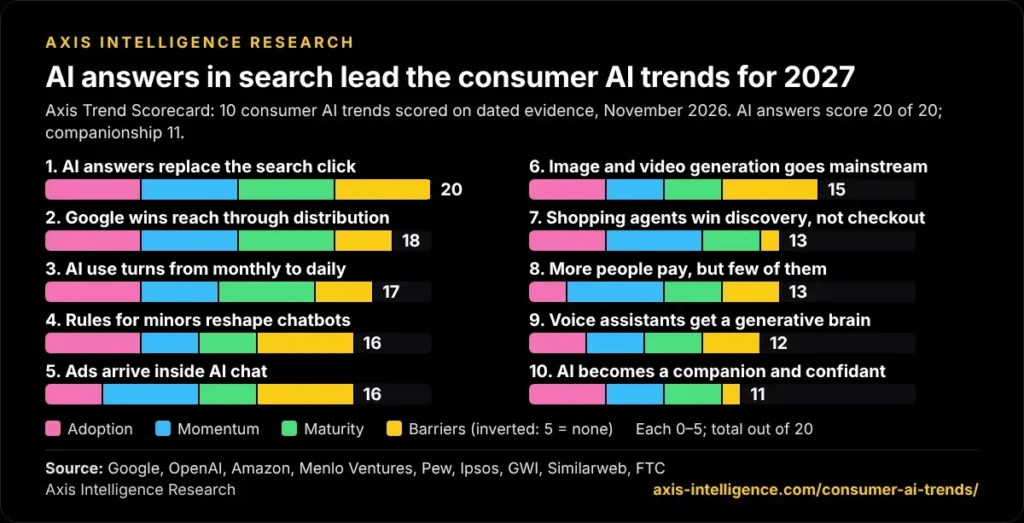
Ten shifts have measured evidence behind them. Axis Intelligence Research scored each on the Axis Trend Scorecard, the same four-part rubric used on our social media trends for 2027: adoption, momentum, maturity and barriers, each out of 5. The rubric is in the Methodology section; every input is a dated row in the CSV.
| # | Trend | Strongest dated evidence | Stage | Who it affects | Signal to watch in 2027 | Score /20 |
|---|---|---|---|---|---|---|
| 1 | AI answers replace the search click | Google’s AI Overviews pass 2.5 billion monthly users; AI Mode passes 1 billion in about a year (Google, May 2026) | Mainstream | Searchers, publishers, advertisers | Whether AI Mode keeps growing after the AI Overviews rollout is complete | 20 |
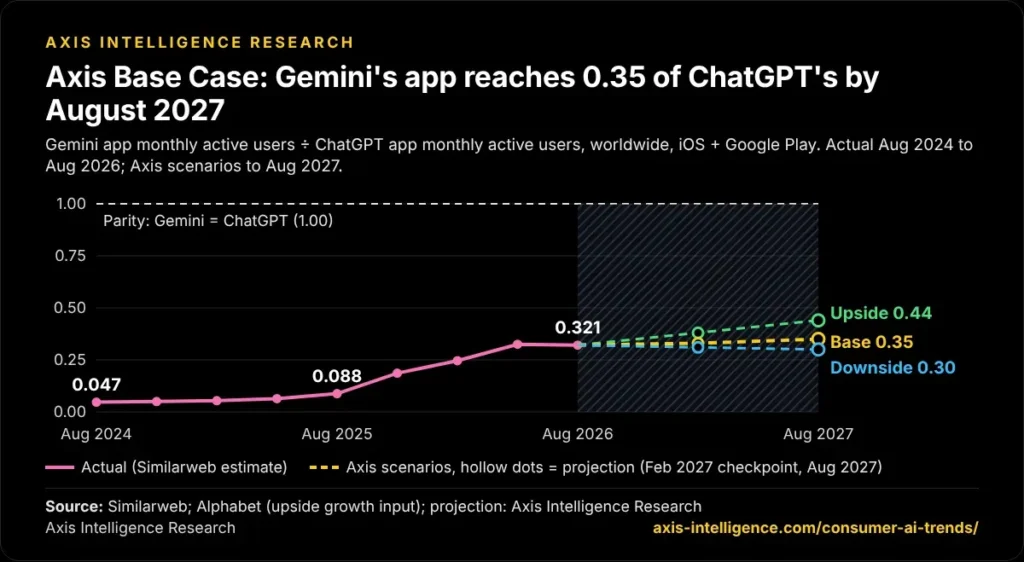
| 2 | Google wins reach through distribution | Gemini app above 1 billion monthly users (Alphabet, Q3 2026); Gemini at 0.83 of ChatGPT’s reach in GWI’s survey | Mainstream | Android and Search users, OpenAI | Gemini’s standalone app share; Axis base case 0.35 of ChatGPT by Aug 2027 | 18 |
| 3 | AI use turns from monthly to daily | US daily AI use up from 19% to 25% of adults (Menlo Ventures, July 2026) | Mainstream | Every consumer AI product | US daily use above 30% in Menlo’s or Pew’s next wave | 17 |
| 4 | Rules for minors reshape chatbots | 64% of US teens use chatbots (Pew); California’s companion chatbot law in force since Jan 1, 2026 | Scaling | Teens, parents, chatbot makers | Enforcement of California’s 2026 package; FTC findings from its 6(b) inquiry | 16 |
| 5 | Ads arrive inside AI chat | ChatGPT Ads reach a $1 billion run rate in under 200 days (OpenAI, Aug 2026) | Scaling | Free-tier users, advertisers | Ad expansion beyond 89 countries; any ad tier on Gemini | 16 |
| 6 | Image and video generation goes mainstream | 35.5% of active AI users create or edit images or video (GWI, Q2 2026); 50 billion+ Nano Banana images (Google, May 2026) | Scaling | Creators, social platforms | Video generation share in GWI’s next wave | 15 |
| 7 | Shopping agents win discovery, not checkout | 400 million+ Amazon customers used Alexa for Shopping in 12 months; OpenAI stepped back from Instant Checkout in March 2026 | Scaling | Shoppers, retailers, payment firms | Share of shoppers who let an agent complete a purchase | 13 |
| 8 | More people pay, but few of them | Consumer AI spending up from $12 billion to $40 billion (Menlo Ventures); 9.5% of online adults pay (GWI) | Scaling | Free users, subscription businesses | Payers per 100 AI users rising above 11.2 worldwide | 13 |
| 9 | Voice assistants get a generative brain | Alexa+ passes 10 million users (Amazon, Jan 2026) and opens to all US users in Feb 2026 | Scaling | Smart-home and car users | Amazon disclosing active Alexa+ users | 12 |
| 10 | AI becomes a companion and confidant | 35% of adults in 21 countries used AI for companionship or support in a year (Ipsos for Google) | Scaling | Lonely and young users, regulators | New state laws and the first enforcement cases | 11 |
Key Findings
- Axis Intelligence Research ranks AI answers in search as the best-evidenced consumer AI trend for 2027, scoring 20 of 20, ahead of Google’s distribution advantage (18) and the shift to daily use (17).
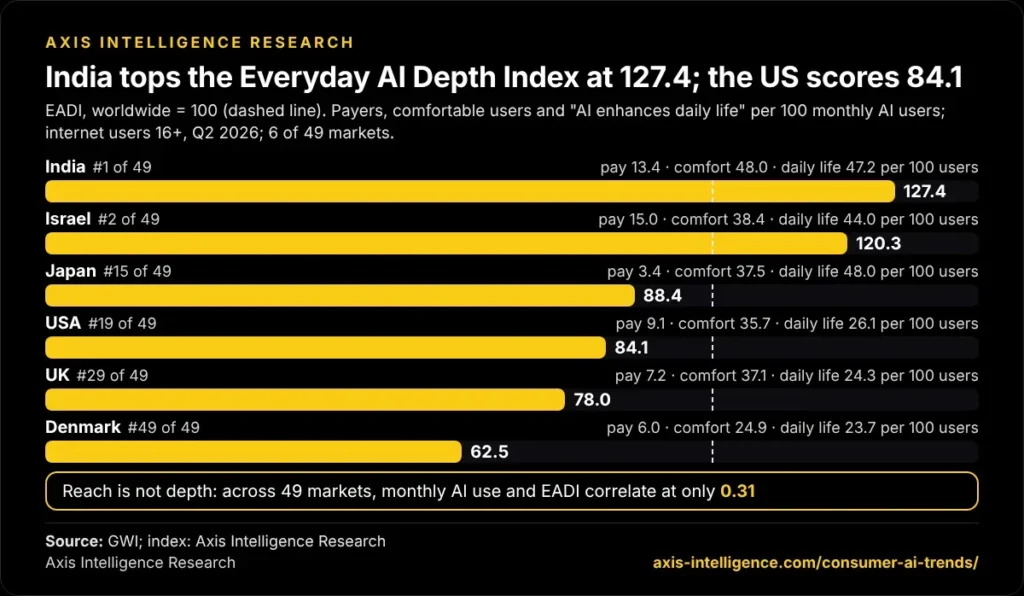
- Axis Intelligence Research’s Everyday AI Depth Index (EADI) puts India first (127.4) and Denmark and the Netherlands last (62.5) among 49 markets, with the US at 84.1 and a reach-to-depth correlation of only 0.31.
- In the Axis base case, Gemini’s standalone app reaches about 0.35 of ChatGPT’s monthly app users by August 2027 (range 0.30 to 0.44), so no app overtake in 2027, even though Gemini already stands at 0.83 of ChatGPT’s survey reach.
- Axis Intelligence Research finds 11.2 paying subscribers per 100 monthly AI users worldwide in GWI’s Q2 2026 data, against Menlo Ventures’ finding that 55% of US AI users pay for at least one AI product.
- AI companionship has the widest gap between use and evidence score: 35% of adults in Ipsos’s 21-country survey used AI for companionship or support, but the trend scores 11 of 20 because of new laws and an FTC inquiry.
Sarah Mitchell’s read: Look at what tops the table and what sits at the bottom. The three strongest trends are all about distribution: AI arriving inside search, inside Android, inside a habit people already have. The weakest are the ones that ask users to trust a model with something new, their money or their feelings. That ordering is the 2027 story. The capability is already there. What decides adoption now is whether people accept AI where it shows up, and whether they will let it act for them.
1. Is AI Replacing the Google Search Click?
What changes. The default answer to a question is becoming an AI summary rather than a list of links. Google said at I/O on May 19, 2026 that AI Overviews has more than 2.5 billion monthly active users and that AI Mode passed 1 billion monthly active users about a year after launch.
How we know. Finding information is the top reason for using AI: 60.4% of active AI users cited it in GWI’s Q2 2026 survey, published in the Digital 2027 report.
Who leads. Google, by putting AI into the search box people already use. ChatGPT sends 77.89% of the web referrals from AI platforms tracked by Statcounter in July 2026, against 9.93% for Gemini.
What would show it is overhyped. AI Overviews usage is automatic once someone searches. AI Mode is opt-in, so a stall in AI Mode’s monthly users would mean people accept AI answers but do not seek them out. The consequences for clicks, publishers and ads are covered in our AI search trends for 2027.
Score: 20/20 (adoption 5, momentum 5, maturity 5, barriers 5).
2. Will Gemini Overtake ChatGPT in 2027?
On reach, Gemini is already close. On standalone app use, the Axis base case says no, not in 2027.
What changes. Google is putting Gemini into Android, Search and Chrome, so people meet it without downloading anything. The Gemini app grew from 400 million monthly users at I/O 2025 to more than 900 million at I/O 2026, and passed 1 billion in Q3 2026, according to Alphabet’s Q3 2026 remarks.
How we know. Six yardsticks published in 2026 put Gemini at between 0.13 and 0.97 of ChatGPT, depending on what they count.
| Yardstick | Gemini as a share of ChatGPT | As of | Source |
|---|---|---|---|
| US AI users who use each assistant | 0.97 (58% vs 60%) | July 2026 | Menlo Ventures |
| Past-month reach, internet users 16+, worldwide | 0.83 (28.7% vs 34.7%) | Q2 2026 | GWI |
| Deduplicated website users | 0.63 | Aug 2026 | Similarweb |
| US adults who have ever used each | 0.55 (24% vs 44%) | Feb 2026 | Pew Research Center |
| Standalone mobile app monthly active users | 0.32 | Aug 2026 | Similarweb |
| Share of AI-platform web referrals | 0.13 (9.93% vs 77.89%) | July 2026 | Statcounter |
Ratios are Axis Intelligence Research calculations. The GWI ratio is the measure we publish as the Gemini–ChatGPT Reach Parity Index (GRPI), 82.7, on our Google Gemini statistics page. GWI finds Gemini ahead of ChatGPT in four of its 53 markets: Morocco (49.2% vs 39.0%), Hong Kong (22.2% vs 18.7%), Thailand (37.4% vs 34.1%) and Mexico (39.3% vs 38.0%).
The Axis base case for August 2027
Similarweb’s app data in the Digital 2027 report puts Gemini at 32.10 against ChatGPT’s 100 in August 2026. Re-anchoring the two growth indices on that value, Axis Intelligence Research finds the Gemini-to-ChatGPT app ratio rose from 0.047 in August 2024 to 0.088 in August 2025, 0.246 in February 2026 and 0.325 in May 2026, then held at 0.321 in August 2026. Between May and August 2026, Gemini’s app users grew 4.6% and ChatGPT’s 5.9%.
Model. Ratio (Aug 2027) = 0.321 × (1 + Gemini app growth) ÷ (1 + ChatGPT app growth)
| Scenario | Gemini app growth, 12 months | ChatGPT app growth, 12 months | Gemini ÷ ChatGPT, Aug 2027 | What anchors the assumptions |
|---|---|---|---|---|
| Base | +30% | +20% | 0.35 | Gemini between its last-quarter pace annualized (+19.5%) and Alphabet’s reported 12-month growth (+53.8%); ChatGPT at its trailing 12-month app growth (+20.7%) |
| Upside for Gemini | +54% | +12% | 0.44 | Gemini repeats Alphabet’s 12-month rate; ChatGPT slips to its H2 2025 pace annualized (+11.9%) |
| Downside for Gemini | +20% | +30% | 0.30 | Gemini holds its last-quarter pace; ChatGPT repeats its Feb–Aug 2026 pace annualized (+30.1%) |
Each 10-point change in either growth assumption moves the August 2027 ratio by about 0.027. An overtake would need Gemini’s app to grow 3.12 times faster than ChatGPT’s over twelve months. It did grow 3.66 times faster in the year to August 2026, so a crossover is possible only if the 2025–26 surge repeats, and the last quarter showed the opposite.
EMARKETER’s US GenAI Consumer Adoption Forecast H1 2026, published June 4, 2026, expects unduplicated US users of Gemini and Google’s AI Mode to exceed ChatGPT’s users in 2027, while noting that ChatGPT still generates heavier engagement. Both calls can hold: EMARKETER counts two Google surfaces in the US, and the Axis base case counts only standalone apps worldwide.
Who leads. Google on reach, OpenAI on deliberate use.
What would show it is overhyped. Gemini’s survey reach rising while its app ratio stays near 0.32 would mean Google is handing Gemini to people rather than winning them over.
Score: 18/20 (adoption 5, momentum 5, maturity 5, barriers 3: the engagement gap on the app).
Sarah Mitchell’s read: Google is winning the distribution game and OpenAI is still winning the destination game, and 2027 will probably end with both statements true. Headlines saying Gemini “overtook” ChatGPT will be true on some yardstick. The question to ask is whether it counts people who chose the assistant or people who were handed it.
3. Are People Using AI Every Day Now?
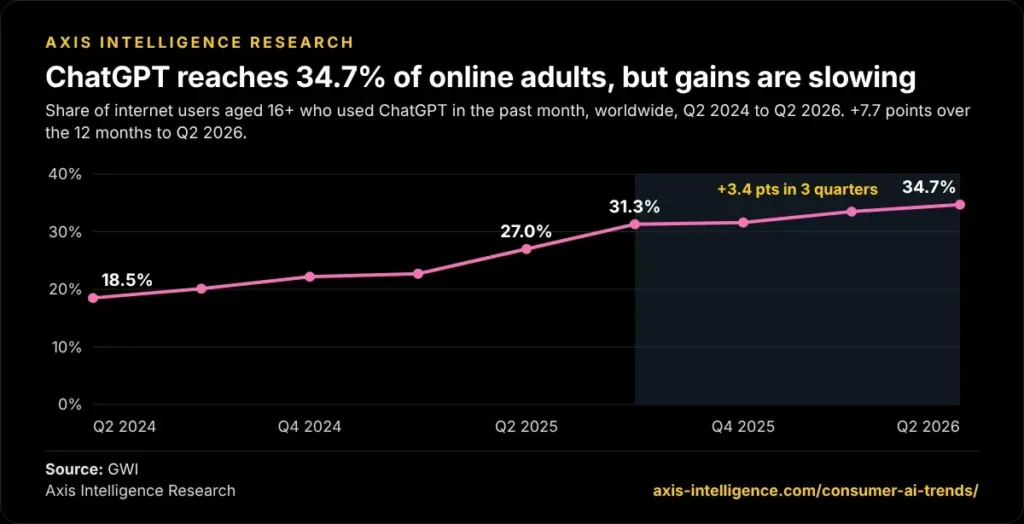
What changes. Growth is coming from people using AI more often, not from new users. Menlo Ventures finds 64% of US adults used AI in July 2026, up only three points from 61% in April 2025, while daily users rose from 19% to 25% of adults. Pew Research Center separately puts daily chatbot use at 24% of US adults in February 2026.
How we know. ChatGPT’s reach in the online population is flattening. GWI’s quarterly series rose from 18.5% of internet users aged 16+ in Q2 2024 to 34.7% in Q2 2026, but only 3.4 points of the last year’s 7.7-point gain came in the three quarters since Q3 2025.
Everyday AI Depth Index: which countries use AI most deeply?
Reach no longer separates markets: GWI finds 85.2% of online adults use AI tools monthly. Depth does. The Everyday AI Depth Index (EADI) is an Axis Intelligence Research calculation that asks, for every 100 people using AI each month in a market, how many pay for an AI tool, how many say they are comfortable using AI, and how many believe AI improves their daily life, each compared with the worldwide average.
Formula. EADI = 100 × average of [(P ÷ U) ÷ 0.1115, (C ÷ U) ÷ 0.3556, (E ÷ U) ÷ 0.3721], where U is the share of internet users aged 16+ using AI tools monthly, P the share paying for an AI subscription, C the share comfortable using AI and E the share who believe AI enhances their daily life, all from GWI’s Q2 2026 survey. The divisors are the worldwide ratios (9.5 ÷ 85.2, 30.3 ÷ 85.2 and 31.7 ÷ 85.2), so the worldwide reading is 100.
| Rank | Market | EADI | Payers per 100 AI users | Comfortable per 100 | “Enhances daily life” per 100 | Monthly AI use |
|---|---|---|---|---|---|---|
| 1 | India | 127.4 | 13.4 | 48.0 | 47.2 | 84.8% |
| 2 | Israel | 120.3 | 15.0 | 38.4 | 44.0 | 94.0% |
| 3 | Hong Kong | 113.7 | 9.8 | 42.6 | 49.5 | 83.3% |
| 4 | China | 112.5 | 14.3 | 34.1 | 42.1 | 89.4% |
| 5 | Taiwan | 107.9 | 8.5 | 46.1 | 43.7 | 85.5% |
| 15 | Japan | 88.4 | 3.4 | 37.5 | 48.0 | 58.6% |
| 19 | USA | 84.1 | 9.1 | 35.7 | 26.1 | 74.6% |
| 29 | UK | 78.0 | 7.2 | 37.1 | 24.3 | 68.0% |
| 43 | France | 68.6 | 6.5 | 26.6 | 27.0 | 67.4% |
| 48 | Netherlands | 62.5 | 6.6 | 25.1 | 21.5 | 80.4% |
| 49 | Denmark | 62.5 | 6.0 | 24.9 | 23.7 | 75.1% |
| — | Worldwide | 100.0 | 11.2 | 35.6 | 37.2 | 85.2% |
Source: Axis Intelligence Research calculation from GWI Q2 2026 data in the Digital 2027 Global Overview Report. All 49 markets are in the CSV.
Across the 49 markets, monthly AI use and EADI correlate at only 0.31. Brazil, Indonesia and the Philippines all clear 93% monthly use; only Brazil (100.7) scores above 100. Japan has the lowest monthly use among large economies, 58.6%, and the lowest payers-per-user ratio, 3.4 per 100, yet 48.0 people per 100 users say AI enhances their daily life.
What would show it is overhyped. Daily use stalling at about a quarter of US adults in the next Pew or Menlo wave.
Score: 17/20 (adoption 5, momentum 4, maturity 5, barriers 3: only 30.3% of online adults say they are comfortable using AI).
Sarah Mitchell’s read: Two US surveys fielded five months apart, with different wording and different panels, landing on 24% and 25% daily use is the closest thing to a settled number this market has. The EADI adds the uncomfortable part: the markets where almost everyone has tried AI are not the ones where it has become a habit people pay for and trust. Reach tells you who has seen the demo. Depth tells you who came back on the fifth try.
4. How Will Rules for Minors Change AI Chatbots in 2027?
What changes. Chatbot makers now have to verify ages, add warnings and run crisis protocols for minors. California’s companion chatbot law, SB 243, took effect on January 1, 2026, and on September 10, 2026 the state signed a package of 13 child-safety bills including SB 1119, a stricter follow-up for companion chatbots, according to the law firm Fenwick. The Federal Trade Commission sent 6(b) orders on September 11, 2025 to seven companies, including Alphabet, Meta, OpenAI, Character Technologies, Snap and xAI, to study chatbots acting as companions.
How we know it matters. The affected group is large. Pew Research Center finds 64% of US teens aged 13 to 17 have used AI chatbots and about three in ten use them daily; 54% have used them for schoolwork, 16% for casual conversation and 12% for emotional support or advice (survey of 1,458 teens, September–October 2025).
Who leads. California, followed by other states and the FTC.
What would show it is overhyped. No enforcement action under SB 243 in 2027, or federal preemption of state chatbot laws.
Score: 16/20 (adoption 5, momentum 3, maturity 3, barriers 5).
5. Will Ads Pay for Free AI in 2027?
What changes. Free AI chat is becoming ad-supported. OpenAI reported on August 31, 2026 that ChatGPT Ads reached a $1 billion annualized revenue run rate in less than 200 days. On October 21, 2026, OpenAI said more than 100,000 advertisers had run campaigns and ads were expanding to 89 countries, on the Free and Go plans only.
How we know. The audience is large: the same October announcement put ChatGPT’s weekly reach at more than 1.2 billion people, the figure OpenAI’s DevDay recap described as “our collective 1.2B weekly users.” OpenAI has not published how many of them see ads, so the adoption score is capped.
Who leads. OpenAI.
What would show it is overhyped. Flat weekly users after the ads rollout, or free users moving to paid tiers to avoid ads in large numbers.
Score: 16/20 (adoption 3, momentum 5, maturity 3, barriers 5).
6. Is AI Image and Video Generation Going Mainstream?
What changes. Making and editing pictures is now an everyday AI task. GWI finds 35.5% of active AI users created or enhanced images or video in the past month (Q2 2026). Google said at I/O 2026 that more than 50 billion images had been generated with its Nano Banana models.
Who leads. Google in images.
What would show it is overhyped. A falling share of AI users creating images or video in GWI’s next wave, which would mean the novelty has passed.
Score: 15/20 (adoption 4, momentum 3: no published growth rate, maturity 3, barriers 5).
7. Will AI Agents Shop for Consumers in 2027?
What changes. AI is becoming the place where shopping starts, not where it ends. GWI finds 26.0% of internet users aged 16+ use AI tools like ChatGPT to research purchases, from 51.3% in Nigeria to 18.5% in the US. Amazon CEO Andy Jassy said on the Q3 2026 earnings call that more than 400 million customers used Alexa for Shopping in the previous 12 months, up from 350 million in July, according to Modern Retail; Retail Dive reported that Jassy said active users nearly doubled year over year in Q2 2026.
What would show it is overhyped. It already has, at checkout. OpenAI said on March 24, 2026 that the first version of Instant Checkout did not offer the flexibility it wanted, and that merchants would use their own checkout while it focused on product discovery. In a Bizrate Insights and EMARKETER survey of US digital shoppers in August 2026, 51.0% had not bought through an AI platform and were not interested in doing so.
Who leads. Amazon, inside its own store.
Score: 13/20 (adoption 4, momentum 5, maturity 3, barriers 1); it ranks ahead of paying for AI on the adoption tie-break. Our AI shopping statistics track the conversion side.
8. How Many People Pay for AI?
What changes. Spending is rising fast while the share of payers stays small. Menlo Ventures estimates global consumer AI spending at $40 billion in 2026, more than three times the $12 billion it measured a year earlier.
How we know. The share of payers depends on the definition, and the gap between definitions is the widest in this dataset.
| Source | Measure | Value | As of |
|---|---|---|---|
| GWI (Digital 2027) | Internet users aged 16+ paying for an AI tool subscription | 9.5% worldwide; 6.8% in the US | Q2 2026 |
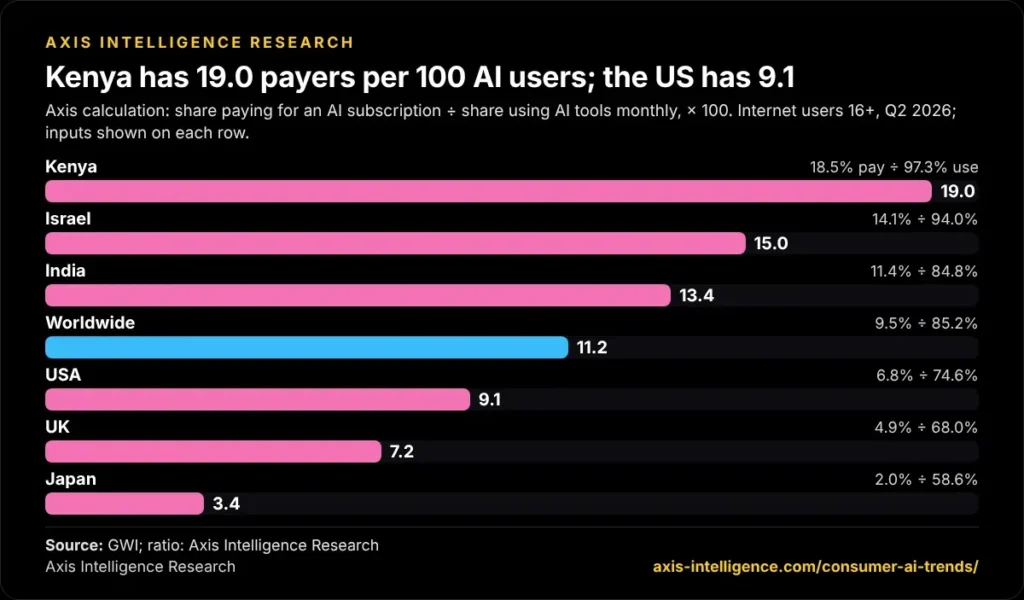
| Axis Intelligence Research calculation | Payers per 100 monthly AI users (GWI basis) | 11.2 worldwide; 9.1 in the US | Q2 2026 |
| OpenAI (company-reported) | Consumer subscribers per 100 weekly ChatGPT users (50 million ÷ 900 million) | about 5.6 | Feb 27, 2026 |
| Menlo Ventures | US AI users paying for at least one AI product | 55% | July 2026 |
Payment does not follow national income in GWI’s data: Kenya (19.0 payers per 100 AI users), Israel (15.0), China (14.3) and India (13.4) lead, while Japan (3.4) trails. Men pay more than women in every age group GWI reports, peaking among men aged 25 to 34 at 12.8%.
What would show it is overhyped. Payers per 100 AI users falling as ads expand the free tier.
Score: 13/20 (adoption 2, momentum 5, maturity 3, barriers 3: price).
Sarah Mitchell’s read: The gap between 9% and 55% for American AI users is the footnote investors and product teams fight over, because each side quotes the number that fits its deck. I read GWI and OpenAI as the floor for direct, self-chosen subscriptions and Menlo as the ceiling once bundles and workplace seats count. The 2027 question is which side of that gap the ad-funded free tier pulls people toward.
9. Are Voice Assistants Getting Smarter in 2027?
What changes. The assistants already in homes are being rebuilt on large language models. Amazon said in January 2026 that more than 10 million people were using Alexa+, as reported by GSMArena from a TechCrunch interview. The service opened to all US users on February 4, 2026, free for Prime members and $19.99 a month for others, according to TechRepublic.
Who leads. Amazon in the home; Google announced audio glasses for fall 2026 at I/O.
What would show it is overhyped. Amazon not disclosing active Alexa+ users through 2027, or Alexa+ use staying below Alexa for Shopping’s audience.
Score: 12/20 (adoption 3, momentum 3, maturity 3, barriers 3: the monthly fee outside Prime). All figures here are company-reported through the press.
10. Are People Using AI for Companionship?
What changes. Emotional use is a mass behavior outside the US and Western Europe. In the Google and Ipsos Multi-Country AI Survey of about 21,000 adults in 21 countries, fielded September 22 to October 10, 2025, 35% said they had used an AI application in the previous twelve months for companionship or support, including mental health support. The share was 59% in India, 55% in Nigeria and 50% in the UAE, against 27% in the UK and 12% in the US.
How we know. The AI in the Wild research by Marc Zao-Sanders, published by Harvard Business Review in June 2026 and charted in the Digital 2027 report, ranks therapy and companionship as the top generative AI use case for a second year, based on forum and social posts. Excitement about AI companions follows the same split: 83% in India and 25% in the US, against 52% across Ipsos’s 21 countries.
What would show it is overhyped. Use falling after the 2026 rules for minors take effect.
Score: 11/20 (adoption 4, momentum 3, maturity 3, barriers 1: the laws and the FTC inquiry in trend 4). Our Character.AI statistics follow the companion apps.
Sarah Mitchell’s read: Companionship is the trend with the biggest distance between what people do and what the evidence score allows. A third of adults across 21 countries already use AI this way, more than use it for images. It scores last because regulators moved before the products matured, and in 2027 that is the right order of events.
How Many People Actually Use AI? Why the Numbers Disagree
Between one in five and six in seven, depending on who counts and whom they count.
| Source | Measure | Population counted | Value | As of |
|---|---|---|---|---|
| GWI (Digital 2027) | Used AI tools in the past month | Internet users aged 16+, 53 markets | 85.2% | Q2 2026 |
| Menlo Ventures | Use AI | US adults | 64% | July 2026 |
| Pew Research Center | Use AI chatbots | US adults | 49% | Feb 2026 |
| Manochi analysis (Digital 2027) | Monthly users of standalone GenAI platforms | World population | 3.24 billion (38.9%) | Oct 2026 |
| Microsoft AI Economy Institute | Used a generative AI product | Working-age population (15–64), telemetry | 18.8% | June 2026 |
Microsoft’s Global AI Diffusion report includes everyone aged 15 to 64, online or not; GWI surveys people already online. The two sources also disagree on growth: Manochi’s analysis in the Digital 2027 Global Overview Report counts 3.24 billion users, up 57.2% in a year, while Menlo estimates 2.0 billion, up 11%.
The sharpest single gap is Kenya: 97.3% of Kenyan online adults use AI tools monthly in GWI’s survey, while the Microsoft diffusion figure charted in the Digital 2027 report puts Kenya at 8.9% of working-age people, a ratio of about 11 to 1.
Sarah Mitchell’s read: Neither number is wrong. GWI interviews the connected, younger, urban slice of a market; Microsoft starts from every working-age person, including the many who have never opened a browser. For the global consumer story, I anchor on Microsoft for the population view and on GWI for behavior inside the connected population, and never average the two.
What Could Change This Outlook in 2027?
| Signpost | Expected timing | Trend it tests | What would change our view |
|---|---|---|---|
| Next Similarweb app snapshot, if the Digital 2027 mid-year update repeats the app charts | Around April 2027 (the 2026 update was published in April) | 2 | Gemini ÷ ChatGPT app ratio at or above 0.38 (upside checkpoint) or below 0.31 (downside) |
| Alphabet Q4 2026 results and Google I/O 2027 | Early 2027; I/O 2026 was held in May | 1, 2 | AI Mode or Gemini app growth stalling |
| OpenAI’s next weekly-user and subscriber disclosure | Unscheduled | 5, 8 | Flat weekly users after the ads rollout |
| Menlo Ventures and Pew US surveys | 2027 | 3 | US daily use above 30%, or stuck near 25% |
| First enforcement under California’s companion chatbot laws; FTC 6(b) report | 2027 | 4, 10 | Penalties would push companion apps to restrict minors further |
| GWI Q2 2027 wave in Digital 2028 | October 2027 (October precedent) | 3, 6, 8 | EADI leaders change; payers per 100 users move from 11.2 |
Grade-back commitment. In November 2027, Axis Intelligence Research will re-score all ten trends with the same rubric, compare the August 2027 base case with Similarweb’s reported app ratio and recompute the EADI from GWI’s Q2 2027 data. The next edition opens with that comparison, right or wrong. Our AI trends for 2027 page covers the technology side (models, agents for work, regulation) and the total number of generative AI users.
Methodology
Axis Trend Scorecard. The same rubric as our social media trends page. Adoption (0–5): 5 = measured use by 1 billion+ people or over 50% of a measured population; 4 = 100 million to 1 billion or 30–50%; 3 = 10–100 million or 15–30%, and the maximum when no user figure is published; 2 = under 15%; 1 = intention only. Momentum (0–5): measured year-on-year growth; 5 = over 50%; 4 = 20–50%; 3 = 10–20%, and the maximum when no growth rate is published; 2 = 3–10%; 1 = 0–3%; 0 = falling. Maturity: 1 emerging, 3 scaling, 5 mainstream. Barriers (inverted): 5 = no material barrier in the sources reviewed; 3 = documented trust, price or engagement friction; 1 = binding rules or a documented product retreat. For the rules-for-minors trend, adoption measures use among the affected group (US teens). Ties are broken by adoption, then momentum. Trends without measured evidence were cut: AI on-device features and smart glasses lack consumer usage figures and stay on the watch list.
Everyday AI Depth Index (EADI). Equal weights across payers, comfort and perceived daily-life value per monthly AI user, each divided by its worldwide value. It covers the 49 markets where GWI publishes all four inputs; Kenya, Nigeria, Ghana and Morocco lack the comfort and daily-life series. The components are aggregate ratios, not shares of individual users.
Base case. Similarweb’s ChatGPT and Gemini app indices (August 2024 = 100) are converted to a ratio by anchoring on the August 2026 cross-platform index (Gemini 32.10, ChatGPT 100). Growth assumptions come only from observed rates in that series and from Alphabet’s reported Gemini app users.
Data. Survey figures come from GWI’s Q2 2026 wave, published in the Digital 2027 Global Overview Report (DataReportal, We Are Social and Meltwater, October 21, 2026); GWI removed Russia from its survey from Q1 2026. App and web indices are Similarweb estimates; referral shares are Statcounter estimates. OpenAI, Alphabet, Google and Amazon figures are company-reported; Amazon’s come through press reports of its statements.
About This Dataset
The CSV holds every figure on this page: the ten trend scores and their components, the evidence rows behind them, GWI country series, the 49-market EADI with its components, Similarweb indices, and the base case inputs and outputs. Each row carries its source, URL, publication date, retrieval date, and whether it is an Axis calculation with its formula.
File: consumer-ai-trends.csv · License: CC BY 4.0
How to Cite This Page
- APA: Axis Intelligence Research. (2026, November 29). Consumer AI trends 2027: 10 shifts in how people use ChatGPT, Gemini and everyday AI. Axis Intelligence. https://axis-intelligence.com/consumer-ai-trends/
- MLA: Axis Intelligence Research. “Consumer AI Trends 2027: 10 Shifts in How People Use ChatGPT, Gemini and Everyday AI.” Axis Intelligence, 29 Nov. 2026, axis-intelligence.com/consumer-ai-trends/.
- Chicago: Axis Intelligence Research. “Consumer AI Trends 2027: 10 Shifts in How People Use ChatGPT, Gemini and Everyday AI.” Axis Intelligence, November 29, 2026. https://axis-intelligence.com/consumer-ai-trends/.
Consumer AI in 2027: Questions People Ask
What is the biggest consumer AI trend for 2027?
AI answers replacing the search click scores highest on the Axis Trend Scorecard, 20 of 20. Google reported more than 2.5 billion monthly users of AI Overviews and more than 1 billion for AI Mode in May 2026.
Is Gemini bigger than ChatGPT?
Not on standalone app use: Similarweb puts Gemini’s app at 32.10 against ChatGPT’s 100 in August 2026. On survey reach it is closer, with GWI finding 28.7% of online adults used Gemini in the past month against 34.7% for ChatGPT.
Why can’t you compare ChatGPT’s 1.2 billion users with Gemini’s 1 billion?
OpenAI reports weekly users and called its 1.2 billion figure “collective” weekly users at DevDay on September 29, 2026. Alphabet reports monthly Gemini app users without saying which surfaces count. A weekly and a monthly count of differently defined products cannot be divided into a market share.
What percentage of people pay for AI?
GWI finds 9.5% of internet users aged 16+ paid for an AI subscription in Q2 2026, or 11.2 payers per 100 monthly AI users by Axis Intelligence Research’s calculation. Menlo Ventures’ broader definition gives 55% of US AI users.
How many people use AI every day?
About one in four US adults: Pew found 24% use chatbots daily in February 2026, and Menlo Ventures found 25% use AI daily in July 2026, up from 19% in April 2025. Among US teens, about three in ten use chatbots daily, according to Pew.
Will people let AI agents buy things for them in 2027?
Mostly not yet. In an August 2026 Bizrate Insights and EMARKETER survey, 51.0% of US digital shoppers had not bought through an AI platform and were not interested, and OpenAI stepped back from in-chat checkout in March 2026. AI is winning the research step: GWI finds 26.0% of online adults use AI to research purchases.
Which country uses AI the most?
It depends on the measure. Kenya leads GWI’s monthly-use ranking at 97.3% of online adults; the UAE leads Microsoft’s telemetry at 73.3% of working-age people; India leads Axis Intelligence Research’s Everyday AI Depth Index at 127.4.
Related Axis research cited on this page: ChatGPT statistics · ChatGPT vs Claude vs Gemini statistics · AI adoption by country · Generative AI statistics · AI assistant statistics.