

Smartphone Trends 2027
By Axis Intelligence Research
Co-author: Alex Rivera | Last updated: November 28, 2026 | License: CC BY 4.0
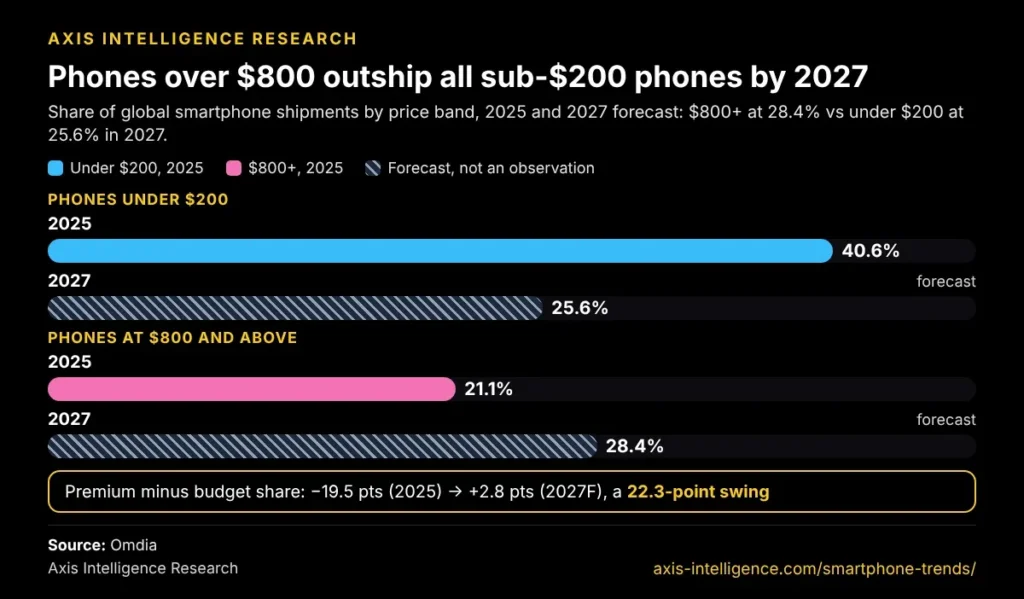
The smartphone that disappears in 2027 is the cheap one. Omdia forecasts that phones under $200 will fall from 40.6% of global shipments in 2025 to 25.6% in 2027, while phones above $800 rise from 21.1% to 28.4% (Omdia, September 15, 2026). AI phones become the majority at the same time, with Counterpoint Research forecasting that 52% of 2027 shipments will be GenAI-capable. Axis Intelligence Research calculates that about two-thirds of the 2026 rise in that share comes from non-AI budget phones dropping out of the market, not from more AI phones being sold.
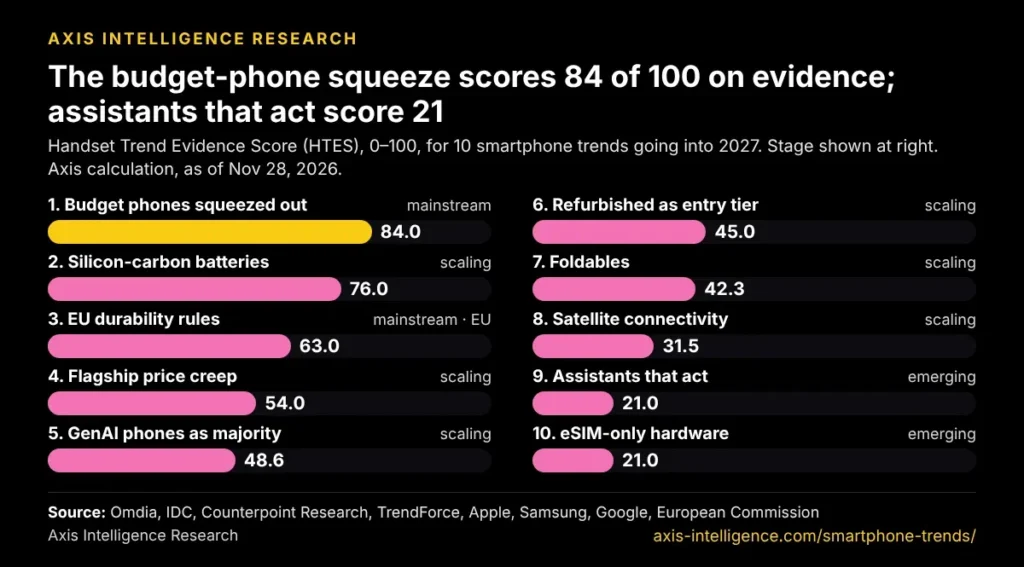
Axis Intelligence Research scores ten smartphone trends for 2027 on the Handset Trend Evidence Score (HTES), a 0–100 rating of how well each change is supported by measured adoption, momentum, maturity and barriers. The memory-driven budget squeeze leads at 84; silicon-carbon batteries come second at 76; assistants that act on your behalf score 21.
| Rank | Trend for 2027 | Strongest dated evidence | Stage | Who it affects | Signal to watch in 2027 | HTES |
|---|---|---|---|---|---|---|
| 1 | Budget phones squeezed out by memory costs | Sub-$200 share 40.6% (2025) → 25.6% (2027F), Omdia, Sep 2026 | Mainstream | Buyers under $200, emerging markets, Transsion-type brands | LPDDR contract prices in early 2027 | 84.0 |
| 2 | Bigger batteries through silicon-carbon cells | ≥6,000mAh phones: 29% of global sales, Jan 2026, vs 10% a year earlier (Counterpoint) | Scaling | Android buyers, China first | Whether Apple, Samsung, Google ship Si-C cells | 76.0 |
| 3 | EU durability and repair rules | Ecodesign rules applying since June 20, 2025; battery Article 11 from Feb 18, 2027 | Mainstream (EU) | Every new model sold in the EU | Repairability scores on EU labels | 63.0 |
| 4 | Flagship prices rise while specs stand still | 7 of 8 US flagship lines launched $100 higher in the 2026 cycle (Axis panel) | Scaling | Premium buyers in the US | Galaxy S27 launch pricing | 54.0 |
| 5 | GenAI-capable phones become the majority | 36% (2025) → 45% (2026F) → 52% (2027F), Counterpoint, Jun 2026 | Scaling | Mid-range buyers | GenAI share in sub-$400 phones | 48.6 |
| 6 | Refurbished and repaired phones as the new entry tier | Global refurbished volume forecast +11% in 2026 (Counterpoint) | Scaling | Price-sensitive buyers, carriers, repair shops | H2 2026 pre-owned tracker | 45.0 |
| 7 | Foldables grow on Apple’s entry | 22.9M (2026F, +12.6%) → about 27M (2027F, +18%), IDC, Aug 2026 | Scaling | Premium buyers | iPhone Duo sell-through in Q1 2027 | 42.3 |
| 8 | Satellite connectivity spreads beyond SOS | 46% of shipments NTN-capable by 2030 (Counterpoint, Apr 2026) | Scaling | Rural users, travelers, carriers | 3GPP Release 19 phones | 31.5 |
| 9 | Assistants that take actions in apps | Siri AI beta from Sep 14, 2026, English only (Apple) | Emerging | iPhone 15 Pro and newer, Pixel owners | Siri AI leaving beta; new languages | 21.0 |
| 10 | eSIM-only hardware | iPhone Duo eSIM-only worldwide (Apple, Sep 2026) | Emerging | Travelers, carriers in physical-SIM markets | More eSIM-only markets for iPhone 18 | 21.0 |
Alex Rivera, consumer technology lead at Axis Intelligence The budget phone isn’t getting a 2027 redesign; it’s being retired. When phones above $800 outship everything under $200, the buyer who used to pick up a $150 Android every two years is left with three options: pay up, buy used, or keep the old one. For a kid’s first phone or a parent’s replacement, last year’s mid-ranger on clearance is now a better bet than this year’s entry model.
Which smartphone trends will actually matter in 2027?
The two trends with measured sales behind them, the budget squeeze and bigger batteries, score highest; the two that rest mostly on company launches, phone agents and eSIM-only designs, score lowest. Axis Intelligence Research built the HTES to separate what buyers will feel in 2027 from what launch events promise.
Handset Trend Evidence Score (HTES) = (Adoption + Momentum + Maturity + Barriers) × Evidence factor, on a 0–100 scale:
| Component | Points | Rule |
|---|---|---|
| Adoption | 0–30 | Share of global shipments or sales the trend reaches: ≥50% = 30 · 25–49% = 22 · 10–24% = 15 · 2–9% = 8 · under 2% or no published share = 3. Trends confined to one region are capped at 15. |
| Momentum | 0–30 | Latest year-on-year change in the trend’s indicator: ≥50% = 30 · 20–49% = 22 · 5–19% = 15 · 0–4% or no published rate = 8 · falling = 0 |
| Maturity | 5–20 | Emerging 5 · scaling 12 · mainstream 20 |
| Barriers (inverted) | 5–20 | None documented in the producer sources = 20 · one = 12 · two or more = 5 |
| Evidence factor | ×0.75–1.0 | 1.0 if the adoption input is a measured actual · 0.9 if it is a producer forecast · 0.75 if it rests on company announcements |
The table below shows how each score was built, so any reader can change one input and recompute it.
| Trend | Adoption | Momentum | Maturity | Barriers | Factor | HTES |
|---|---|---|---|---|---|---|
| Budget squeeze | 30 (market-wide price rise) | 22 (ASP +27.6%, IDC) | 20 | 12 (memory supply normalizing in 2028) | 1.0 | 84.0 |
| Silicon-carbon batteries | 22 (29% of sales) | 30 (10% → 29%) | 12 | 12 (battery-size regulations outside China) | 1.0 | 76.0 |
| EU durability rules | 15 (EU only, cap) | 8 (no new phone obligation in 2027) | 20 | 20 | 1.0 | 63.0 |
| Flagship price creep | 15 ($800+ phones 21.1% in 2025) | 15 (median +9.5%) | 12 | 12 (retail discounting) | 1.0 | 54.0 |
| GenAI majority | 22 (45% in 2026F) | 15 (GenAI units +7.6%) | 12 | 5 (memory cost; no upgrade pull) | 0.9 | 48.6 |
| Refurbished entry tier | 3 (no published share) | 15 (+11%) | 12 | 20 | 0.9 | 45.0 |
| Foldables | 8 (about 2.3%) | 15 (+12.6%) | 12 | 12 ($1,999 iPhone Duo entry) | 0.9 | 42.3 |
| Satellite connectivity | 3 (no published 2026 share) | 8 | 12 | 12 (proprietary vs 3GPP split) | 0.9 | 31.5 |
| Phone agents | 3 | 8 | 5 | 12 (beta, English only) | 0.75 | 21.0 |
| eSIM-only hardware | 3 | 8 | 5 | 12 (limited markets) | 0.75 | 21.0 |
Alex Rivera, consumer technology lead at Axis Intelligence The score puts AI phones fifth, behind battery size, and I think that’s the honest ranking. The 29% figure for 6,000mAh phones is sell-through someone counted; the AI share is a forecast of chips that can run a model, which says nothing about whether owners use the features. At every 2027 launch I’d treat an AI feature as a spec line until it shows up in a sales tracker or a usage number.
Why are cheap smartphones disappearing?
Memory now costs too much for a sub-$150 phone to make money. Counterpoint Research expects LPDDR4 supply, the memory used in entry phones, to fall more than 40% in 2026 and says certain sub-$150 price tiers face “effective permanent ejection” from the market (Counterpoint, June 1, 2026). IDC puts smartphone memory costs up about 350% from a year earlier and still rising (IDC, October 2026).
| Price band | 2025 share of shipments | 2027 share (forecast) | Change |
|---|---|---|---|
| Under $100 | 12.6% | 3.0% | −9.6 pts |
| $100–199 | 28.0% | 22.6% | −5.4 pts |
| All under $200 | 40.6% | 25.6% | −15.0 pts |
| $800 and above | 21.1% | 28.4% | +7.3 pts |
Source: Omdia, forecast published September 15, 2026.
Axis Intelligence Research calculates that the $800-plus band moves from 19.5 points behind the sub-$200 bands in 2025 to 2.8 points ahead in 2027, a 22.3-point swing in two years. IDC adds the volume at stake: 173 million phones shipped below $100 in 2025, a segment it describes as facing “an existential crisis” (IDC, August 26, 2026).
The squeeze carries into 2027. Counterpoint’s November 25 forecast cuts 2027 shipments by a further 6%, citing tight mobile DRAM supply and further LPDDR price increases expected in early 2027, and expects the market below $200 to keep shrinking (Counterpoint, November 25, 2026). The full shipment forecast, and how far IDC, Omdia and Counterpoint differ on it, is in our smartphone market outlook for 2027; the memory side of the shortage is tracked in our AI chip shortage analysis.
Are flagship phones getting more expensive, and do you get less for the money?
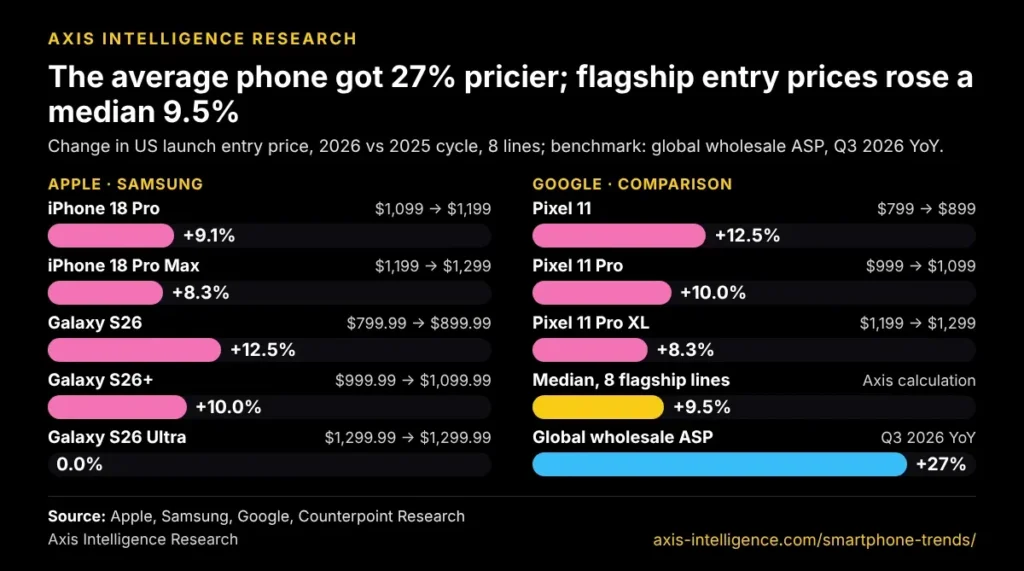
Yes on price, and in some cases yes on specs. Seven of the eight US flagship lines in the Axis panel launched $100 higher in the 2026 cycle than in the 2025 cycle; the median entry-price increase is 9.5%. Counterpoint Research expects buyers to pay more while getting fewer hardware upgrades, “for the first time in years,” as brands trim base memory, cameras and model ranges (Counterpoint, June 22, 2026).
| Flagship line | 2025-cycle US entry price | 2026-cycle US entry price | Change | Base storage |
|---|---|---|---|---|
| iPhone 17 Pro → 18 Pro | $1,099 | $1,199 | +9.1% | 256GB → 256GB |
| iPhone 17 Pro Max → 18 Pro Max | $1,199 | $1,299 | +8.3% | 256GB → 256GB |
| Galaxy S25 → S26 | $799.99 | $899.99 | +12.5% | 128GB → 256GB |
| Galaxy S25+ → S26+ | $999.99 | $1,099.99 | +10.0% | 256GB → 256GB |
| Galaxy S25 Ultra → S26 Ultra | $1,299.99 | $1,299.99 | 0.0% | 256GB → 256GB |
| Pixel 10 → Pixel 11 | $799 | $899 | +12.5% | 128GB → 256GB |
| Pixel 10 Pro → 11 Pro | $999 | $1,099 | +10.0% | 128GB → 256GB |
| Pixel 10 Pro XL → 11 Pro XL | $1,199 | $1,299 | +8.3% | 256GB → 256GB |
Sources: Apple, September 2025 and September 2026; Samsung, January 2025 and March 2026; Google, August 2025 and August 2026. Launch list prices; percentage changes are Axis Intelligence Research calculations.
The Galaxy S26 Ultra only held its price at launch: Samsung’s US store now shows a regular price of $1,399.99 for the 256GB model, $100 above its launch price, with a temporary sale price beside it, as checked on November 28, 2026 (Samsung.com).
Against the market average, the flagship increase is small. Omdia forecasts the global average selling price (ASP) rising from $467 in 2025 to $594 in 2026, up 27%, and to $624 in 2027; Counterpoint measured a record $442 wholesale ASP in Q3 2026, also up 27% (Counterpoint, November 3, 2026). Axis Intelligence Research calculates that the average phone’s price rose roughly three times faster than the flagships’ entry prices. The rest of the ASP jump is mix: fewer cheap phones in the average.
The spec side shows up in memory. Google’s Pixel 11 Pro XL ships with 12GB of RAM at 256GB, where the Pixel 10 Pro XL had 16GB at every storage tier (Google Store, Pixel 11 Pro specs; Pixel 10 Pro specs). Axis Intelligence Research calculates that the entry Pro XL’s price per gigabyte of RAM went from $74.94 to $108.25, up 44%. TrendForce reports the same pressure across the market: mid-range phones are reverting to 8GB as the core configuration and entry models mostly settle around 4GB (TrendForce, May 14, 2026), and by November it found that average memory content per smartphone had stopped growing (TrendForce, November 12, 2026).
Alex Rivera, consumer technology lead at Axis Intelligence The Pixel 11 Pro XL is the cleanest picture of 2027 pricing: $100 more than last year’s model for a quarter less RAM at the same storage. Apple raised the Pro by $100 and still doesn’t list RAM at all; Samsung held the Ultra at launch and raised it in October instead. My baseline for anyone shopping in 2027 is last year’s model: while it’s still on sale, it often has the better spec per dollar than its replacement.
Per-model figures for each brand are in our iPhone statistics, Samsung statistics and Google Pixel statistics.
Will most phones be AI phones in 2027?
On paper, yes: Counterpoint Research forecasts GenAI-capable phones at 36% of global shipments in 2025, 45% in 2026 and 52% in 2027, and says GenAI is now standard above $400 wholesale but “has yet to give consumers a compelling reason to upgrade” (Counterpoint, June 22, 2026). The same release says a clear gap remains between phones that can run GenAI and phones on which owners regularly use AI features, and that the extra DRAM needed for model weights keeps these devices above $400 wholesale.
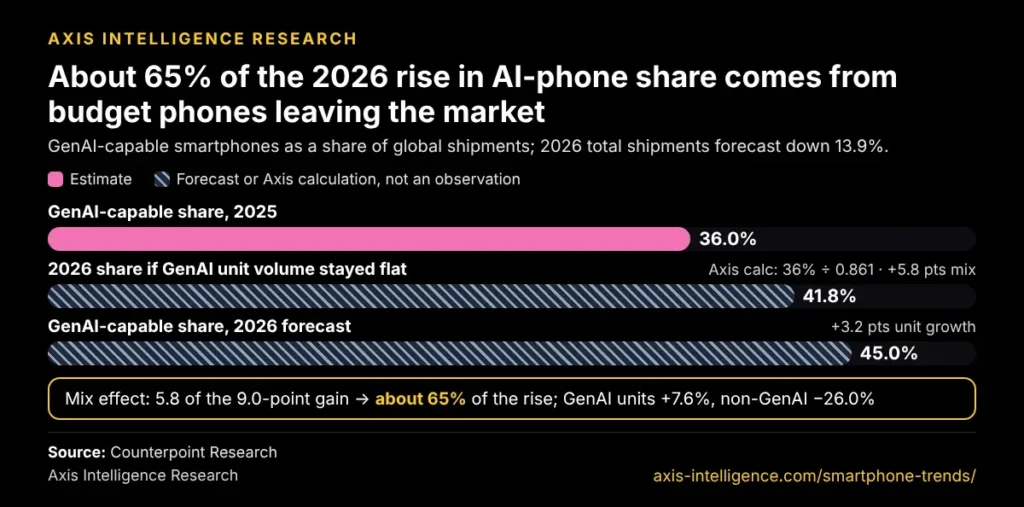
The share rises faster than the phones themselves. Using the same Counterpoint edition, which pairs the 45% share with a 13.9% fall in total 2026 shipments, Axis Intelligence Research calculates:
| Step | Value |
|---|---|
| GenAI share, 2025 | 36.0% |
| Share in 2026 if GenAI unit volume had stayed flat (36% ÷ 0.861) | 41.8% |
| Mix effect: share gained only because non-AI phones disappeared | +5.8 pts |
| Gain from GenAI unit growth | +3.2 pts |
| GenAI share, 2026 forecast | 45.0% |
| Implied GenAI unit growth, 2026 | +7.6% (about 452M → 486M) |
| Implied non-GenAI unit change, 2026 | −26.0% |
About 65% of the 2026 rise in AI phone share is a mix effect. GenAI phones are growing in units, but most of the jump in their share comes from budget non-AI phones leaving the market. The 2027 step to 52% is likely to carry the same effect, since Counterpoint now expects total shipments to fall another 6%; the June edition does not split 2027 that way, so Axis does not calculate it.
The forecasters also disagree on the level. IDC counted over 370 million GenAI phones in 2025, a 30% share (IDC, August 27, 2025), six points under Counterpoint’s 36% for the same year.
Alex Rivera, consumer technology lead at Axis Intelligence Thirty percent and thirty-six percent describe the same 2025 phones; the six points come from where each firm draws the line on which chips qualify as GenAI-capable. I’d follow Counterpoint’s series for direction because one edition runs from 2025 through 2027, and I’d never put the two firms on one line chart. For buyers, “GenAI-capable” in 2027 mostly means “priced above the budget tier,” which is why the label is spreading faster than the habit.
Will your phone’s assistant start doing things for you in 2027?
It has started, in beta and in English. Apple’s Siri AI began rolling out with iOS 27 as a beta on September 14, 2026, for supported devices set to English (Apple, September 9, 2026); our Siri AI guide covers which iPhones qualify. Google says the Tensor G6 in the Pixel 11 runs the latest Gemini Nano model and processes on-device AI tasks up to 3.5 times faster than the Tensor G5 (Google, August 12, 2026). Both are launches, not measured usage, which is why the trend scores 21.
The memory squeeze pushes the other way. TrendForce reports that phone makers are leaning more on cloud resources to offset memory costs (TrendForce, May 14, 2026), so in 2027 a large share of “on-device” assistant work below the flagship tier is likely to run in the cloud.
Are foldable phones finally going mainstream?
They are growing, but from a small base. IDC forecasts foldable shipments up 12.6% to 22.9 million in 2026 and up 18% to roughly 27 million in 2027, crediting Apple’s entry in the second half of 2026 (IDC, August 26, 2026). Against IDC’s total of just over 1 billion phones in 2026, Axis Intelligence Research calculates that foldables are at most about 2.3% of shipments.
Apple’s iPhone Duo starts at $1,999 and shipped on October 23, 2026, eSIM-only worldwide (Apple, September 2026). Counterpoint expects foldable and rollable OLED panel shipments to grow more than 23% in 2026 even as the overall smartphone OLED market slips (Counterpoint, November 2026). Vendor shares and the Axis Foldable Leadership Margin are on our foldable phone market share page.
Growth led by a $1,999 phone is a premium story. The foldable trend in 2027 widens the top of the market rather than replacing the slab phone.
Is buying refurbished becoming the new budget phone?
Yes, and one indicator already shows it overtaking the new-phone supply chain. Counterpoint projects global refurbished smartphone volume to grow around 11% in 2026 (Counterpoint, April 2026), and its November forecast says some demand will be permanently displaced by longer replacement cycles and refurbished devices (Counterpoint, November 25, 2026).
The most surprising figure on this page comes from displays. In Q1 2026, 298 million display panels went to the refurbished and repair market, against 289 million to smartphone makers, with the refurbished channel up 20% year over year (Omdia, August 5, 2026). Omdia’s count includes consumer repairs and aftermarket parts as well as professional refurbishment, so it measures the whole second-life economy, not refurbished phone sales alone.
Alex Rivera, consumer technology lead at Axis Intelligence More screens went into repairing and refurbishing old phones than into building new ones in Q1 2026, which tells me the “entry-level phone” of 2027 is often a two-year-old flagship. That changes what a buyer should check: battery health, whether the display is an original-grade part, and how many years of OS updates the model has left. At the same price, a used Pro with years of updates left beats a new phone with 4GB of RAM.
Brand shares in the second-hand market, including Apple’s lead, are on our refurbished smartphone market share page.
Why are phone batteries suddenly so much bigger?
Silicon-carbon anodes let phone makers fit more capacity into the same space. Counterpoint Research measured the average global smartphone battery at 5,291mAh in January 2026, and phones with 6,000mAh or more at 29% of global sales, up from 10% in January 2025 (Counterpoint, March 25, 2026). Six of the top ten models in that segment used silicon-carbon cells and were sold only in China, where Counterpoint notes that battery-size regulations elsewhere slow the spread.
That is the strongest measured hardware trend going into 2027: the share of big-battery phones nearly tripled in a year. Rated cycle life and the gap between battery life and update support are compared model by model in our smartphone battery statistics.
Will phones have replaceable batteries in 2027?
Not in the way the headlines suggest. Article 11 of the EU Batteries Regulation, which requires portable batteries to be removable and replaceable by end users, applies from February 18, 2027. For smartphones, the Commission’s updated guidelines, published on October 22, 2026, state that the removability and replaceability obligations in Annex II of the smartphone ecodesign regulation, Regulation (EU) 2023/1670, prevail over Article 11 (EUR-Lex, Commission Notice C/2026/5531). Under that annex, a phone battery must be replaceable either by a layperson or by a “generalist” with basic repair skills, and the generalist route is allowed only if the battery and the phone meet stricter durability requirements. Those requirements include battery endurance (at least 80% capacity after 1,000 full charge cycles) and IP67 water resistance (European Commission JRC, stakeholder meeting slides, June 2023). The February 2027 date does not by itself put pop-out batteries in water-resistant flagships.
The EU rules that do change phones were already in force from June 20, 2025: batteries rated for at least 800 cycles at 80% capacity, spare parts within 5–10 working days for at least seven years after a model leaves the market, and operating system updates for at least five years after the last unit is sold (European Commission, June 20, 2025). Google already commits to seven years of OS, security and Pixel Drop updates on its latest phones (Google, August 2026).
Alex Rivera, consumer technology lead at Axis Intelligence If you’re in Europe and holding out for a phone with a pop-out battery in February 2027, don’t. For water-resistant flagships the 2027 change is mostly paperwork; the rule that matters for daily life is the five-year update floor, because it decides how long a phone stays safe to use and how much it’s worth second-hand.
Will satellite texting and eSIM-only phones become standard?
Both are spreading from the top of the market, and neither has measured 2026 adoption in the producer sources we opened. Counterpoint Research projects that 46% of global smartphone shipments will be able to connect to non-terrestrial networks (NTN) by 2030, but says 3GPP Release 17 use cases are limited to SOS and messaging and that mass adoption in the mid-price segment is expected only with Release 19 (Counterpoint, April 29, 2026). Apple extended free satellite features for another year for iPhone 14, 15 and 16 users (Apple, September 9, 2026). Network readiness, including Starlink and AST SpaceMobile, is scored on our direct-to-cell satellite statistics page.
On eSIM, the iPhone Duo is eSIM-only in every market, while the iPhone 18 Pro is eSIM-only in a limited set that includes the US and Canada; Apple says the freed space adds two hours of video playback and that eSIM is supported by over 500 carriers worldwide (Apple, September 9, 2026).
What could change these smartphone trends in 2027?
| Date | Catalyst | What it would change |
|---|---|---|
| Early 2027 | Further LPDDR contract price increases expected (Counterpoint, Nov 25, 2026) | Confirms the budget squeeze and more spec cuts in 2027 mid-range launches |
| Early 2027 | Apple’s next base iPhone, moved from fall 2026 to early 2027 (IDC forecast commentary, late 2025) | Tests whether a $799-class iPhone holds its price |
| Feb 18, 2027 | EU Batteries Regulation Article 11 applies | Shows how many new models use the Annex II “generalist” replacement route rather than layperson replacement |
| H2 2027 | New memory capacity starts to arrive (Counterpoint, Feb 2026) | An early price peak would lower the budget-squeeze score in the next edition |
| 2028 | Recovery: Counterpoint forecasts shipments +6%; IDC sees any recovery in 2028 at the least | The test of whether lost budget demand returns or stays with refurbished phones |
Two risks cut against the price trends. IDC warns that weak demand could leave inventory building up heading into 2027 (IDC, October 2026), and TrendForce already sees channel players cutting prices to clear stock (TrendForce, November 12, 2026). Discounts on 2026 models would soften street prices in early 2027 without changing list prices. On the other side, IDC expects memory prices to keep rising until at least 2028 (IDC, August 26, 2026).
Country-level shifts in who ships and who is used are on our smartphone market share by country page, and the year’s base figures are in our smartphone statistics. Every outlook in this sector is listed on the Consumer Tech, Media & Gaming outlook hub.
Smartphone trends 2027: questions buyers and analysts ask
Should I buy a phone now or wait until 2027?
The data points to no relief from waiting. IDC expects memory prices to keep rising until at least 2028, and Counterpoint expects further LPDDR price increases in early 2027. The near-term exception is discounting: IDC and TrendForce both see inventory pressure, so promotions on 2026 models are the likeliest price cuts in early 2027.
Will 4GB RAM phones be common in 2027?
At the entry level, yes. TrendForce reported in May 2026 that entry-level models mostly settle around 4GB of RAM and mid-range phones are reverting to 8GB, and in November 2026 it found average memory content per smartphone had stopped growing. Phones with 2GB and 3GB are being phased out, so the floor rises while the middle stalls.
Why does the Pixel 11 Pro XL have less RAM than the Pixel 10 Pro XL?
Google does not give a reason on its store pages. The specifications show 12GB of RAM on the 256GB Pixel 11 Pro XL against 16GB on every Pixel 10 Pro XL tier, at a $100 higher entry price ($1,299 vs $1,199). The cut lines up with TrendForce’s May 2026 finding that persistently high DRAM prices are pushing phone makers to readjust memory configurations, with mid-range models reverting to 8GB.
Will the iPhone Duo make foldable phones cheaper?
Not in 2027 on current evidence. The iPhone Duo starts at $1,999 (Apple), and IDC attributes most of the foldable growth to Apple’s entry, forecasting about 27 million foldables in 2027. That growth is concentrated at the top of the price range, where memory costs are easiest to absorb.
Is satellite texting free on iPhones in 2027?
For iPhone 14, 15 and 16 owners, Apple extended free access to its satellite features for an additional year in September 2026. Counterpoint notes that standard 3GPP Release 17 satellite features are limited to SOS and messaging, and expects mass adoption in mid-priced phones only with Release 19.
Methodology
This page scores trends, not forecasts. Each HTES input comes from a document opened on November 27–28, 2026: Omdia (price bands, ASP, refurbished display panels), IDC (ASP, memory costs, foldables, GenAI 2025), Counterpoint Research (GenAI share, budget tiers, 2027 shipments, batteries, satellite, refurbished, Q3 ASP), TrendForce (DRAM configurations), Apple, Samsung and Google (launch prices and specifications) and the European Commission (EU rules). Forecasts are reported at each firm’s precision and dated; no year was interpolated. The flagship panel compares US launch list prices of each line’s entry configuration across the 2025 and 2026 cycles; it excludes carrier deals and promotions. The GenAI decomposition uses one Counterpoint edition for both the share and the market decline, so the inputs share a definition. Shipment forecasts and the Axis 2027 Base Case live on the smartphone market outlook, not here.
Dataset: smartphone-trends.csv — HTES inputs and scores, price-band shares, flagship price panel and the GenAI decomposition. License: CC BY 4.0 for Axis calculations; third-party figures remain their producers’.
Cite this page: Axis Intelligence Research, “Smartphone Trends 2027: AI Phones, Higher Prices and the Vanishing Budget Phone”, data as of November 28, 2026, https://axis-intelligence.com/smartphone-trends/ [Copy]